First Snow Leopard Population Assessment in India
#GS-3 #Environment #Biodiversity #Wildlife #Prelims #Snow Leopard
Key takeaways
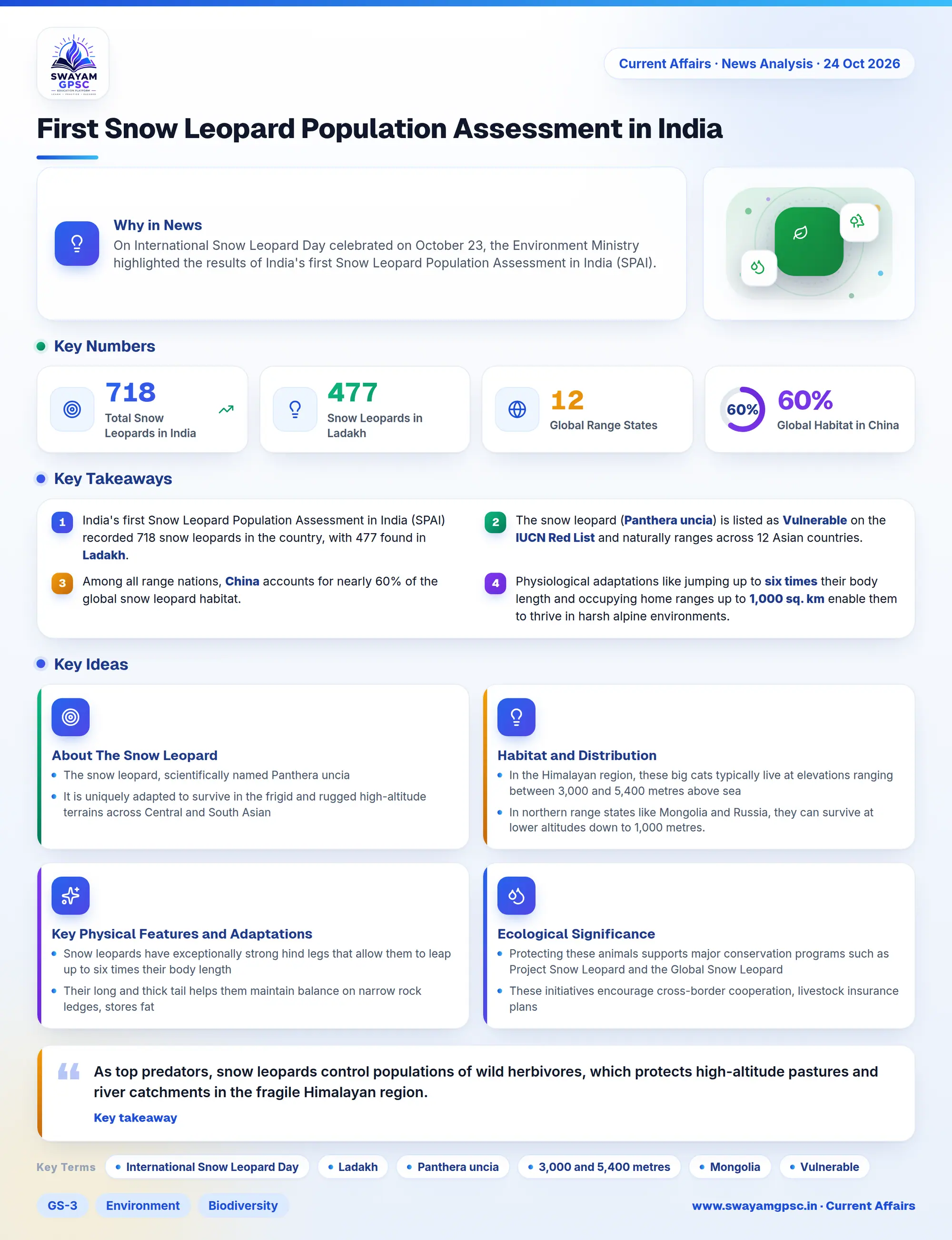
- India's first Snow Leopard Population Assessment in India (SPAI) recorded 718 snow leopards in the country, with 477 found in Ladakh.
- The snow leopard (Panthera uncia) is listed as Vulnerable on the IUCN Red List and naturally ranges across 12 Asian countries.
- Among all range nations, China accounts for nearly 60% of the global snow leopard habitat.
- Physiological adaptations like jumping up to six times their body length and occupying home ranges up to 1,000 sq. km enable them to thrive in harsh alpine environments.
- Conservation initiatives such as Project Snow Leopard and GSLEP focus on mitigating human-wildlife conflicts through community participation and livestock insurance.
Why in News
- On International Snow Leopard Day celebrated on October 23, the Environment Ministry highlighted the results of India's first Snow Leopard Population Assessment in India (SPAI).
- This landmark assessment recorded a total of 718 snow leopards across the country, with 477 individuals identified in Ladakh alone.
- The survey findings reaffirm India's strong national commitment to preserving high-altitude wildlife and fragile mountain ecosystems.
About The Snow Leopard
- The snow leopard, scientifically named Panthera uncia, is a solitary apex carnivorous big cat widely referred to as the Ghost of the Mountains.
- It is uniquely adapted to survive in the frigid and rugged high-altitude terrains across Central and South Asian mountain ranges.
Habitat and Distribution
- In the Himalayan region, these big cats typically live at elevations ranging between 3,000 and 5,400 metres above sea level.
- In northern range states like Mongolia and Russia, they can survive at lower altitudes down to 1,000 metres.
- They prefer cold, dry, alpine, and sub-alpine zones with sparse vegetation, choosing steep cliffs, rocky outcrops, ridges, and deep ravines that provide concealment for hunting.
- The species is categorized as Vulnerable on the IUCN Red List of Threatened Species.
- Snow leopards are distributed across 12 range states, including Afghanistan, Bhutan, China, India, Kazakhstan, Kyrgyz Republic, Mongolia, Nepal, Pakistan, Russia, Tajikistan, and Uzbekistan.
- Among all range countries, China holds the largest share of the species' habitat, covering approximately 60% of the global total.
Key Physical Features and Adaptations
- Snow leopards have exceptionally strong hind legs that allow them to leap up to six times their body length, helping them move easily across steep mountain cliffs.
- Their long and thick tail helps them maintain balance on narrow rock ledges, stores fat, and wraps around their body for extra warmth during extreme cold.
- They possess thick pale-grey fur covered with dark rosettes, which blends into rocky surroundings and provides camouflage while hunting.
- Depending on the availability of prey like bharal, ibex, and argali, an individual's home range can span from 30-65 sq. km to more than 1,000 sq. km.
- Key physical features like enlarged nasal cavities, a deep chest, and broad fur-covered paws help them breathe thin mountain air, conserve heat, and walk on soft snow without sinking.
Ecological Significance and Conservation Efforts
- As top predators, snow leopards control populations of wild herbivores, which protects high-altitude pastures and river catchments in the fragile Himalayan region.
- Protecting these animals supports major conservation programs such as Project Snow Leopard and the Global Snow Leopard and Ecosystem Protection Program (GSLEP).
- These initiatives encourage cross-border cooperation, livestock insurance plans, and local community participation to reduce human-wildlife conflict.