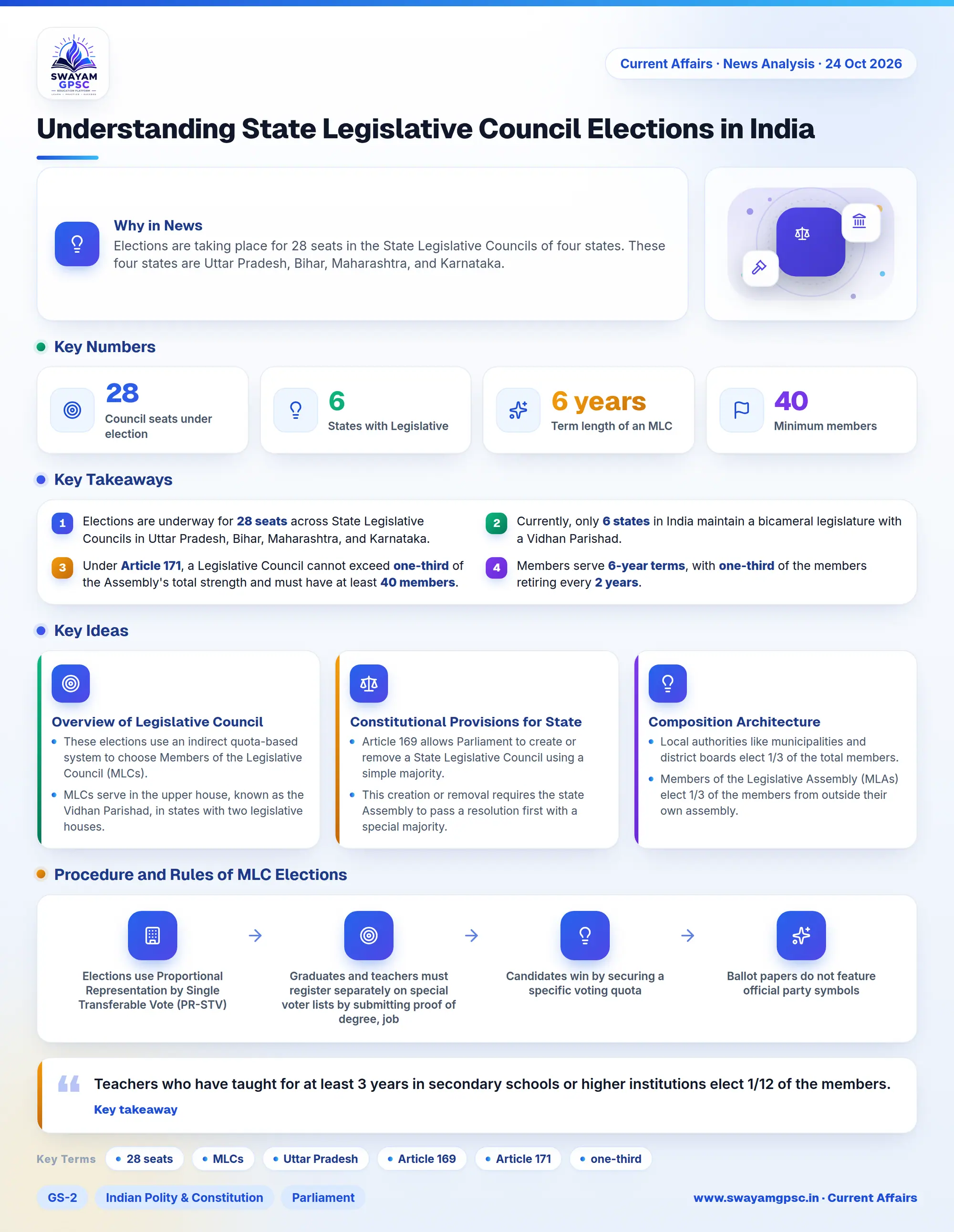
Understanding State Legislative Council Elections in India
#GS-2 #Indian Polity & Constitution #Parliament #Current Events #National #Elections #State Legislature
Key takeaways
- Elections are underway for 28 seats across State Legislative Councils in Uttar Pradesh, Bihar, Maharashtra, and Karnataka.
- Currently, only 6 states in India maintain a bicameral legislature with a Vidhan Parishad.
- Under Article 171, a Legislative Council cannot exceed one-third of the Assembly's total strength and must have at least 40 members.
- Members serve 6-year terms, with one-third of the members retiring every 2 years.
- Voting uses the Proportional Representation by Single Transferable Vote (PR-STV) system without party symbols on the ballot papers.
Why in News
- Elections are taking place for 28 seats in the State Legislative Councils of four states.
- These four states are Uttar Pradesh, Bihar, Maharashtra, and Karnataka.
Overview of Legislative Council Elections
- These elections use an indirect quota-based system to choose Members of the Legislative Council (MLCs).
- MLCs serve in the upper house, known as the Vidhan Parishad, in states with two legislative houses.
- Only six Indian states currently have a Vidhan Parishad.
- These six states are Uttar Pradesh, Bihar, Maharashtra, Karnataka, Telangana, and Andhra Pradesh.
Constitutional Provisions for State Legislative Councils
- Article 169 allows Parliament to create or remove a State Legislative Council using a simple majority.
- This creation or removal requires the state Assembly to pass a resolution first with a special majority.
- Article 171 sets rules for the council's total strength and overall election structure.
- A Legislative Council cannot have more members than one-third of the state Assembly's total strength.
- The minimum size for any Legislative Council is fixed at 40 members.
- Article 172(2) and Article 173 state that the Legislative Council is a permanent body that never dissolves.
- MLCs serve 6-year terms, and one-third of the members retire every 2 years.
- Candidates must be at least 30 years old to qualify for election as an MLC.
Composition Architecture of the Council
- Local authorities like municipalities and district boards elect 1/3 of the total members.
- Members of the Legislative Assembly (MLAs) elect 1/3 of the members from outside their own assembly.
- Registered university graduates with at least 3 years of residence elect 1/12 of the council.
- Teachers who have taught for at least 3 years in secondary schools or higher institutions elect 1/12 of the members.
- The State Governor nominates the remaining 1/6 of the members.
- Governor nominations go to experts in literature, science, art, the cooperative movement, or social service.
Eligible Voters for Council Elections
- Unlike general Assembly elections, voting is limited to specific groups based on the seat type.
- Local authority seats allow only elected corporators, municipal councillors, and district board members to vote.
- Graduates constituencies require voters to hold a degree for at least 3 years and submit proof.
- Teachers constituencies require voters to have at least 3 years of teaching experience in approved institutions.
- The MLA quota seats are voted on exclusively by sitting Assembly members.
Procedure and Rules of MLC Elections
- Elections use Proportional Representation by Single Transferable Vote (PR-STV), where voters rank candidates by choice.
- Graduates and teachers must register separately on special voter lists by submitting proof of degree, job, and residency.
- Candidates win by securing a specific voting quota, with surplus or lower candidate votes transferred as needed.
- Ballot papers do not feature official party symbols, even though political parties actively support candidates.