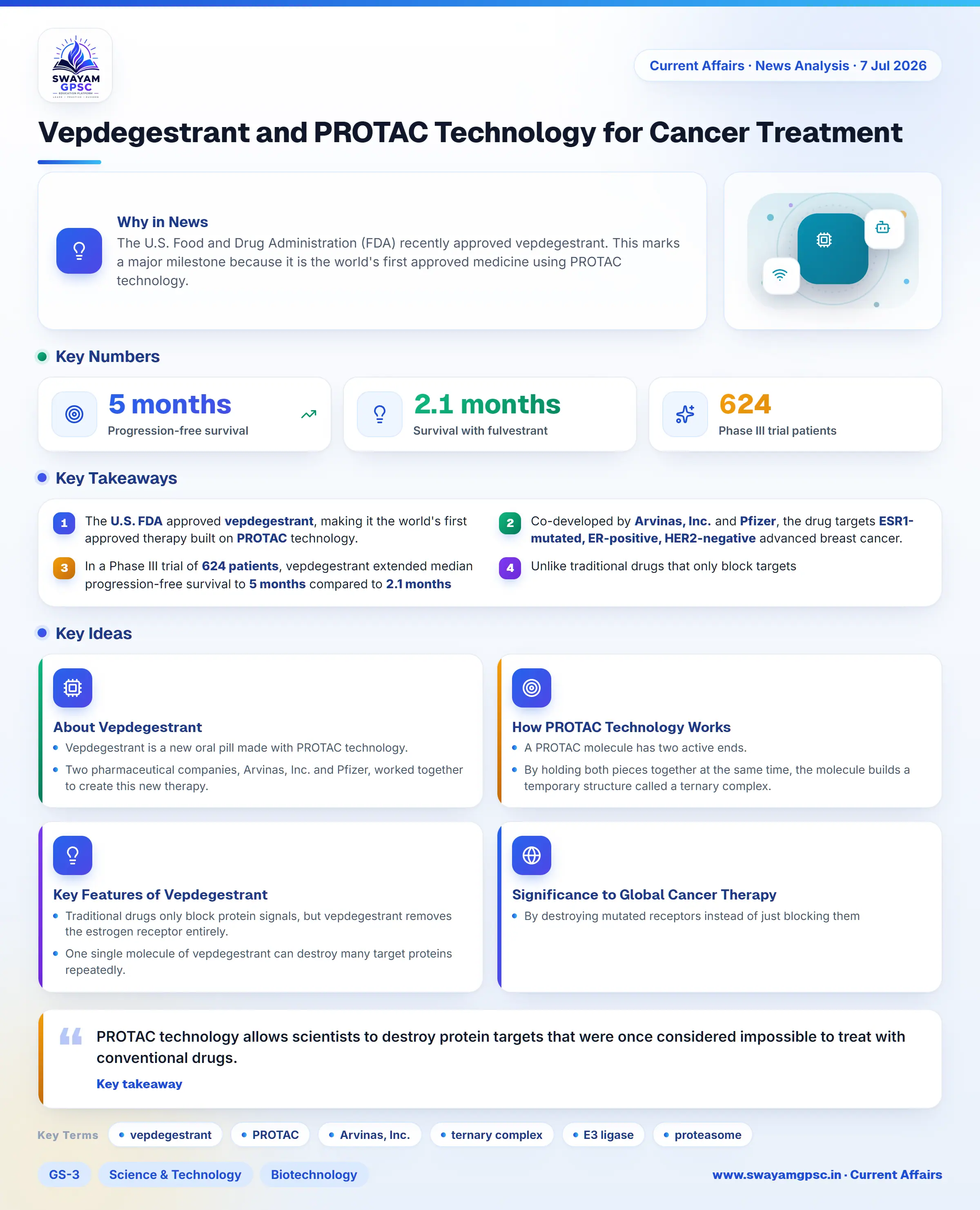
Vepdegestrant and PROTAC Technology for Cancer Treatment
#GS-3 #Science & Technology #Biotechnology #Health #Cancer Treatment #PROTAC Technology
Key takeaways
- The U.S. FDA approved vepdegestrant, making it the world's first approved therapy built on PROTAC technology.
- Co-developed by Arvinas, Inc. and Pfizer, the drug targets ESR1-mutated, ER-positive, HER2-negative advanced breast cancer.
- In a Phase III trial of 624 patients, vepdegestrant extended median progression-free survival to 5 months compared to 2.1 months with fulvestrant.
- Unlike traditional drugs that only block targets, PROTAC technology uses the cell's disposal system to destroy disease-causing proteins completely.
Why in News
- The U.S. Food and Drug Administration (FDA) recently approved vepdegestrant. This marks a major milestone because it is the world's first approved medicine using PROTAC technology.
About Vepdegestrant
- Vepdegestrant is a new oral pill made with PROTAC technology. Instead of just blocking bad proteins like older medicines, it uses the cell's own cleanup system to destroy them completely.
- Two pharmaceutical companies, Arvinas, Inc. and Pfizer, worked together to create this new therapy.
- It treats advanced breast cancer that is ESR1-mutated, ER-positive, and HER2-negative. It targets mutated estrogen receptors that no longer respond to normal hormone treatments.
How PROTAC Technology Works
- A PROTAC molecule has two active ends. One side grabs the target protein, while the other side connects to an E3 ligase enzyme.
- By holding both pieces together at the same time, the molecule builds a temporary structure called a ternary complex.
- Next, the E3 ligase attaches ubiquitin tags onto the bad protein. This marks the target protein for permanent destruction inside the cell.
- A cellular machine called a proteasome breaks down the marked protein into amino acids. Meanwhile, the PROTAC molecule leaves untouched to attack more target proteins.
Key Features of Vepdegestrant
- Traditional drugs only block protein signals, but vepdegestrant removes the estrogen receptor entirely. This stops all cancer growth signals coming from that protein.
- One single molecule of vepdegestrant can destroy many target proteins repeatedly. This high efficiency means patients can take smaller doses.
- Patients take this treatment as a once-daily oral tablet. It replaces painful monthly injection therapies like fulvestrant.
- In a trial of 624 patients, vepdegestrant kept cancer from growing for a median of 5 months, compared to only 2.1 months with fulvestrant.
- The drug causes mostly mild side effects such as fatigue, nausea, muscle aches, and short-term shifts in liver enzymes or heart rhythm readings.
Significance to Global Cancer Therapy
- PROTAC technology allows scientists to destroy protein targets that were once considered impossible to treat with conventional drugs.
- By destroying mutated receptors instead of just blocking them, vepdegestrant offers new hope when standard hormone therapies stop working in advanced cancer.