UN CBD COP-17: Adoption of the Yerevan Pathway
#GS-2 #International Treaties & Agreements #Current Events #International #GS-3 #Environment #Conservation #Environmental Pollution & Degradation #Biodiversity
Key takeaways
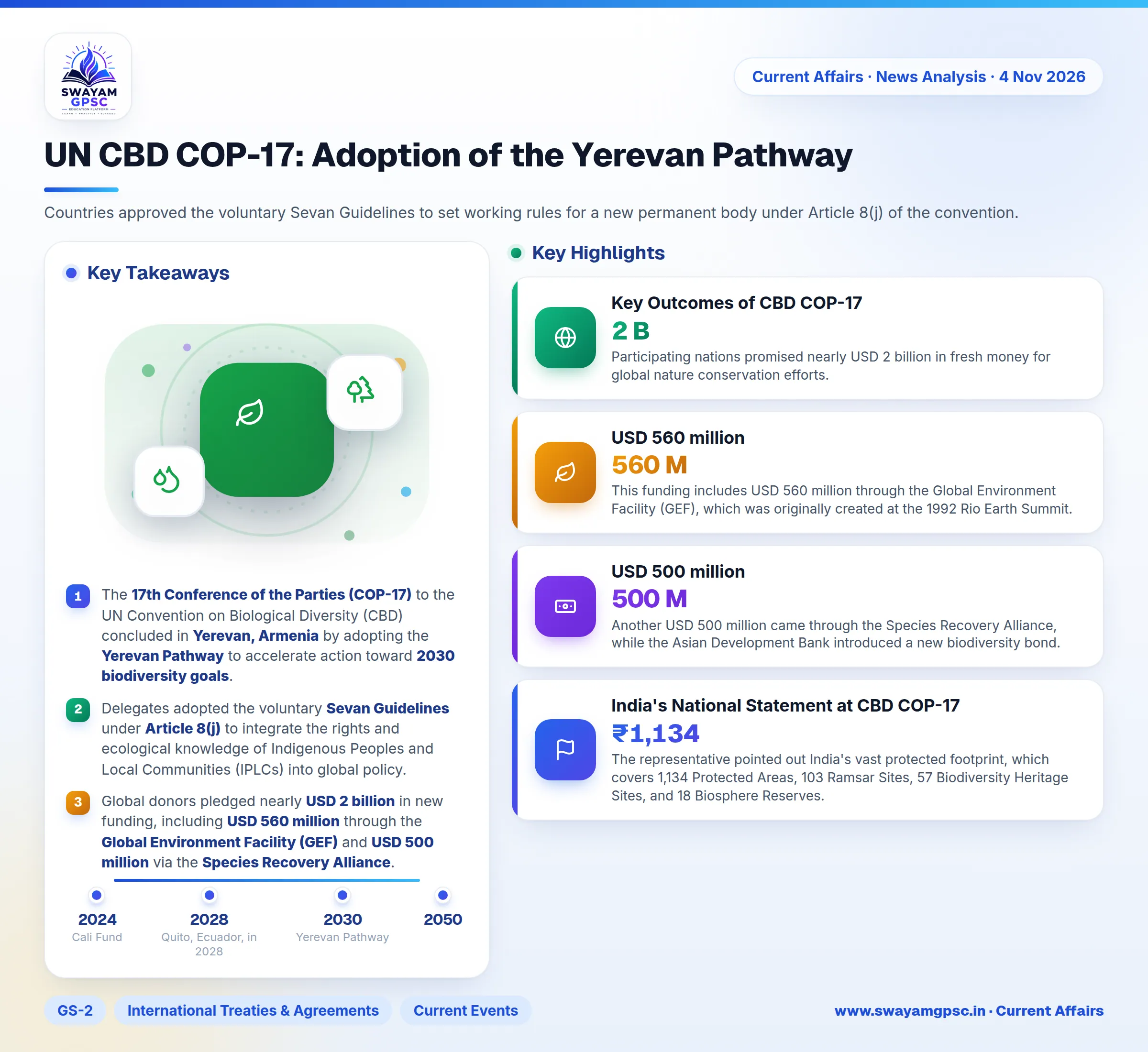
- The 17th Conference of the Parties (COP-17) to the UN Convention on Biological Diversity (CBD) concluded in Yerevan, Armenia by adopting the Yerevan Pathway to accelerate action toward 2030 biodiversity goals.
- Delegates adopted the voluntary Sevan Guidelines under Article 8(j) to integrate the rights and ecological knowledge of Indigenous Peoples and Local Communities (IPLCs) into global policy.
- Global donors pledged nearly USD 2 billion in new funding, including USD 560 million through the Global Environment Facility (GEF) and USD 500 million via the Species Recovery Alliance.
- India showcased its conservation network of 1,134 Protected Areas, 103 Ramsar Sites, 57 Biodiversity Heritage Sites, and 18 Biosphere Reserves.
- Executing India's updated NBSAP (2024-2030) to restore 30% of degraded ecosystems will require an estimated annual expenditure of Rs 81,664 crore.
Why in News?
- The 17th Conference of the Parties (COP-17) to the UN Convention on Biological Diversity (CBD) ended in Yerevan, Armenia with the adoption of the Yerevan Pathway.
- During the summit, India insisted that developed countries must provide steady funding and transfer modern technology so developing nations can implement the Kunming-Montreal Global Biodiversity Framework (KMGBF) effectively.
Key Outcomes of CBD COP-17
- Delegates accepted the Yerevan Pathway after the first global review of the KMGBF revealed slow progress toward meeting the 2030 deadline.
- The new pathway asks countries to link national budgets to nature goals, phase out harmful subsidies, and build stronger monitoring systems.
- Countries approved the voluntary Sevan Guidelines to set working rules for a new permanent body under Article 8(j) of the convention.
- These guidelines protect Indigenous Peoples and Local Communities (IPLCs) by including their rights and traditional knowledge in global decisions.
- Participating nations promised nearly USD 2 billion in fresh money for global nature conservation efforts.
- This funding includes USD 560 million through the Global Environment Facility (GEF), which was originally created at the 1992 Rio Earth Summit.
- Another USD 500 million came through the Species Recovery Alliance, while the Asian Development Bank introduced a new biodiversity bond.
- Attempts to push countries to eliminate nature-harming subsidies met strong opposition from Saudi Arabia, Russia, and India.
- Negotiators softened the final statement, asking nations to reform harmful policies based on their own internal circumstances.
- Talks continued on the Cali Fund, a mechanism created at COP-16 in 2024 to share profits from Digital Sequence Information (DSI).
- Delegates agreed to start a test phase that lets a governing committee issue formal certificates to businesses making voluntary payments.
- Countries delayed final choices on funding rules and governance to COP-18, which takes place in Quito, Ecuador, in 2028.
India's National Statement at CBD COP-17
- India declared that global conservation rules must respect national sovereignty and come with reliable financing from rich nations.
- The delegation backed the Cali Fund to ensure countries share benefits from digitized genetic data fairly.
- India urged nations to handle synthetic biology using strict scientific evidence and strong safety precautions.
- The representative pointed out India's vast protected footprint, which covers 1,134 Protected Areas, 103 Ramsar Sites, 57 Biodiversity Heritage Sites, and 18 Biosphere Reserves.
- India noted that 13 of its biosphere reserves belong to the international UNESCO MAB network.
- Local village Biodiversity Management Committees (BMCs) help India share resource benefits fairly at the grassroots level.
- India highlighted the MISHTI scheme, which works to rebuild and protect coastal mangrove forests.
- The delegation presented Amrit Dharohar, a national effort focused on saving valuable wetland locations.
- India promoted the International Big Cat Alliance (IBCA) to protect seven major feline species across multiple countries.
- The representative explained how Mission LiFE and "Ek Ped Maa Ke Naam" encourage ordinary citizens to take care of nature.
Kunming-Montreal Global Biodiversity Framework (KMGBF)
- World leaders adopted the KMGBF back in 2022 during COP-15 to replace the older Aichi Biodiversity Targets (2011-2020).
- The plan targets urgent action to create a nature-positive world by 2030 and live in total harmony with nature by 2050.
- This framework sets up 4 overarching Goals for 2050 alongside 23 action-oriented Targets for 2030.
- The deal works through voluntary national promises rather than legally binding laws, similar to the setup of the Paris Agreement.
- Member nations must update their domestic NBSAPs to match all 23 global targets directly.
- The Global Biodiversity Framework Fund (GBFF) operates under the Global Environment Facility (GEF) to channel money to developing nations.
India’s National Biodiversity Strategy and Action Plan (NBSAP)
- India updated its national plan for 2024-2030 to coordinate action across government offices and civic groups.
- Protecting domestic habitats is vital because India houses nearly 8% of all global animal species and 9.24% of global plant species.
- A central goal of the plan is repairing at least 30% of degraded land, inland water, and coastal areas.
- The policy devotes 8 of its 23 targets to stopping habitat destruction, pollution, and climate damage.
- The plan works to solve practical social problems like food shortages, water scarcity, and animal-human conflicts.
- Executing this strategy will cost an estimated Rs 81,664 crore each year between 2024-25 and 2029-30.
Way Forward
- Countries must deliver steady funding and share green technology to achieve global biodiversity goals on schedule.
- India needs to strengthen village-led conservation efforts so local communities can protect nature and support long-term sustainability.