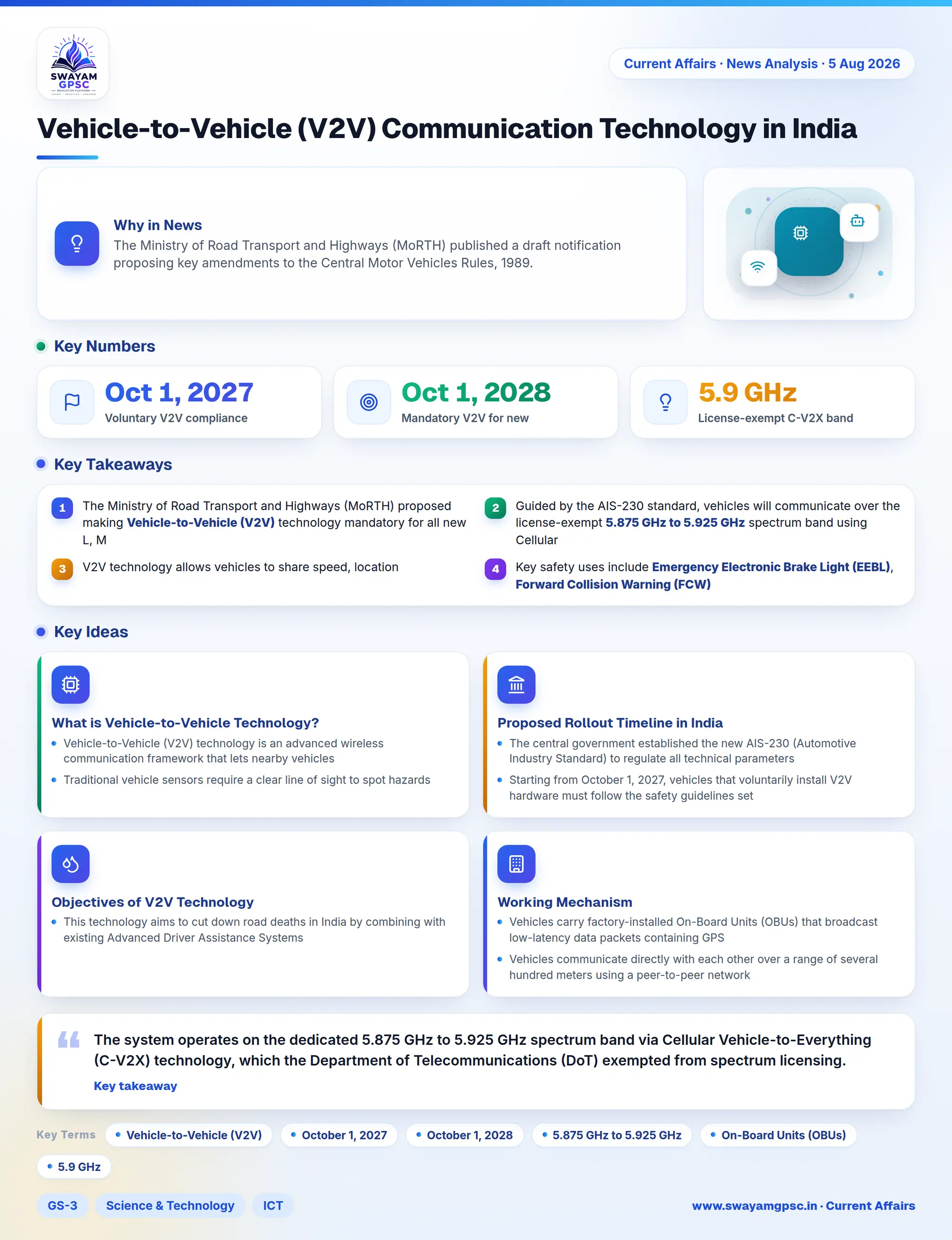
Vehicle-to-Vehicle (V2V) Communication Technology in India
#GS-3 #Science & Technology #ICT #Economy #Infrastructure #Current Events #National #V2V Technology #Road Safety
Key takeaways
- The Ministry of Road Transport and Highways (MoRTH) proposed making Vehicle-to-Vehicle (V2V) technology mandatory for all new L, M, and N category vehicles from October 1, 2028.
- Guided by the AIS-230 standard, vehicles will communicate over the license-exempt 5.875 GHz to 5.925 GHz spectrum band using Cellular Vehicle-to-Everything (C-V2X) technology.
- V2V technology allows vehicles to share speed, location, and braking data directly over a peer-to-peer network without relying on cell towers or cloud servers.
- Key safety uses include Emergency Electronic Brake Light (EEBL), Forward Collision Warning (FCW), and alerts for emergency vehicles or wrong-way drivers.
Why in News
- The Ministry of Road Transport and Highways (MoRTH) published a draft notification proposing key amendments to the Central Motor Vehicles Rules, 1989.
What is Vehicle-to-Vehicle Technology?
- Vehicle-to-Vehicle (V2V) technology is an advanced wireless communication framework that lets nearby vehicles continually exchange real-time information such as speed, location, direction, acceleration, and braking status.
- Traditional vehicle sensors require a clear line of sight to spot hazards, but V2V technology warns drivers about hidden obstacles beyond their visual range to prevent road accidents.
Proposed Rollout Timeline in India
- The central government established the new AIS-230 (Automotive Industry Standard) to regulate all technical parameters for V2V systems.
- Starting from October 1, 2027, vehicles that voluntarily install V2V hardware must follow the safety guidelines set under the AIS-230 rules.
- Beginning October 1, 2028, fitting V2V technology will become mandatory for all newly produced L, M, and N category motor vehicles.
- The system operates on the dedicated 5.875 GHz to 5.925 GHz spectrum band via Cellular Vehicle-to-Everything (C-V2X) technology, which the Department of Telecommunications (DoT) exempted from spectrum licensing.
Objectives of V2V Technology
- This technology aims to cut down road deaths in India by combining with existing Advanced Driver Assistance Systems (ADAS) and building a strong base for Intelligent Transportation Systems (ITS).
Working Mechanism
- Vehicles carry factory-installed On-Board Units (OBUs) that broadcast low-latency data packets containing GPS coordinates, speed, trajectory, and safety alerts.
- Vehicles communicate directly with each other over a range of several hundred meters using a peer-to-peer network without depending on cell towers or cloud servers.
- An onboard processor checks incoming signals against the vehicle trajectory in milliseconds and alerts the driver through screens, audio tones, or steering wheel vibrations before a hazard appears.
Key Features of AIS-230 Standard
- The standard uses license-free C-V2X radio channels working in the 5.9 GHz band (5.875 GHz to 5.925 GHz).
- It establishes strict performance criteria for receiver sensitivity, GNSS location precision, battery protection, and electromagnetic compatibility.
- It delivers complete 360-degree non-line-of-sight coverage, working reliably around sharp turns, blind intersections, heavy fog, or behind large trucks.
- It includes a built-in cybersecurity system with encrypted verification protocols to prevent fake signals, unauthorized message changes, and hacker attacks.
Primary Applications
- The Emergency Electronic Brake Light (EEBL) system alerts trailing drivers when a vehicle several positions ahead brakes hard, preventing multi-car pileups.
- The Forward Collision Warning (FCW) notifies the driver whenever a front-end crash becomes likely due to stopped or slow-moving traffic.
- The Blind Spot and Lane Change Warnings inform drivers if another car is approaching fast in a side mirror blind spot during overtaking moves.
- The Wrong-Way Driving Alert identifies vehicles traveling in the wrong direction on one-way roads or divided highways.
- The Emergency Vehicle Approaching Alert warns drivers about coming ambulances, fire engines, or police cars so they can clear the lane early.