VB-G RAM G Act 2025: Transforming Rural Employment in India
#GS-2 #GS-3 #Governance & Social Justice #Poverty #Employment #Infrastructure #National #Government Policies & Interventions
Why in News
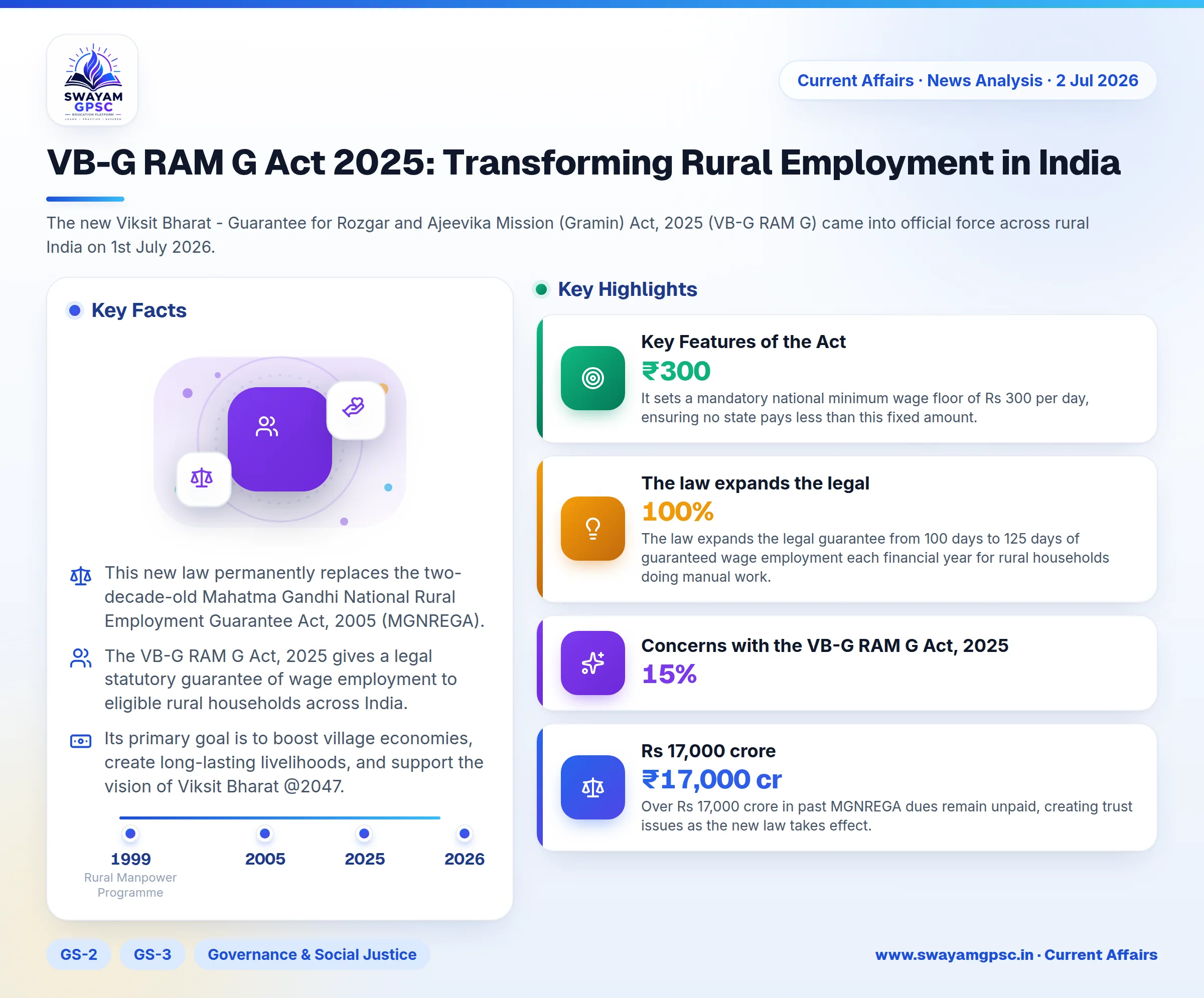
- The new Viksit Bharat - Guarantee for Rozgar and Ajeevika Mission (Gramin) Act, 2025 (VB-G RAM G) came into official force across rural India on 1st July 2026.
- This new law permanently replaces the two-decade-old Mahatma Gandhi National Rural Employment Guarantee Act, 2005 (MGNREGA).
Overview of the VB-G RAM G Act 2025
- The VB-G RAM G Act, 2025 replaces MGNREGA with a modernized framework that increases guaranteed work to 125 days, focuses on durable rural infrastructure, builds climate resilience, uses digital planning, and aligns with Viksit Bharat @2047.
- While modernizing the sector, the law raises major concerns including a six-fold rise in state financial burdens, dilution of the demand-driven right to work, central control, potential digital exclusion, and unpaid MGNREGA liabilities.
What is the VB-G RAM G Act, 2025?
- The VB-G RAM G Act, 2025 gives a legal statutory guarantee of wage employment to eligible rural households across India.
- Its primary goal is to boost village economies, create long-lasting livelihoods, and support the vision of Viksit Bharat @2047.
- India's rural employment programs began with the Rural Manpower Programme in the 1960s and the Crash Scheme for Rural Employment in 1971, evolving later into Jawahar Rozgar Yojana in 1993 and Sampoorna Grameen Rozgar Yojana in 1999.
- The Maharashtra Employment Guarantee Act, 1977 first introduced a statutory right to work, setting the stage for MGNREGA, 2005.
- The new law places Gram Panchayats at the center of development, focusing on building strong rural assets, managing natural resources, conserving water, and empowering women through Self Help Groups (SHGs).
Key Features of the Act
- The law expands the legal guarantee from 100 days to 125 days of guaranteed wage employment each financial year for rural households doing manual work.
- It introduces a compulsory 60-day pause during peak farming seasons to protect agricultural labor supply, while providing the 125 days of work during the remaining 305 days.
- It sets a mandatory national minimum wage floor of Rs 300 per day, ensuring no state pays less than this fixed amount.
- Wages must be paid weekly or within a strict statutory limit of 14 days after work completion to protect workers' earnings.
- Workers will receive new Gramin Rozgar Guarantee Cards, while existing e-KYC verified job cards stay valid during the transition period.
- The Centre and normal states will share costs under a 60:40 ratio, while Northeastern states, Himalayan states, and UTs with assemblies get a 90:10 ratio, and UTs without assemblies receive 100% central funding.
- Funds will now follow a top-down normative budget ceiling linked to the 16th Finance Commission recommendations, ending the old demand-driven funding model.
- Employment is strictly mapped to four priority areas: water security, core rural infrastructure, livelihood infrastructure, and climate resilience projects.
- Village plans generated under Viksit Gram Panchayat Plans will link directly with PM Gati Shakti to prevent disconnected asset creation.
- All created assets will be tracked together through the Viksit Bharat National Rural Infrastructure Stack for centralized monitoring.
Drawbacks of MGNREGA
- Works were frequently scattered and uncoordinated, which prevented the creation of high-quality, durable assets.
- The demand-driven system created serious labor shortages for farmers during peak sowing and harvest periods.
- Administrative delays and slow fund releases caused long delays in paying daily wages to rural workers.
- Systemic leakages like ghost beneficiaries, fake muster rolls, financial theft, and poor work quality hurt performance.
- Unpredictable funding requirements led to rising delayed payments and financial uncertainty for state budgets.
Rationale for VB-G RAM G Act, 2025
- Falling rural poverty, shifting work patterns, and growing digital access made it essential to reform MGNREGA to match Viksit Bharat @2047 goals.
- The scheme directs labor specifically into water security, rural infrastructure, livelihoods, and climate resilience, using PM Gati Shakti for coordination.
- It modernizes rural governance by holding authorities accountable and combining daily employment with long-term economic development.
Concerns with the VB-G RAM G Act, 2025
- The new 60:40 funding ratio will increase financial costs for states by up to six times, placing heavy pressure on state budgets and federal relations.
- Fixed financial ceilings based on 16th Finance Commission rules may unfairly penalize states with better population control, and states must pay for any extra costs above the central limit.
- Replacing demand-driven funding with pre-fixed budgets weakens the legal right to work, turning a rights-based safety net into a budget-capped scheme.
- A rigid 60-day work suspension during farming season can leave poor families without income during sudden droughts or monsoon failures.
- Greater central control over budgets and planning weakens Gram Sabha independence and undermines the spirit of the 73rd Constitutional Amendment.
- Centralized dispute resolution and weaker independent social audits lower transparency and reduce local community oversight.
- The new Rs 300 per day minimum wage gave over 15% pay raises in Northern states like UP and Bihar, but Southern states already paying higher rates saw under 3% raises, while Sikkim keeps a peak rate of Rs 450 in select panchayats.
- Over Rs 17,000 crore in past MGNREGA dues remain unpaid, creating trust issues as the new law takes effect.
Way Forward
- The Centre should introduce a gradual financial transition, or use the 16th Finance Commission to provide bonus funds to states facing high employment demand.
- States like Tamil Nadu suggest that the Centre should pay 100% of wages and administrative expenses, while sharing material expenses in a 75:25 ratio.
- Connecting the new scheme with state-funded housing projects can speed up rural home building and support poor families.
- State governments should have direct power to approve scheme convergence without waiting for central government approvals.
- Local Gram Sabhas and District Collectors should decide when to apply the 60-day farming pause, so work can continue during local crop failures or droughts.
- A National Contingency Buffer Fund should automatically provide extra funds whenever natural disasters or economic distress increase labor demand beyond the fixed budget.
- Where e-KYC or biometric devices fail, offline verification like manual rolls must be allowed legally so that elderly and disabled workers are not denied work.
- In line with the 73rd Constitutional Amendment, Gram Panchayats must retain real decision-making powers instead of just executing central portal directives.
- An independent body for social audits should be created in the official rules to preserve local accountability and stop bureaucratic control.
Conclusion
- The VB-G RAM G Act, 2025 shifts rural policy from basic poverty relief toward building national economic assets for Viksit Bharat @2047.
- The success of this reform depends on protecting state finances from extreme stress and ensuring digital tools do not exclude vulnerable rural workers.