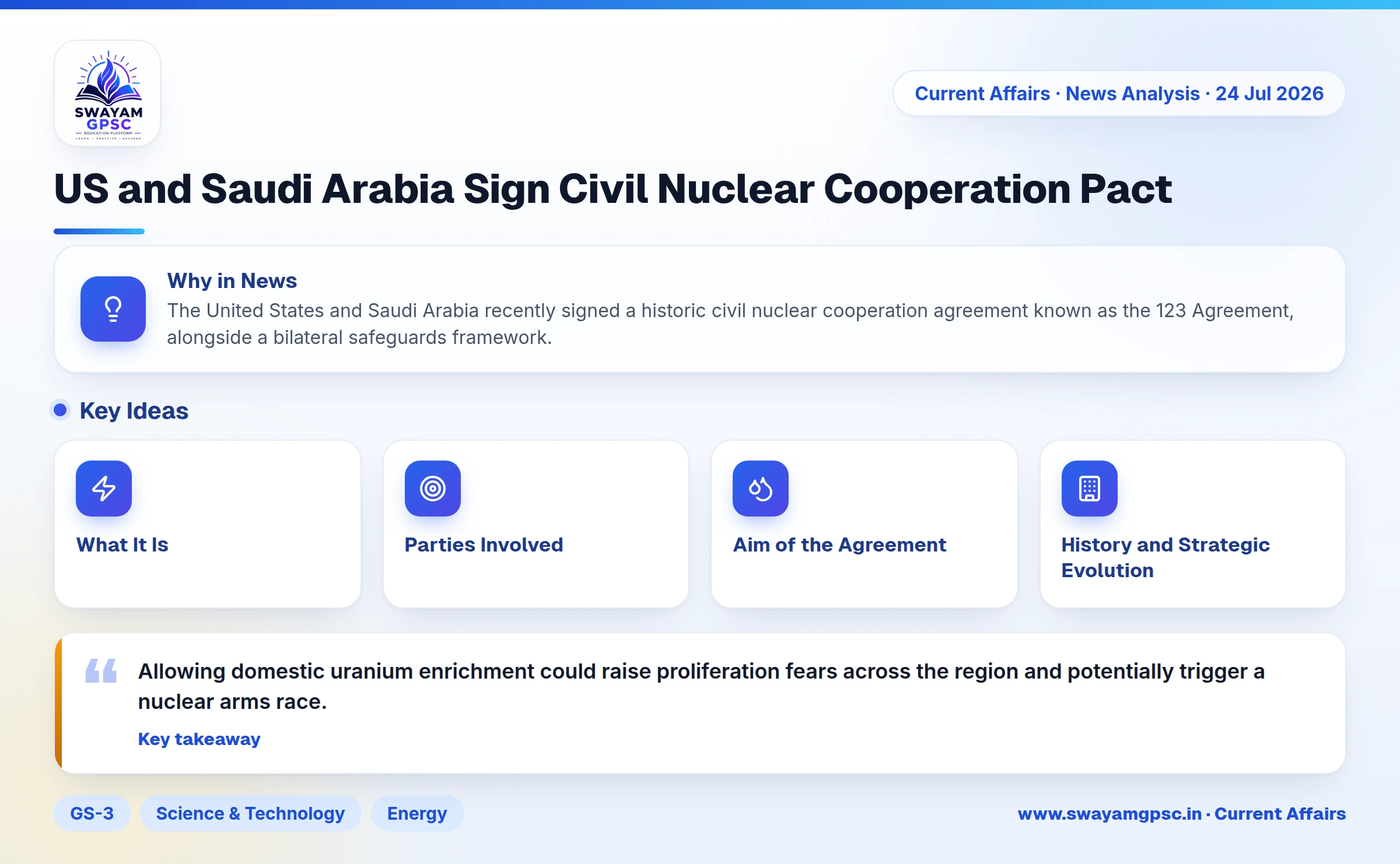
US and Saudi Arabia Sign Civil Nuclear Cooperation Pact
#GS-3 #Science & Technology #Energy #Current Events #International #US-Saudi 123 Agreement #Nuclear Cooperation
Why in News
- The United States and Saudi Arabia recently signed a historic civil nuclear cooperation agreement known as the 123 Agreement, alongside a bilateral safeguards framework.
What It Is
- This deal operates under Section 123 of the US Atomic Energy Act of 1954, creating the legal basis required for the United States to share nuclear reactors, fuel, and technology with another nation for peaceful purposes.
Parties Involved
- On the American side, US Energy Secretary Chris Wright signed the deal under the administration of President Donald Trump.
- On the Saudi side, Energy Minister Prince Abdulaziz bin Salman signed the document with full backing from Crown Prince Mohammed bin Salman.
Aim of the Agreement
- The pact aims to help Saudi Arabia reduce its reliance on crude oil by generating clean nuclear electricity for domestic cooling and water desalination plants.
History and Strategic Evolution
- Past discussions hit a roadblock because the United States insisted on the Gold Standard to ban domestic uranium enrichment, while also demanding normalized relations with Israel.
- The approach changed in 2026 by dropping the condition regarding Israel and offering flexibility for American-backed domestic uranium enrichment.
Key Features of the Agreement
- The pact allows private companies from the United States to supply civil nuclear reactors, key components, and technical know-how directly to Saudi Arabia.
- It grants Saudi Arabia the option to enrich uranium within American-built facilities under mutually agreed conditions.
- It establishes a bilateral monitoring process to verify that nuclear material is never diverted toward military weapons.
- It does not require Saudi Arabia to sign the IAEA Additional Protocol, avoiding intrusive on-site inspections.
- The pact must undergo a mandatory review lasting 90 legislative days within the US Congress before coming into force.
Implications
- Allowing domestic uranium enrichment could raise proliferation fears across the region and potentially trigger a nuclear arms race.
- The deal firmly establishes American influence in the energy grid of Saudi Arabia while keeping competing options from Russia and China at bay.