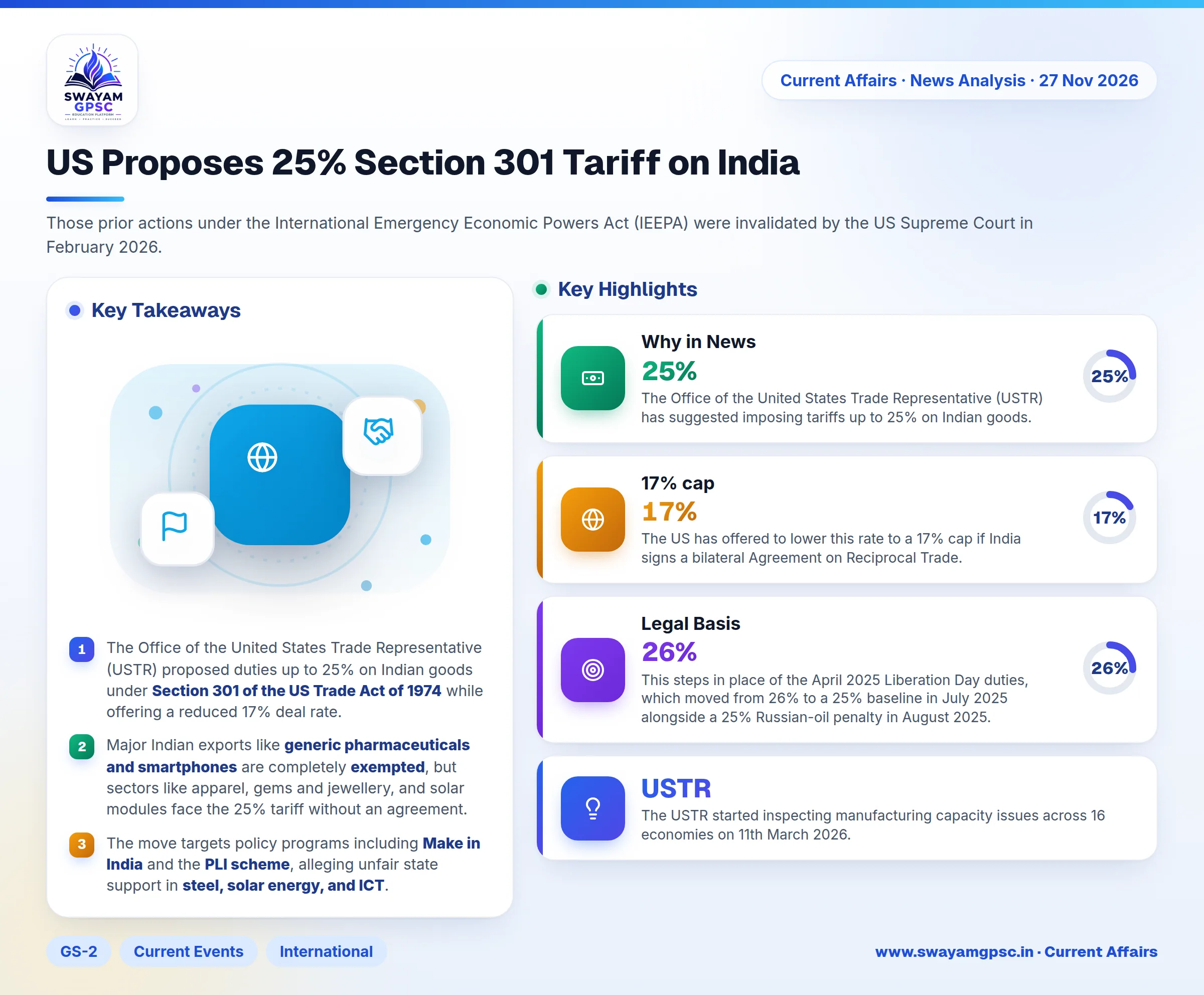
US Proposes 25% Section 301 Tariff on India
#GS-2 #Current Events #International #Effect of Policies & Politics of Countries on India's Interests #Bilateral Groupings & Agreements #Rapid Fire CA #Quick Facts For Prelims
Key takeaways
- The Office of the United States Trade Representative (USTR) proposed duties up to 25% on Indian goods under Section 301 of the US Trade Act of 1974 while offering a reduced 17% deal rate.
- Major Indian exports like generic pharmaceuticals and smartphones are completely exempted, but sectors like apparel, gems and jewellery, and solar modules face the 25% tariff without an agreement.
- The move targets policy programs including Make in India and the PLI scheme, alleging unfair state support in steel, solar energy, and ICT.
- This legal step replaces older tariffs under the IEEPA that were struck down by the US Supreme Court in February 2026.
Why in News
- The Office of the United States Trade Representative (USTR) has suggested imposing tariffs up to 25% on Indian goods.
- These actions are being taken under Section 301 of the US Trade Act of 1974 due to alleged unfair trade practices.
- The US has offered to lower this rate to a 17% cap if India signs a bilateral Agreement on Reciprocal Trade.
Background
- The USTR started inspecting manufacturing capacity issues across 16 economies on 11th March 2026.
- The new duty rates focus on 14 economies including India, China, and the European Union (EU), while bypassing Mexico and Norway for now.
Legal Basis
- The law relies on Section 301, which lets the US government respond against unreasonable foreign trade actions.
- This steps in place of the April 2025 Liberation Day duties, which moved from 26% to a 25% baseline in July 2025 alongside a 25% Russian-oil penalty in August 2025.
- Those prior actions under the International Emergency Economic Powers Act (IEEPA) were invalidated by the US Supreme Court in February 2026.
Core US Allegations
- The US trade office highlighted five policy areas of concern, including industrial initiatives like Make in India and the Production Linked Incentive (PLI) scheme.
- The report cited poor worker protections, state-influenced bank lending, limited market access, and reliance on raw materials from non-market nations.
- The complaints target critical manufacturing sectors, particularly steel, solar energy, and ICT.
Impact on Indian Exports
- India's biggest exports to the US, such as generic pharmaceuticals and smartphones, remain completely exempted from these new duties.
- Labour-heavy and growing sectors like apparel and textiles, gems and jewellery, shrimp and seafood, solar modules, medical devices, and non-Section 232 engineering goods face taxes up to 25% if no deal is finalized.
- Goods currently taxed under Section 232 of the US Trade Expansion Act, 1962 (including select steel, aluminium, and auto products) will stay under their current rules rather than adding these new tariffs.
Comparative Asian Standing
- Reaching the negotiated 17% rate will help India maintain a trade advantage over Asian competitors like Bangladesh, Cambodia, Indonesia, Malaysia, Thailand, Vietnam, and China.
India's Stance & Red Lines
- India has denied any excess manufacturing capacity in its domestic industries.
- Indian officials stated that trade issues must be resolved through the ongoing India-U.S. Bilateral Trade Agreement (BTA) discussions.