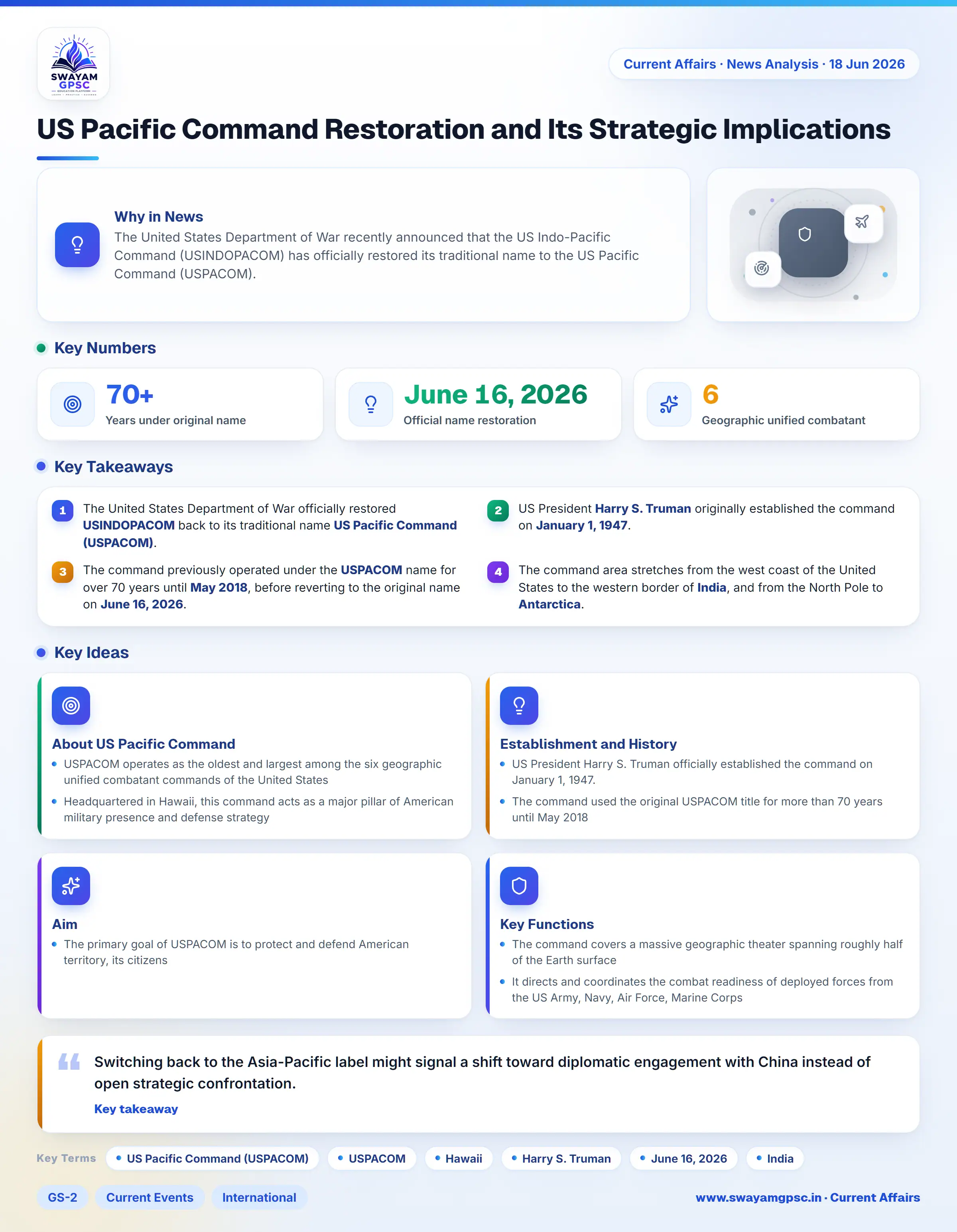
US Pacific Command Restoration and Its Strategic Implications
#GS-2 #Current Events #International #Economy #Defence
Key takeaways
- The United States Department of War officially restored USINDOPACOM back to its traditional name US Pacific Command (USPACOM).
- US President Harry S. Truman originally established the command on January 1, 1947.
- The command previously operated under the USPACOM name for over 70 years until May 2018, before reverting to the original name on June 16, 2026.
- The command area stretches from the west coast of the United States to the western border of India, and from the North Pole to Antarctica.
Why in News
- The United States Department of War recently announced that the US Indo-Pacific Command (USINDOPACOM) has officially restored its traditional name to the US Pacific Command (USPACOM).
About US Pacific Command
- USPACOM operates as the oldest and largest among the six geographic unified combatant commands of the United States Armed Forces.
- Headquartered in Hawaii, this command acts as a major pillar of American military presence and defense strategy worldwide.
Establishment and History
- US President Harry S. Truman officially established the command on January 1, 1947.
- The command used the original USPACOM title for more than 70 years until May 2018, when authorities renamed it USINDOPACOM to emphasize the growing strategic weight of the Indian Ocean region.
- The current administration officially brought back the traditional name on June 16, 2026.
Aim
- The primary goal of USPACOM is to protect and defend American territory, its citizens, and sovereign interests across its assigned region.
Key Functions
- The command covers a massive geographic theater spanning roughly half of the Earth surface, stretching from the west coast of the United States to the western border of India, and from the North Pole to Antarctica.
- It directs and coordinates the combat readiness of deployed forces from the US Army, Navy, Air Force, Marine Corps, and Space Force stationed in the Pacific.
- It partners with regional militaries through joint training exercises and capacity-building programs to keep sea lanes and trade corridors open.
- It leads international disaster response networks by deploying logistics, medical aid, and search-and-rescue teams during crises across Asia.
Implications
- Switching back to the Asia-Pacific label might signal a shift toward diplomatic engagement with China instead of open strategic confrontation.
- This decision creates uncertainty about the future focus on the Quad and the significance of the Indian Ocean in regional strategy.
- Dropping the word Indo symbolically decreases emphasis on India and its central role in a unified security framework.