US and Iran Sign Islamabad MoU and its Implications
#GS-2 #International Treaties & Agreements #Bilateral Groupings & Agreements #International #Economy #Infrastructure #Energy
Key takeaways
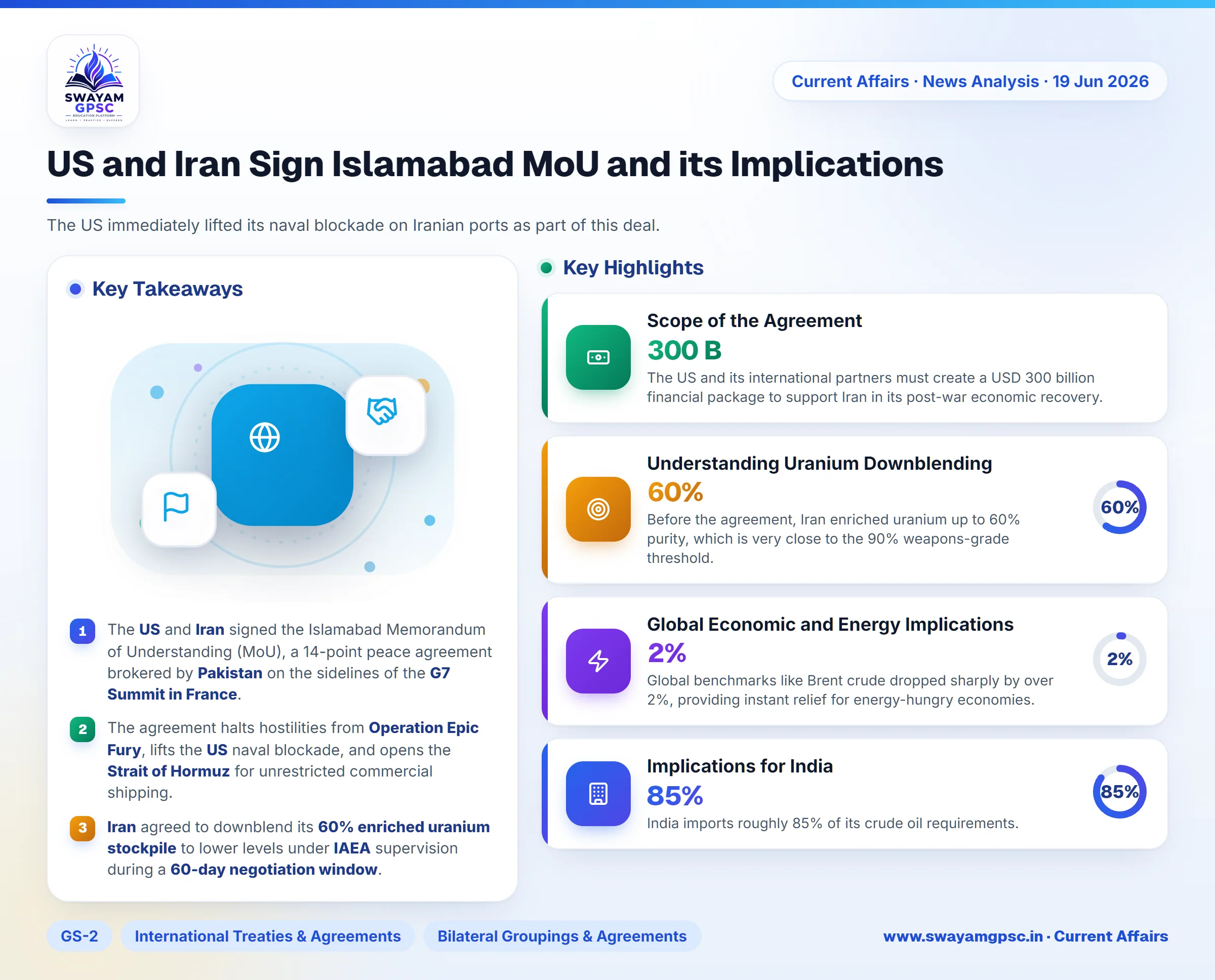
- The US and Iran signed the Islamabad Memorandum of Understanding (MoU), a 14-point peace agreement brokered by Pakistan on the sidelines of the G7 Summit in France.
- The agreement halts hostilities from Operation Epic Fury, lifts the US naval blockade, and opens the Strait of Hormuz for unrestricted commercial shipping.
- Iran agreed to downblend its 60% enriched uranium stockpile to lower levels under IAEA supervision during a 60-day negotiation window.
- The US and its partners committed to a USD 300 billion financial package to support Iran's post-war economic recovery and unfreeze overseas sovereign assets.
- The deal provides major relief to India by lowering crude oil import bills, reducing inflation, and reviving connectivity projects like the Chabahar Port and the INSTC.
Why in News
- A major breakthrough in West Asian geopolitics occurred as the US and Iran signed a landmark 14-point peace agreement called the Islamabad Memorandum of Understanding (MoU).
- The agreement was signed on the sidelines of the G7 Summit in France and was mediated by Pakistan.
- It successfully halts the intense military hostilities of Operation Epic Fury that began in February 2026.
- The US immediately lifted its naval blockade on Iranian ports as part of this deal.
- The strategically vital Strait of Hormuz is now open for unrestricted international maritime trade.
Scope of the Agreement
- The Islamabad MoU acts as an interim diplomatic framework rather than a permanent peace treaty.
- It sets up an immediate stop to fighting and starts a 60-day negotiation process between the US and Iran on nuclear issues, regional security, and sanctions relief.
- The final comprehensive agreement will be made official through a binding resolution of the UN Security Council.
- The agreement requires Iran to downblend its Highly Enriched Uranium (HEU) under the supervision of the International Atomic Energy Agency (IAEA).
- The US and its international partners must create a USD 300 billion financial package to support Iran in its post-war economic recovery.
- The US agreed to lift its naval blockade, ease restrictions on crude oil exports, and open talks for wider sanctions relief.
- Iran promised to stop developing nuclear weapons, keep commercial shipping flowing freely through the Persian Gulf, and join final settlement talks.
- Iran agreed to give absolute toll-free transit to all commercial vessels through the Strait of Hormuz during the 60-day negotiation window.
- Maritime traffic through the channel must return to full pre-conflict capacity within 30 days of signing.
Understanding Uranium Downblending
- Downblending is a nuclear process that mixes Highly Enriched Uranium (HEU), which has a high concentration of the Uranium-235 isotope, with natural or depleted uranium.
- This process chemically dilutes the stockpile into Low-Enriched Uranium (LEU).
- Low-Enriched Uranium (LEU) is safe for civilian power generation but cannot be used to make weapons.
- Before the agreement, Iran enriched uranium up to 60% purity, which is very close to the 90% weapons-grade threshold.
- By agreeing to downblend this stockpile, Iran extends its breakout time, which addresses key security concerns of Western and regional nations.
The Downblending Process
- The process begins with gasification where UF6 feedstock is heated to 80 to 110 degrees Celsius in autoclaves to convert the solid into gas.
- A low-enriched uranium gas is added as a diluting agent to reduce the concentration of Uranium-235 in the material.
- Both gas streams enter a blending tee where baffles create turbulence to ensure complete and uniform mixing.
- Automated sensors regulate gas ratios while enrichment monitors track U-235 levels and trigger shutdowns if limits are exceeded.
- The blended UF6 is solidified and converted into uranium dioxide (UO2), which is a stable form that is unsuitable for direct enrichment.
- IAEA experts verify enrichment levels through laboratory testing and secure the material with tamper-proof seals.
Global Economic and Energy Implications
- The immediate reopening of the Strait of Hormuz instantly removes the geopolitical risk premium on oil.
- Global benchmarks like Brent crude dropped sharply by over 2%, providing instant relief for energy-hungry economies.
- The deal removes the need for expensive maritime detours around the Cape of Good Hope, slashing high freight costs and war-risk insurance premiums.
- The unfreezing of restricted assets, waivers on crude oil exports, and the proposed USD 300 billion reconstruction fund will reintegrate Iran into the global financial system.
Regional Implications for West Asia
- The MoU is a major strategic defeat for Israel because it mandates a permanent end to military operations and shields Hezbollah from destruction.
- The Israeli Defense Forces (IDF) vowed to continue operations in southern Lebanon, which risks a severe diplomatic rupture with Washington.
- For Gulf Cooperation Council (GCC) states like Saudi Arabia and the UAE, the MoU is a double-edged sword.
- While they needed the Strait of Hormuz reopened, they worry that financial support will help Iran fund its ballistic missile program and proxy networks.
- Tying the end of fighting in Lebanon to the US-Iran grand bargain threatens to freeze Lebanon's political status quo and leaves armed non-state actors in power.
Geopolitical and Strategic Implications
- Iran views the agreement as a diplomatic victory because it preserves key parts of its nuclear and missile capabilities.
- The US acceptance of Iran keeping a limited ballistic missile capability marks a departure from its maximum pressure doctrine.
- Pakistan successfully mediated the deal with support from Qatar and Omans, highlighting the growing role of regional middle powers in resolving conflicts.
Implications for India
- India imports roughly 85% of its crude oil requirements.
- The drop in global crude prices will compress India's import bill, rein in the current account deficit, and control domestic fuel inflation.
- Slashed logistics costs will improve the global competitiveness of Indian export sectors like plastics, chemicals, textiles, and engineering goods.
- The halt in military attacks can secure stranded Indian seafarers who faced acute risks from conflicts.
- The lifting of the naval blockade clears the path for the unhindered operation of the Chabahar Port and accelerates the International North-South Transport Corridor (INSTC).
- While the INSTC is revitalized, the deal stalls the India-Middle East-Europe Economic Corridor (IMEC) due to Israel's isolation and operations in Lebanon.
- India will need to balance its strategic partnership with a defiant Israel while building economic ties with an emboldened Iran.
- Pakistan's role as mediator strengthens its ties with Iran, which could clear the path for projects like the Iran-Pakistan Gas Pipeline free from secondary US sanctions.
Measures Needed for Durable Peace
- A verifiable IAEA-backed monitoring mechanism must be set up during the upcoming Swiss round of negotiations to oversee nuclear downblending and enrichment pauses.
- The UN and the International Maritime Organization (IMO) must decouple freedom of navigation in the Strait of Hormuz from regional political bargains.
- Neutral international intermediaries must address Israel's northern security concerns in the upcoming Swiss negotiations to prevent military actions from shattering the peace.