US Blocks Bid to List BLA and Majeed Brigade under UN 1267
#GS-2 #International Relations #Current Events #National #Security
Key takeaways
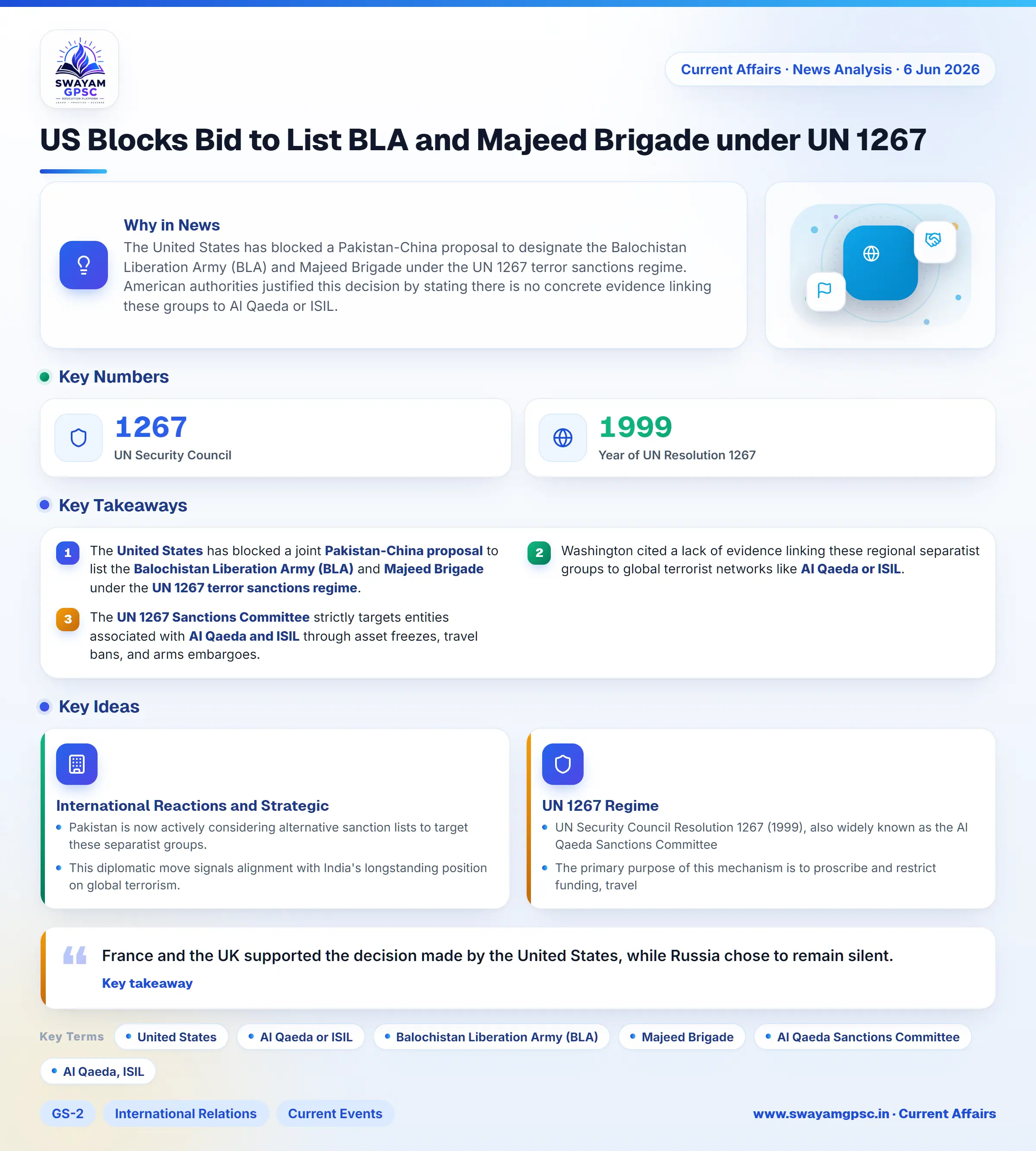
- The United States has blocked a joint Pakistan-China proposal to list the Balochistan Liberation Army (BLA) and Majeed Brigade under the UN 1267 terror sanctions regime.
- Washington cited a lack of evidence linking these regional separatist groups to global terrorist networks like Al Qaeda or ISIL.
- The UN 1267 Sanctions Committee strictly targets entities associated with Al Qaeda and ISIL through asset freezes, travel bans, and arms embargoes.
Why in News
- The United States has blocked a Pakistan-China proposal to designate the Balochistan Liberation Army (BLA) and Majeed Brigade under the UN 1267 terror sanctions regime.
- American authorities justified this decision by stating there is no concrete evidence linking these groups to Al Qaeda or ISIL.
International Reactions and Strategic Significance
- France and the UK supported the decision made by the United States, while Russia chose to remain silent.
- Pakistan is now actively considering alternative sanction lists to target these separatist groups.
- This diplomatic move signals alignment with India's longstanding position on global terrorism.
- The action effectively counters Pakistan's official narrative and eases concerns about any potential US tilt toward Pakistan.
- The Balochistan Liberation Army (BLA) operates as an armed separatist group in Balochistan, Pakistan, with the ultimate goal of creating an independent Baloch state.
- The Majeed Brigade functions as an offshoot or allied faction of Baloch separatist groups in the same region, focusing mainly on armed resistance, sabotage, and propaganda.
UN 1267 Regime
- UN Security Council Resolution 1267 (1999), also widely known as the Al Qaeda Sanctions Committee, governs the global designation of terrorist individuals and groups.
- The primary purpose of this mechanism is to proscribe and restrict funding, travel, and assets of individuals and entities associated with Al Qaeda, ISIL, and affiliated groups.
- A dedicated UNSC Sanctions Committee manages this framework by maintaining a consolidated list of designated targets and considering new additions or removals.
- The sanctions imposed include comprehensive asset freezes, international travel bans, and strict arms embargoes to disrupt the operational and financial networks of listed entities.
- The scope and enforcement apply strictly to groups linked to Al Qaeda or ISIL, requiring member states to implement these sanctions domestically under the threat of UN-level enforcement or diplomatic action.