Unlocking Growth in India's Tourism and Hospitality Sector
#GS-3 #Economy #Infrastructure #Employment #Growth #Current Events #National
Why in News?
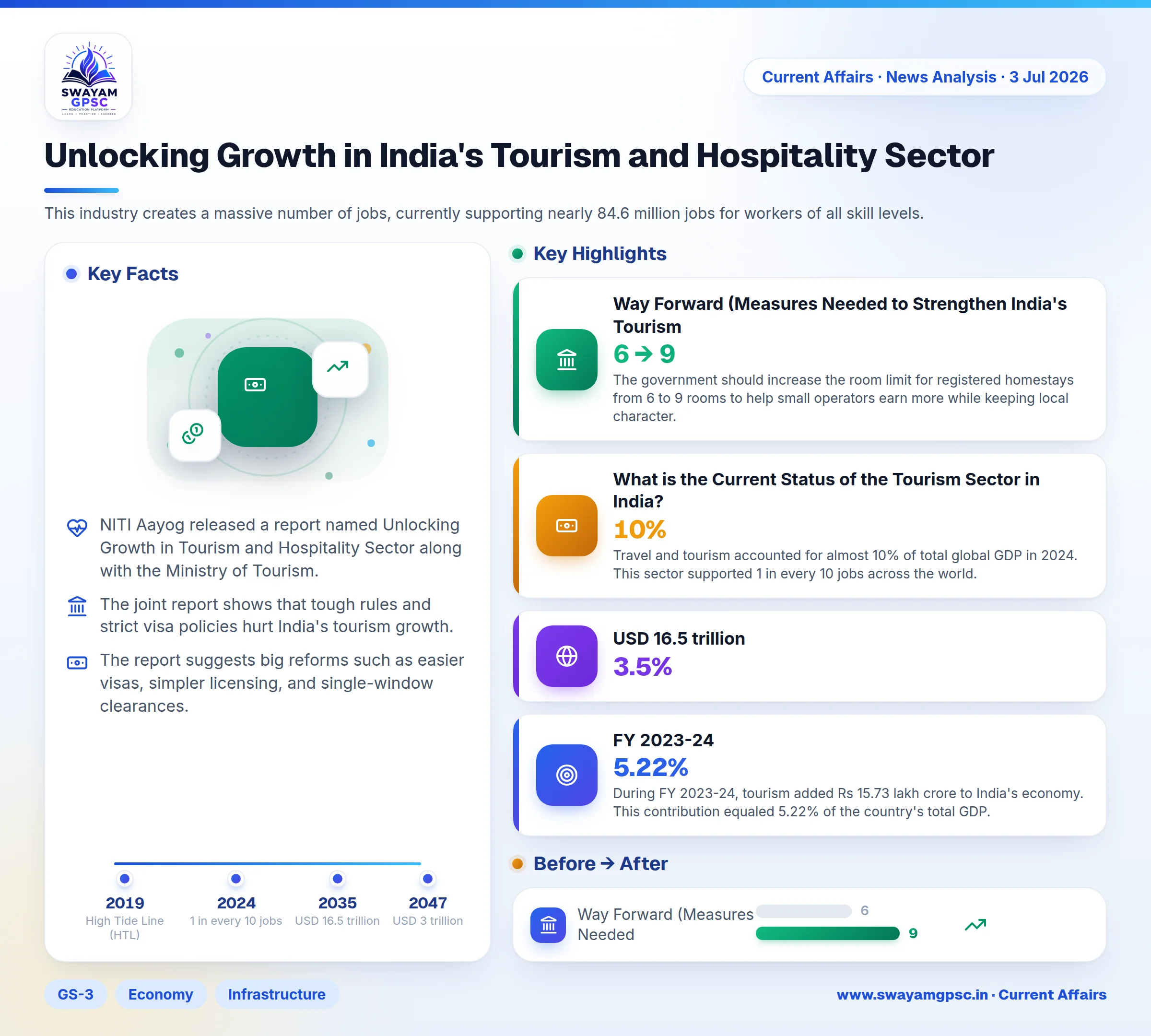
- NITI Aayog released a report named Unlocking Growth in Tourism and Hospitality Sector along with the Ministry of Tourism. This report offers a clear plan to remove official delays and rules. It aims to change India's tourism from just attracting large numbers of visitors to attracting high-value investments.
Summary
- The joint report shows that tough rules and strict visa policies hurt India's tourism growth. It highlights that poor infrastructure and slow government approvals stop India from using its rich cultural and natural heritage fully.
- The report suggests big reforms such as easier visas, simpler licensing, and single-window clearances. It also recommends relaxed building rules, better transport policies, and faster environmental permissions to attract foreign investment and make India a top travel hub.
What is the Current Status of the Tourism Sector in India?
- Travel and tourism accounted for almost 10% of total global GDP in 2024. This sector supported 1 in every 10 jobs across the world.
- Experts project the global tourism economy to touch USD 16.5 trillion by 2035 with an annual growth rate of 3.5%. It helps developing nations by creating jobs, boosting local growth, and bringing in foreign currency easily.
- During FY 2023-24, tourism added Rs 15.73 lakh crore to India's economy. This contribution equaled 5.22% of the country's total GDP.
- This industry creates a massive number of jobs, currently supporting nearly 84.6 million jobs for workers of all skill levels. This number shows a 20% growth over the past five years.
- Domestic tourism is booming in India, recording 2.9 billion visits in 2024. However, foreign tourist arrivals are still far below their true potential.
- Foreign tourist arrivals reached 9.95 million in 2024. Because of this low number, India holds less than a 1.5% share in total global tourist arrivals.
- The World Economic Forum's Travel & Tourism Development Index 2024 ranks India 6th for natural assets and 9th for cultural assets. Yet India ranks 39th overall because of weak business conditions and strict entry rules.
India's Tourism Promotion Initiatives
- The government launched the Swadesh Darshan Scheme and Swadesh Darshan 2.0 to develop thematic tourist circuits across the country.
- The PRASHAD Scheme focuses on developing infrastructure around major spiritual and pilgrimage sites in India.
- The Dekho Apna Desh Initiative encourages citizens to explore domestic travel destinations within the country.
- The Incredible India and Incredible India 2.0 campaigns promote India's rich heritage and tourism potential to international visitors.
- The Ek Bharat Shreshtha Bharat initiative builds cultural connections between different states through travel and exchange programs.
- The government organizes Paryatan Parv to highlight the economic importance of tourism and engage citizens.
- The National Digital Tourism Mission (NDTM) aims to digitize services and build a seamless tech framework for tourism.
- The NIDHI Portal creates a unified database for hospitality businesses to track and support industry units.
- The Utsav Portal showcases various festivals and spiritual events across India to attract tourists.
- The LGSCATSS scheme provided financial credit guarantees to support tourism businesses affected during the pandemic.
Demand-Side Challenges (International Accessibility)
- India scores 38.14 on the UN Tourism Visa Openness Index. This score is lower than the global average of 40 and the Asia-Pacific average of 46.
- Only travelers from Nepal, Bhutan, and Maldives get visa-free entry into India. Meanwhile, Visa-on-Arrival is limited to citizens of Japan, South Korea, and the UAE.
- Foreign tourists face multiple issues like complicated visa application forms, payment failures with foreign credit cards, and poor customer support. These tech issues discourage tourists from choosing India.
- India lacks unified marketing plans, customer loyalty benefits, and rewards for repeat tourists. As a result, the country struggles to keep high-spending foreign visitors coming back.
- India earns around USD 35 billion in foreign exchange from tourism. This amount is far lower than earnings in Turkey, Thailand, and Saudi Arabia.
- Indian tourists are spending 15% more on foreign trips compared to pre-pandemic times. This means local tourism demand is shifting away to foreign destinations.
Supply-Side Challenges (Investment & Infrastructure)
- Branded hotels in India offer only 0.2 million rooms, which is less than 8% of the total accommodation stock of 2.48 million rooms.
- Building a hotel in India takes 36 to 48 months from approval to completion. In contrast, competing ASEAN countries complete similar projects in 12 to 18 months.
- Long project delays increase interest costs, as hospitality loans carry high interest rates of 11% to 14%. This slows down the creation of new hotel rooms.
- Hotel businesses must obtain between 50 to 60 approvals and licenses from central, state, and local governments, making operation very difficult.
- Hotels face repeated checks, like getting separate health licenses for spas and banquets within the same building. They also need police-issued Eating House Licenses for serving food.
- Outdated building rules increase project construction costs and stop hotel businesses from expanding their size easily.
- Low Floor Area Ratio (FAR) and strict ground cover rules force developers to build expensive tall structures to get sufficient usable space.
- Low height limits for high-rise buildings, such as 15 meters in Kerala, mandate costly firefighting equipment early on. This discourages people from building budget hotels.
- Even after introducing the All India Tourist Permit (AITP), tourist transport operators still deal with irregular and unfair tax rules in different states.
- Many states collect separate entry taxes on tourist vehicles from other states. This double taxation removes the advantage of holding a national permit.
- Vehicles operating in another state for more than 12 months face complex rules that demand complete vehicle re-registration.
- Tourism projects face long delays in getting Environmental Clearances (EC). This happens because state appraisal committees review them together with polluting factories and mining projects.
- A CAG audit revealed that 89% of environmental clearance cases missed the official target timeline of 105 days.
- Projects in coastal areas face delays in getting Coastal Regulation Zone (CRZ) permissions because of outdated and paper-based maps of the High Tide Line (HTL).
Way Forward (Measures Needed to Strengthen India's Tourism Sector)
- Government departments must issue health, fire, and municipal approvals using the National Single Window System (NSWS) to prevent one-by-one approval delays.
- Authorities should issue a single health license and a single alcohol permit for multi-facility hotels. They must also drop the mandatory police-issued Eating House License.
- The government should increase the room limit for registered homestays from 6 to 9 rooms to help small operators earn more while keeping local character.
- Authorities must eliminate the requirement of obtaining No Objection Certificates (NOCs) from local panchayats or municipalities to register homestays easily.
- The government should raise the base FAR limits between 1 and 4 on roads and change the high-rise building mark to 23 meters.
- Parliament should amend Section 47 of the Motor Vehicles Act, 1988. Address changes should happen digitally through the VAHAN database without demanding vehicle re-registration.
- India should introduce a 90-day multiple-entry Visa-on-Arrival system for tourists from key target nations to boost last-minute trips.
- The e-Visa application should have fewer questions, support international card payments reliably, and store tourist profile data to help repeat visitors.
- Authorities should extend the validity of the All India Tourist Permit (AITP) up to 5 years and stop states from charging extra entry taxes.
- Maps showing the High Tide Line (HTL) and Low Tide Line (LTL) under the CRZ Notification 2019 must be fully digitized to clear project approvals faster.
- Forest maps should link with land revenue records to speed up clearances under the Van (Sanrakshan Evam Samvardhan) Adhiniyam, 1980.
- The MoEFCC must set up separate appraisal committees in states to clear Environmental Clearances (EC) specifically for tourism projects quickly.
Conclusion
- The report aims to create a globally competitive tourism industry backed by foreign investment and simple rules. To reach a USD 3 trillion tourism economy by 2047, India needs faster approvals, simple visas, and better facilities to support Viksit Bharat @2047.
Frequently Asked Questions (FAQs)
- What is the objective of the report? The report aims to boost tourism by simplifying rules, attracting investment, easing visa policies, and improving the ease of doing business.
- Why is India's tourism sector underperforming despite high potential? Strict visa rules, slow official clearances, insufficient infrastructure, and strict entry policies limit India's tourism growth.
- What are the major challenges facing the tourism sector? Tourism faces hurdles like excessive licensing, delayed project clearances, strict building laws, transport taxes, and slow environmental permissions.
- What reforms does the report recommend? It suggests single-window approvals, reduced licensing requirements, flexible building rules, free interstate transport, and quick environmental clearances.