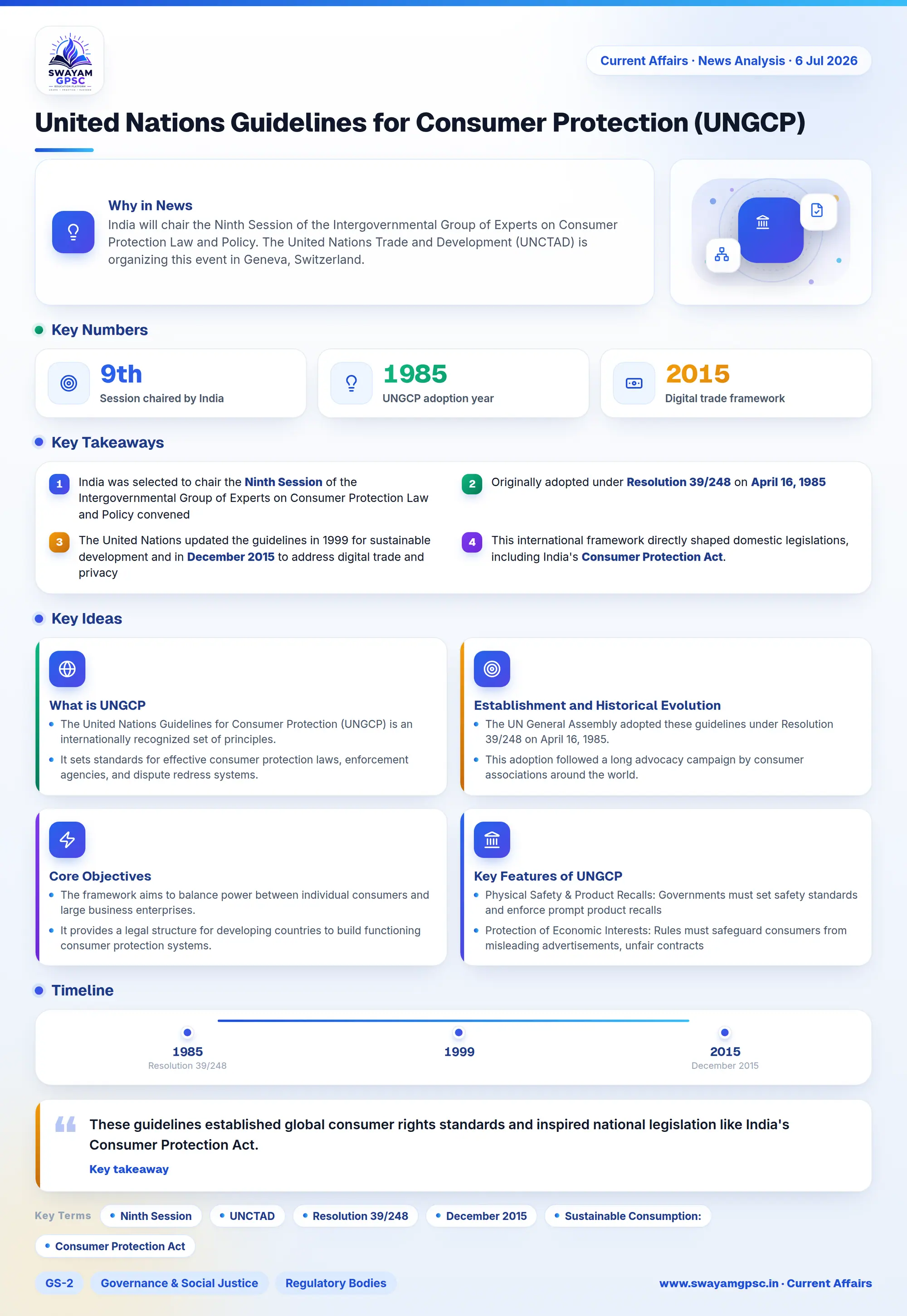
United Nations Guidelines for Consumer Protection (UNGCP)
#GS-2 #Governance & Social Justice #Regulatory Bodies #GS-3 #Economy #Current Events #International #National #Consumer Protection #UNCTAD #UNGCP
Why in News
- India will chair the **Ninth Session** of the Intergovernmental Group of Experts on Consumer Protection Law and Policy.
- The United Nations Trade and Development (**UNCTAD**) is organizing this event in **Geneva, Switzerland**.
What is UNGCP
- The **United Nations Guidelines for Consumer Protection (UNGCP)** is an internationally recognized set of principles.
- It sets standards for effective consumer protection laws, enforcement agencies, and dispute redress systems.
- While it is a non-binding soft law tool, it serves as the global model for making domestic consumer laws.
Establishment and Historical Evolution
- The UN General Assembly adopted these guidelines under **Resolution 39/248** on **April 16, 1985**.
- This adoption followed a long advocacy campaign by consumer associations around the world.
- The UN expanded the guidelines in **1999** to include sustainable development goals.
- The UN General Assembly updated the framework again in **December 2015** to cover modern digital markets.
Core Objectives
- The framework aims to balance power between individual consumers and large business enterprises.
- It provides a legal structure for developing countries to build functioning consumer protection systems.
Key Features of UNGCP
- **Physical Safety & Product Recalls:** Governments must set safety standards and enforce prompt product recalls or compensation for unsafe goods.
- **Protection of Economic Interests:** Rules must safeguard consumers from misleading advertisements, unfair contracts, fraudulent services, high-interest lending, and food adulteration.
- **Information & Consumer Education:** Products must carry clear safety labels and hazard warnings to help consumers make informed choices.
- **Digital & E-Commerce Provisions:** Updated rules in **2015** address online privacy, secure payments, digital dispute resolution, and cross-border shopping.
- **Sustainable Consumption:** The guidelines promote eco-friendly and energy-efficient goods to support long-term environmental sustainability.
Significance
- These guidelines established global consumer rights standards and inspired national legislation like India's **Consumer Protection Act**.
- They offer a shared framework to combat online fraud, protect digital shoppers, and resolve international e-commerce disputes.