A Unified Policy Architecture for India's Energy Future
#GS-3 #Economy #Infrastructure #Energy #Science & Technology #Environment #Climate Change #Sustainable Development
Why in News
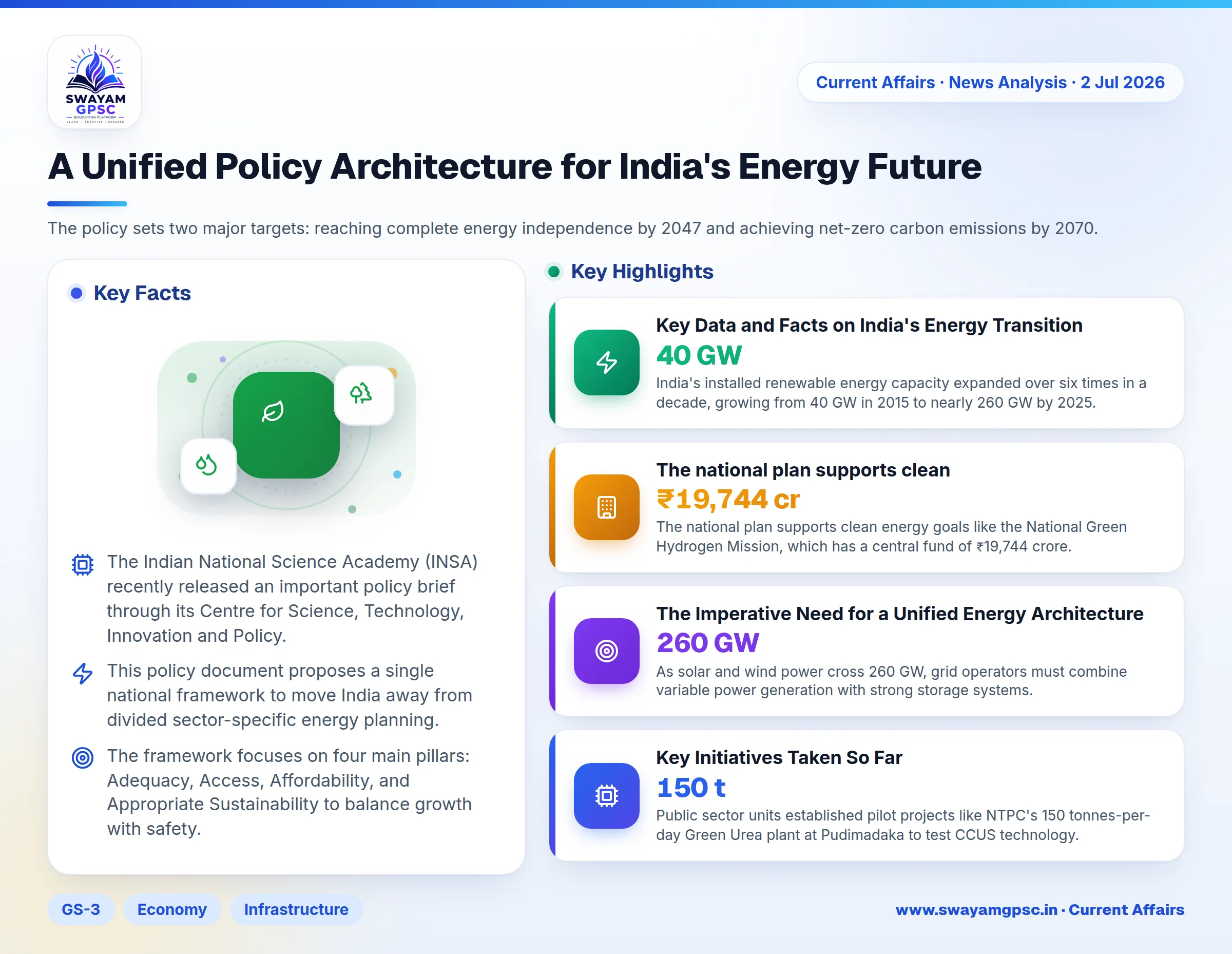
- The Indian National Science Academy (INSA) recently released an important policy brief through its Centre for Science, Technology, Innovation and Policy.
- This policy document proposes a single national framework to move India away from divided sector-specific energy planning.
- The framework focuses on four main pillars: Adequacy, Access, Affordability, and Appropriate Sustainability to balance growth with safety.
Key Data and Facts on India's Energy Transition
- India's installed renewable energy capacity expanded over six times in a decade, growing from 40 GW in 2015 to nearly 260 GW by 2025.
- The policy sets two major targets: reaching complete energy independence by 2047 and achieving net-zero carbon emissions by 2070.
- The national plan supports clean energy goals like the National Green Hydrogen Mission, which has a central fund of ₹19,744 crore.
The Imperative Need for a Unified Energy Architecture
- India's energy governance remains split across different ministries. This makes long-term policy planning difficult.
- Rapid industrial growth and urbanization require a coordinated power grid to prevent localized electricity shortages.
- India relies heavily on foreign crude oil and natural gas imports. This exposes the domestic economy to international price shocks.
- As solar and wind power cross 260 GW, grid operators must combine variable power generation with strong storage systems.
- The nation needs regional transition strategies rather than a rigid approach. This protects fossil-fuel workers while building clean energy options.
Key Initiatives Taken So Far
- The government implemented the Saubhagya Scheme to provide electricity connections to nearly all households across the country.
- The Pradhan Mantri Ujjwala Yojana provided clean LPG cooking gas to millions of poor families to reduce indoor air pollution.
- India launched the National Green Hydrogen Mission to make the country a leading producer and exporter of green hydrogen.
- Public sector units established pilot projects like NTPC's 150 tonnes-per-day Green Urea plant at Pudimadaka to test CCUS technology.
Challenges
- Upgrading existing coal plants and power supply distribution lines to handle renewable energy demands heavy financial investment.
- Connecting large battery storage systems and hydro power to supply electricity when solar power is offline remains technically difficult.
- Creating uniform power sector rules requires close alignment between the central government and financially weak state electricity boards.
- Building specialized pipelines to transport captured carbon dioxide or hydrogen gas requires very high upfront spending.
- Producing new clean fuels like green hydrogen currently costs much more than using traditional fossil fuels.
Way Forward
- India should follow a step-by-step decade plan that strengthens grid networks first before moving into deep industrial expansion.
- Heavy industries like steel and cement should connect directly to Carbon Capture, Utilization, and Storage (CCUS) systems.
- The country must combine battery units, small hydro projects, and pumped storage to ensure round-the-clock power supply.
- The government should build public-private partnerships with international leaders to make solar equipment and electrolyzers locally.
- Transition funds and retraining programs must support workers in fossil-fuel sectors to make the transition fair for everyone.
Conclusion
- The INSA report highlights that India must view its power supply grid as one unified system rather than separate energy markets.
- By grounding energy goals in adequacy, access, affordability, and sustainability, India can reduce carbon emissions safely while maintaining economic growth.