UNICEF's Children's Climate Risk Report 2026
#GS-2 #GS-3 #Environment #Climate Change #Governance & Social Justice #Health #Poverty
Key takeaways
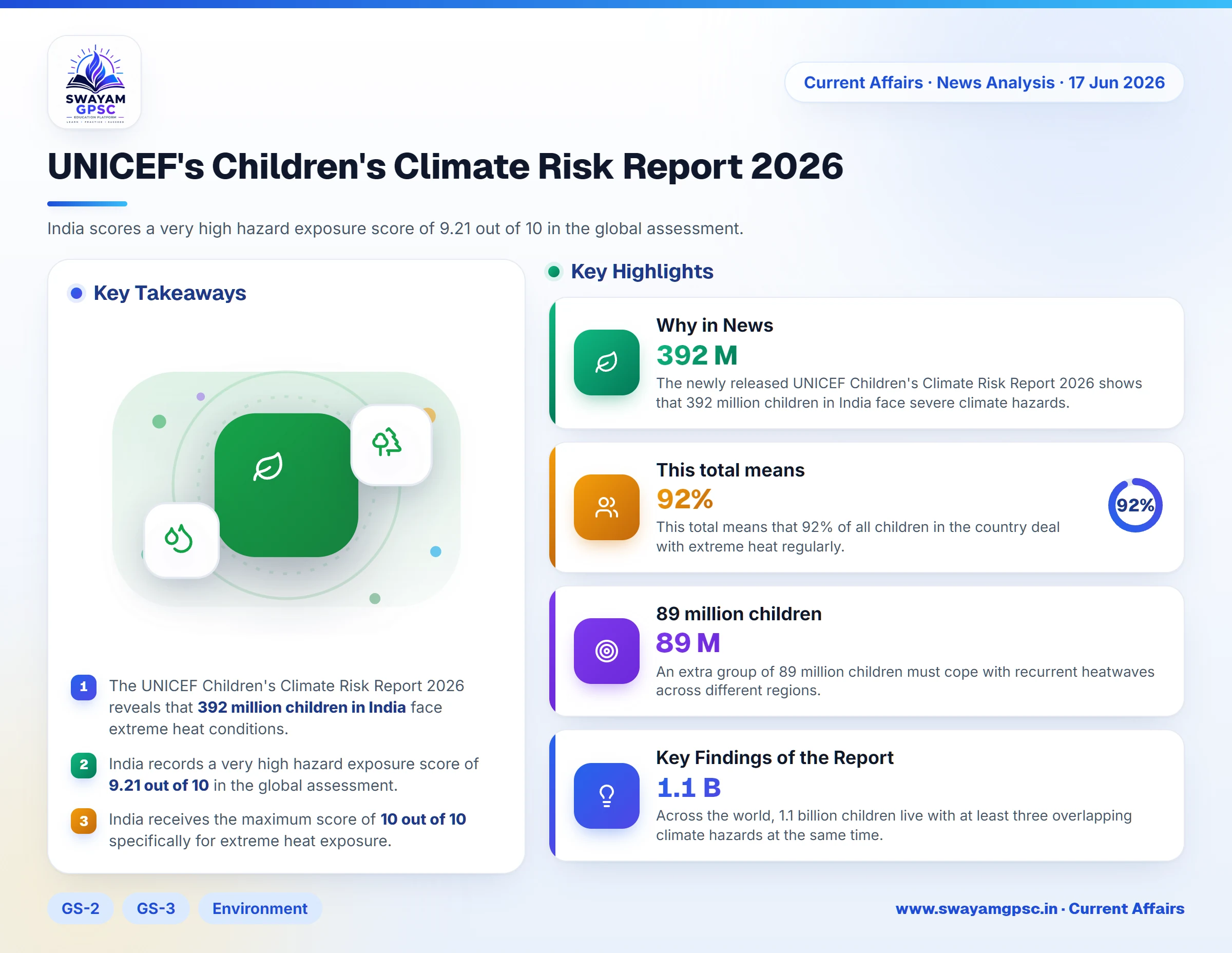
- The UNICEF Children's Climate Risk Report 2026 reveals that 392 million children in India face extreme heat conditions.
- India records a very high hazard exposure score of 9.21 out of 10 in the global assessment.
- India receives the maximum score of 10 out of 10 specifically for extreme heat exposure.
- The report gives India an air pollution exposure score of 9.94 out of 10.
- Globally, 1.1 billion children are exposed to at least three overlapping climate hazards at the same time.
Why in News
- The newly released UNICEF Children's Climate Risk Report 2026 shows that 392 million children in India face severe climate hazards.
- This total means that 92% of all children in the country deal with extreme heat regularly.
- An extra group of 89 million children must cope with recurrent heatwaves across different regions.
About the Report
- The UNICEF Children's Climate Risk Report 2026 is a global study that checks how vulnerable children are to environmental dangers.
- It looks at how overlapping climate problems like extreme heat, droughts, floods, storms, and dirty air harm children.
- The report tracks direct impacts on kids by studying their health, education, daily nutrition, and overall survival rates.
Key Findings of the Report
- India scores a very high hazard exposure score of 9.21 out of 10 in the global assessment.
- Only Pakistan at 9.44 and Bangladesh at 9.38 score higher than India in the South Asian region.
- India gets the highest possible score of 10 out of 10 specifically for extreme heat exposure.
- Global climate change is making heatwaves happen more often, last longer, and grow much more intense.
- India's exposure score for air pollution stands at a dangerous 9.94 out of 10.
- Bad air quality continues to threaten the normal health and physical development of young children.
- The report gives India a drought risk score of 8.84 out of 10 due to rising water shortages.
- Water scarcity creates serious risks for daily nutrition, family livelihoods, and overall child welfare.
- Across the world, 1.1 billion children live with at least three overlapping climate hazards at the same time.
- Many children in India face a dangerous mix of extreme heat, dry droughts, and heavy air pollution.
- Current Heat Action Plans in India mostly ignore children and lack proper safety rules for them.
- Existing plans fail to include special safeguards for schools and Anganwadis.
- Action plans also miss rules for managing night-time heat and mapping child vulnerability properly.
- Most policies lack age-specific adaptation steps to protect young bodies from climate stress.
Implications
- Rising heat stress, air pollution, and climate disasters directly increase diseases and malnutrition among children.
- Extreme heat and climate shocks reduce school attendance and lower the learning capacity of students.
- Future climate policies must include child-specific measures like resilient schools and stronger public healthcare systems.