UNFPA State of World Population Report 2026 Analysis
#GS-2 #Governance & Social Justice #Health #Current Events #International #National #Demographics #Youth Development #UNFPA
Key takeaways
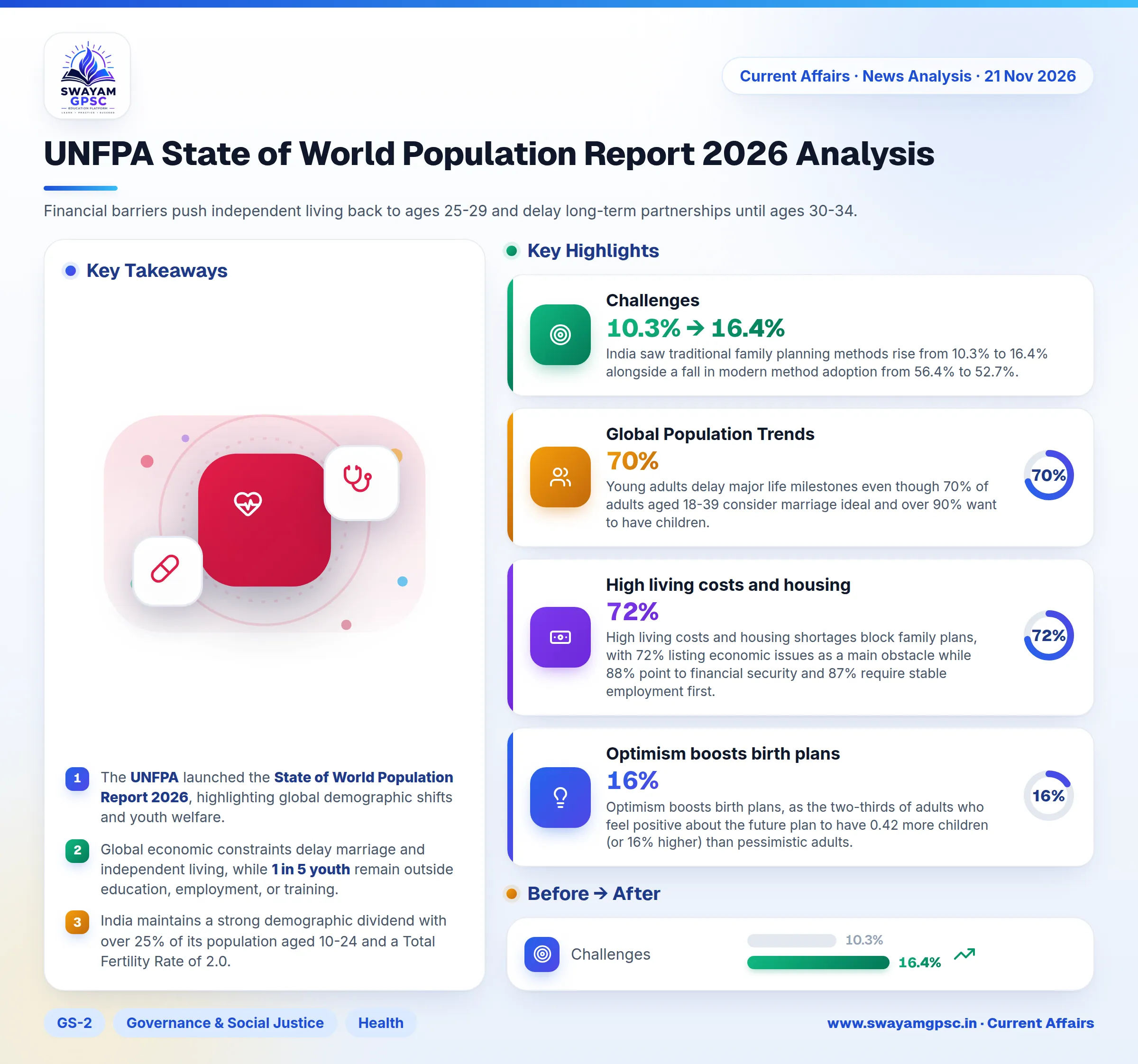
- The UNFPA launched the State of World Population Report 2026, highlighting global demographic shifts and youth welfare.
- Global economic constraints delay marriage and independent living, while 1 in 5 youth remain outside education, employment, or training.
- India maintains a strong demographic dividend with over 25% of its population aged 10-24 and a Total Fertility Rate of 2.0.
- India improved its Maternal Mortality Ratio to 87 per 100,000 live births (SRS 2022-24), though traditional contraceptive use rose to 16.4%.
- Only 2.8% of global parliamentary seats are held by adults aged 18-30, showing severe youth political underrepresentation.
Why in News
- The United Nations Population Fund (UNFPA) released its annual flagship report titled State of World Population (SOWP) 2026 in New Delhi.
- The 2026 edition is titled Succeeding Generations: Empowering young people to chart the future.
About the Report
- This annual publication by UNFPA tracks international demographic changes, human rights trends, and reproductive health developments across the globe.
- The 2026 report assesses the life aspirations, relationship goals, and parenthood plans of young people using data from the Demographic Futures Survey alongside consultations with over 300 youth leaders across more than 40 countries.
Global Population Trends
- Young adults delay major life milestones even though 70% of adults aged 18-39 consider marriage ideal and over 90% want to have children.
- Financial barriers push independent living back to ages 25-29 and delay long-term partnerships until ages 30-34.
- High living costs and housing shortages block family plans, with 72% listing economic issues as a main obstacle while 88% point to financial security and 87% require stable employment first.
- Optimism boosts birth plans, as the two-thirds of adults who feel positive about the future plan to have 0.42 more children (or 16% higher) than pessimistic adults.
- Youth exclusion remains high, with 1 in 5 youth globally classified as Not in Employment, Education, or Training (NEET).
- The NEET rate jumps to 27% for young women compared to 13% for young men, and reaches 49% among youth living with disabilities.
- Young adults aged 18-30 make up 19% of the global population but occupy only 2.8% of parliamentary seats, leaving 76% of youth under 30 feeling ignored by politicians.
- Mental health issues cause 19% of the global adolescent disease burden, while youth aged 10-24 living within 50 km of active conflicts more than doubled to 340 million.
- Official Development Assistance from DAC nations dropped by a record 23% in 2025 down to $174.3 billion, threatening key youth programs where 90% of adolescents live.
India Population Trends
- India is experiencing a key demographic dividend window because more than 1 in 4 Indians are aged 10-24.
- The national Total Fertility Rate stands at 2.0 births per woman, but large regional variations persist, ranging from 1.0 in Sikkim to 2.7 in Bihar.
- Future optimism remains strong, with 83% of Indian respondents feeling positive despite 47% expressing worries over economic insecurity, social inequality, and global conflicts.
- Indian women aged 18-39 desire an average of 2.1 children, but women aged 35-39 currently average only 1.0 child.
- Nearly 85% of childless Indian respondents aged 35-39 report that they still wish to have children.
- India's Maternal Mortality Ratio fell to 87 per 100,000 live births according to SRS 2022-24 data.
- Skilled birth attendance reached 91.3% across the country, while the Universal Health Coverage service coverage index improved to 69/100.
- Unmet family planning needs dropped to 8.5% nationwide, ranging from 4.4% in Andhra Pradesh to 21.0% in Meghalaya.
- Traditional contraceptive use rose to 16.4% while modern method usage dropped to 52.7%.
- The digital divide persists among women, as 64% of Indian women overall own a mobile phone, representing 77.6% in urban areas compared to 57.4% in rural regions.
Challenges
- Higher education degrees no longer secure stable employment, leaving many young people trapped in informal jobs or gig work vulnerable to AI disruptions without social safety nets.
- In places like the Philippines, gig workers lose immediate income during major typhoons without receiving sick pay or insurance support.
- Unregulated digital platforms and generative AI tools increase digital harassment, deepfakes, and misogynistic abuse while families restrict women's internet access out of social fear.
- In India, 22.3% of women experienced intimate partner violence over the past year, while young women face regular online monitoring due to social reputational concerns.
- Around 44% of partnered women across 78 countries lack full bodily autonomy, while inadequate healthcare counseling drives individuals toward less reliable birth control options.
- India saw traditional family planning methods rise from 10.3% to 16.4% alongside a fall in modern method adoption from 56.4% to 52.7%.
- Older politicians control decision-making bodies, creating policies that pass long-term economic and environmental costs onto future generations.
- Globally, 68% of parliamentarians are over age 45, and 77% of young politicians report being used for publicity while remaining excluded from core political decisions.
Way Forward
- Governments should mandate paid apprenticeships, teach green economy and AI skills, and extend formal legal rights and social security to gig workers.
- Health systems must integrate mental health care, menstrual hygiene, comprehensive education, and non-judgmental reproductive services into primary healthcare under Universal Health Coverage.
- India should expand access to modern contraceptives like DMPA-SC and single-rod implants within its public health systems.
- Institutions must set binding youth parliamentary quotas, introduce participatory budgeting, require generational fairness reviews, and reserve at least 20% of COP climate delegation spots for young people.
- Authorities must enforce strict platform accountability for online abuse, restrict non-consensual data collection, support local fact-checking, and encourage men to participate positively in caregiving and digital spaces.
- International donors need to reverse cuts to adolescent aid programs and provide direct, multi-year funding to youth-led organizations with a focus on young women and persons with disabilities.