UNESCO's GEM Report 2026: Trends and Gender Disparities in India
#GS-2 #Governance & Social Justice #Education #GS-1 #Indian Society #Women #Global Education Monitoring Report #UNESCO #SDG 4
Key takeaways
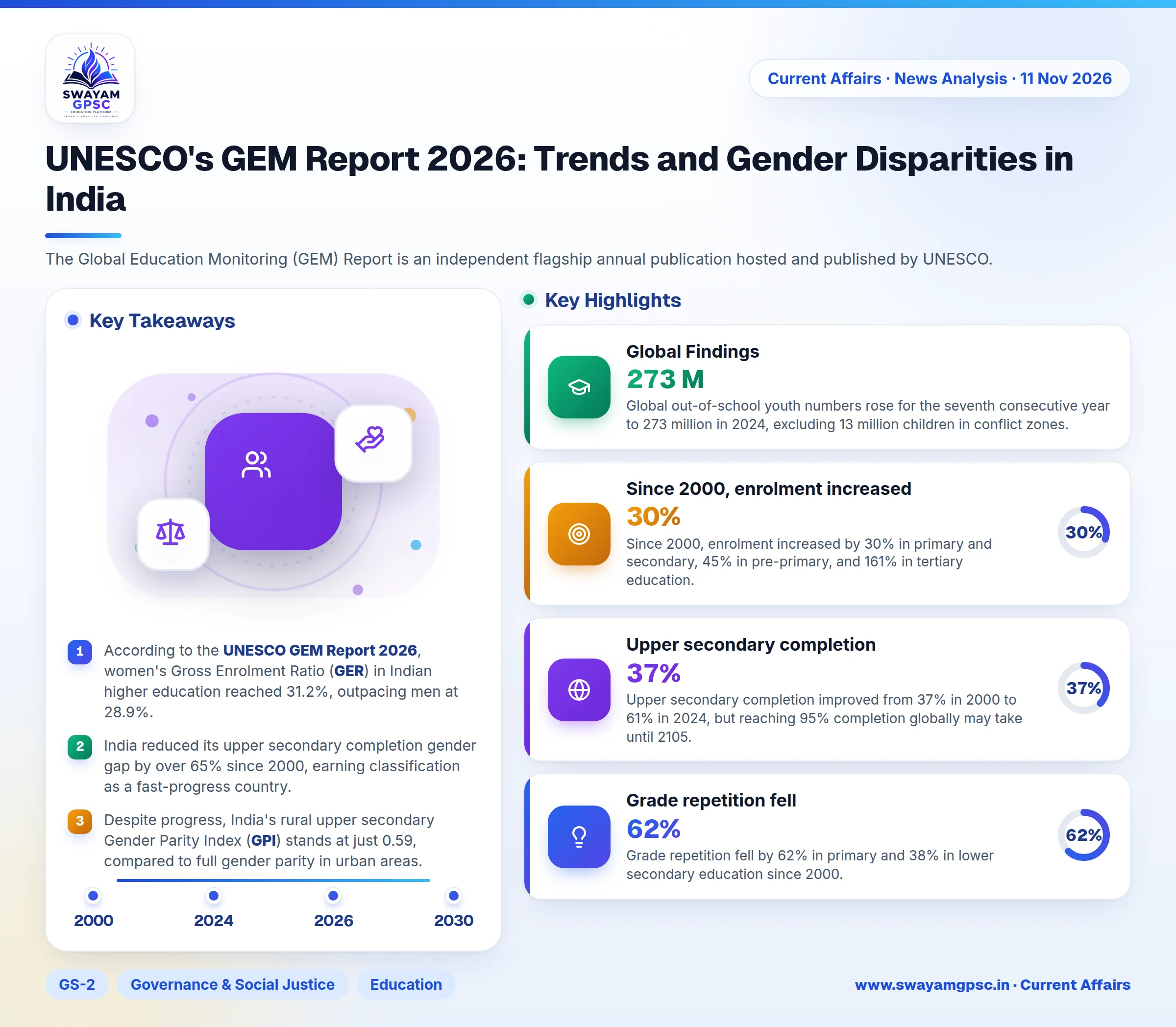
- According to the UNESCO GEM Report 2026, women's Gross Enrolment Ratio (GER) in Indian higher education reached 31.2%, outpacing men at 28.9%.
- India reduced its upper secondary completion gender gap by over 65% since 2000, earning classification as a fast-progress country.
- Despite progress, India's rural upper secondary Gender Parity Index (GPI) stands at just 0.59, compared to full gender parity in urban areas.
- Global out-of-school youth rose for the seventh straight year to 273 million in 2024, excluding 13 million children in conflict zones.
Why in News
- UNESCO released the Global Education Monitoring (GEM) Report 2026, highlighting key trends in Indian and global education.
- The report shows that Indian women now outpace men in higher education enrolment across the country.
- However, a sharp rural-urban divide continues to disadvantage rural girls at the school-completion stage.
About the GEM Report 2026
- The Global Education Monitoring (GEM) Report is an independent flagship annual publication hosted and published by UNESCO.
- It operates under the mandate of the Education 2030 Incheon Declaration and Framework for Action to monitor global progress on Sustainable Development Goal 4 (SDG 4).
Global Findings
- Global out-of-school youth numbers rose for the seventh consecutive year to 273 million in 2024, excluding 13 million children in conflict zones.
- Since 2000, enrolment increased by 30% in primary and secondary, 45% in pre-primary, and 161% in tertiary education.
- Upper secondary completion improved from 37% in 2000 to 61% in 2024, but reaching 95% completion globally may take until 2105.
- Grade repetition fell by 62% in primary and 38% in lower secondary education since 2000.
- Fewer than 10% of countries have strongly equity-oriented education financing systems to support needy students.
- While 75% of five-year-olds attend school, 27% enter primary prematurely, and only 60% complete one full year of preschool.
Key Findings on India
- India's upper secondary Gender Parity Index (GPI) stands at 0.89 nationally, dropping to 0.59 in rural areas despite parity in urban regions.
- UNESCO classifies India as a fast-progress country after it reduced its initial upper secondary completion gender gap by at least 65% since 2000.
- Women outpace men in higher education with a Gross Enrolment Ratio (GER) of 31.2% compared to 28.9% for men, maintaining female dominance for 7 consecutive years.
- Female higher education enrolment grew by 42.2%, rising from 1.57 crore in 2014-15 to 2.24 crore in 2023-24.
- Secondary school dropout rates fell to 7%, school retention reached 51.9%, and girls accounted for 48.4% of total school enrolment.
Positive Interventions Highlighted
- Free school meal programs delivered strong gains for female schooling, showing nearly double the positive impact on primary enrolment for girls compared to boys in poor rural areas.
- Targeted Water, Sanitation, and Hygiene (WASH) infrastructure projects reduced dropouts, as gender-segregated school toilets in rural areas boosted adolescent girls' retention.
- Community mentorship programs helped transitions, as local girls' clubs offering peer support and life-skills training lifted secondary completion rates in Karnataka.
- Coordinated national campaigns bridged historical gaps, helping India close over 65% of its baseline gender gap in upper secondary completion over two decades.
Challenges
- Rural adolescent girls face severe obstacles like long school commutes, safety concerns, and domestic chores, leaving a completion ratio of only 59 rural girls per 100 boys.
- Overage enrolments and progression delays widen the gap between timely and late graduation across lower-income regions.
- Education budgets fail to channel sufficient funding to needy populations, with equity grants accounting for under 0.5% of total education budgets in half the countries using them.
- National monitoring systems lack detailed data, as 1 in 3 countries fails to report education disparities by location and 1 in 2 omits wealth disaggregation.
Way Forward
- Governments must integrate realistic national benchmarks into public budgets and domestic planning cycles rather than relying on symbolic global pledges.
- Policy packages should combine long-term infrastructure, social protection, and institutional reform instead of relying on isolated short-term interventions.
- Public education financing must be reoriented to prioritize disadvantaged regions, rural schools, and marginalized households through direct targeted grants.
- Monitoring systems must shift from gross enrolment ratios to completion metrics while integrating survey data with administrative records to track vulnerable groups.
Conclusion
- India has made strong progress in women's higher education, but the rural-urban gap still hinders secondary completion for rural girls.
- Achieving long-term gains requires equitable public funding, improved rural secondary infrastructure, and targeted local policies.