UNEP Adaptation Gap Report 2026: Finance Deficit and Key Findings
#GS-2 #Governance & Social Justice #Current Events #International #GS-3 #Environment #Climate Change #Groupings & Agreements Involving India and/or Affecting India's Interests #International Treaties & Agreements #Environmental Pollution & Degradation
Key takeaways
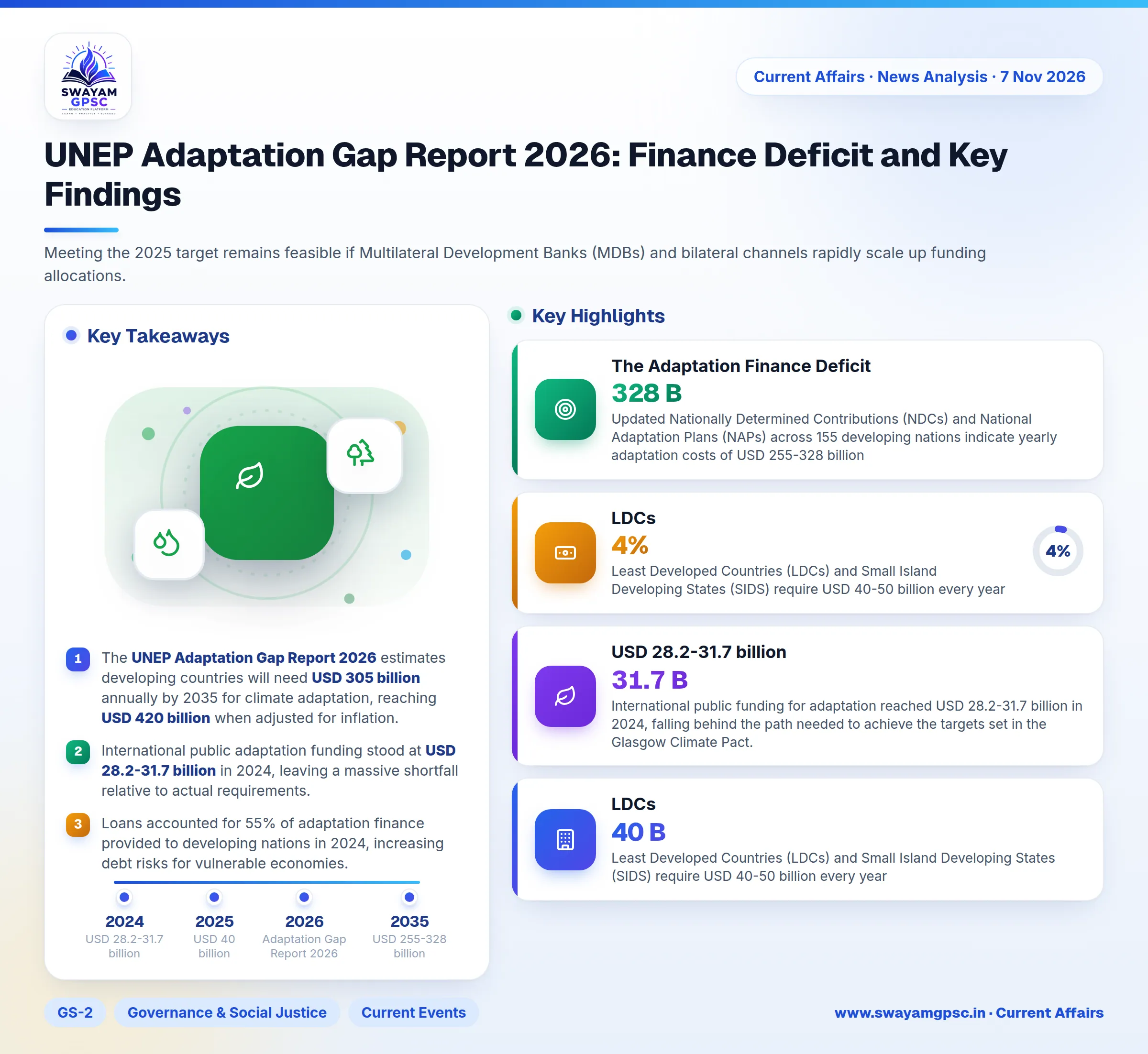
- The UNEP Adaptation Gap Report 2026 estimates developing countries will need USD 305 billion annually by 2035 for climate adaptation, reaching USD 420 billion when adjusted for inflation.
- International public adaptation funding stood at USD 28.2-31.7 billion in 2024, leaving a massive shortfall relative to actual requirements.
- Loans accounted for 55% of adaptation finance provided to developing nations in 2024, increasing debt risks for vulnerable economies.
- The Fund for Responding to Loss and Damage (FRLD) received USD 2.8 billion in requests from 119 countries, far exceeding its initial USD 342 million capacity.
- India continues to demand grant-based climate funding under the CBDR-RC framework while insisting that Global Goal on Adaptation (GGA) indicators remain non-prescriptive.
Why in News
- The United Nations Environment Programme (UNEP) recently published the Adaptation Gap Report 2026, titled "Ready? Not. Climate impacts will not wait. Adaptation finance must rise."
- The publication highlights that global adaptation funding falls well short of actual requirements, institutional bottlenecks limit project execution, and climate-induced damages continue to mount.
Summary
- The report underlines an expanding mismatch between developing nations' adaptation costs and available international funding, leading to growing debt burdens.
- It calls for grant-based climate funding, robust financial backing for the Loss and Damage Fund, and adherence to climate justice through CBDR-RC principles.
The Adaptation Finance Deficit
- Updated Nationally Determined Contributions (NDCs) and National Adaptation Plans (NAPs) across 155 developing nations indicate yearly adaptation costs of USD 255-328 billion, rising to USD 305 billion annually by 2035.
- Least Developed Countries (LDCs) and Small Island Developing States (SIDS) require USD 40-50 billion every year, which amounts to 3-4% of their GDP and double the relative burden of upper-middle-income nations.
- International public funding for adaptation reached USD 28.2-31.7 billion in 2024, falling behind the path needed to achieve the targets set in the Glasgow Climate Pact.
- The Glasgow Climate Pact (COP26, 2021) urged developed countries to double their adaptation support from 2019 levels by 2025, targeting approximately USD 40 billion.
- Meeting the 2025 target remains feasible if Multilateral Development Banks (MDBs) and bilateral channels rapidly scale up funding allocations.
- Although 80-90% of funding for LDCs and SIDS consists of concessional terms, 55% of all adaptation money provided to developing countries in 2024 came as loans.
- Roughly half of all adaptation loans are non-concessional, supplied primarily by MDBs to middle-income nations.
- The COP30 proposal to triple adaptation funding by 2035 would yield USD 85-120 billion per year.
- After accounting for inflation, adaptation needs in 2035 will reach USD 420 billion, meaning a tripling strategy covers only 20-29% of needs and leaves a shortfall of USD 300-335 billion.
- Financial transfers between developing countries are expanding quickly, rising from USD 3.8 billion in 2019 to USD 9.6 billion in 2024.
- Private capital mobilized through public adaptation finance doubled from USD 1.5 billion in 2019 to USD 3 billion in 2024.
- Private funding can only bridge 15-20% of the public adaptation gap, meaning direct public support remains indispensable.
- Successful adaptation depends on eight institutional factors, including solid legal frameworks, explicit mandates, intergovernmental coordination, community engagement, accountability, knowledge sharing, and finance mobilization.
Loss and Damage Insights
- Between 2020 and 2025, 99% of the 765 million people affected by floods and landslides resided in low- and middle-income nations.
- Among 118 surveyed countries, 89% address Loss and Damage in their NDCs or NAPs, 54% maintain tracking systems, and 38% possess relevant legal frameworks.
- Only 27% of the nearly 240,000 recorded extreme-heat deaths between 2020 and 2025 were reported in lower-income countries, pointing to underreporting and data gaps.
- Deficient data tracking conceals major non-economic damages, such as losses in cultural heritage, mental health, and local biodiversity.
- Demands from 119 developing countries reaching USD 2.8 billion overwhelmed the initial USD 342 million allocation of the Fund for Responding to Loss and Damage (FRLD).
Understanding Climate Adaptation
- Climate adaptation involves adjusting ecological, social, or economic systems to lessen harm or take advantage of climate-related opportunities.
- It includes altering operational practices and infrastructure to moderate climate hazards.
- The Global Goal on Adaptation (GGA) under Article 7.1 of the Paris Agreement commits nations to enhance adaptive capacity and reduce economic vulnerability.
- The Least Developed Countries Expert Group (LEG), formed in 2001, gives technical and financial advice to vulnerable nations for creating NAPs.
- The Adaptation Committee (AC), set up in 2010, acts as the primary advisory body ensuring coherent global implementation of the Paris Agreement.
- The Nairobi Work Programme (NWP) operates the Adaptation Knowledge Portal, which serves as a central hub for sharing climate risk data and resilience solutions.
- India bases its climate policy on Common But Differentiated Responsibilities and Respective Capabilities (CBDR-RC), demanding predictable, public, and concessional support from developed countries.
- India insists that performance metrics under the GGA must remain voluntary and nation-driven, opposing their use as conditions for accessing climate funds.
Way Forward
- Adaptation tracking mechanisms must be integrated into the New Collective Quantified Goal (NCQG) to ensure transparent private capital deployment.
- Multilateral Development Banks (MDBs) should reform their lending practices to offer grant-based funding to the Global South, preventing debt distress.
- The Fund for Responding to Loss and Damage (FRLD) requires recapitalization and streamlined access rules to support vulnerable nations quickly.
- Countries need dedicated national Loss and Damage Information Systems to track cascading risks and measure non-economic damages like lost biodiversity.
- National policies like India's National Action Plan on Climate Change (NAPCC) must align with State Action Plans on Climate Change (SAPCCs) to shield coastal and farming communities.
- Governments must resolve institutional deficits by improving legal mandates, inter-agency coordination, and independent monitoring systems.
Conclusion
- Handling climate impacts requires predictable grant funding, stronger commitments under the NCQG, and full capitalization of the FRLD.
- Upholding climate justice and CBDR-RC principles remains essential for building long-term resilience across developing countries.