Understanding Why Women's Workforce Participation Remains Low
#GS-3 #Economy #Employment #GS-2 #Governance & Social Justice #Women #Growth & Development #Human Resource
Key takeaways
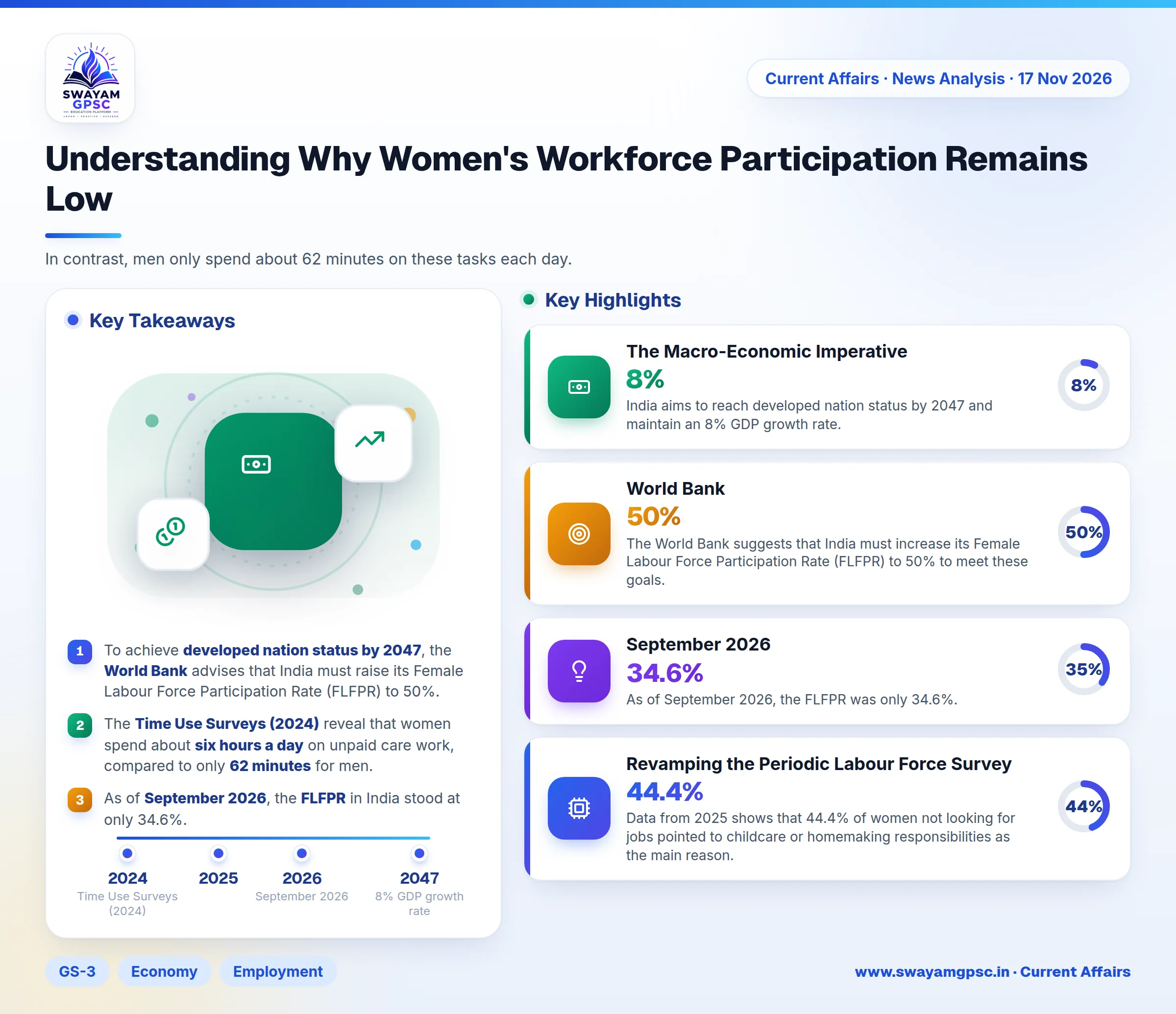
- To achieve developed nation status by 2047, the World Bank advises that India must raise its Female Labour Force Participation Rate (FLFPR) to 50%.
- The Time Use Surveys (2024) reveal that women spend about six hours a day on unpaid care work, compared to only 62 minutes for men.
- As of September 2026, the FLFPR in India stood at only 34.6%.
- The Tamil Nadu model has successfully employed 40% of India's female factory workers by providing industrial dormitories to overcome mobility barriers.
Why in News
- The Ministry of Statistics and Programme Implementation (MoSPI) is updating its main employment surveys to better understand the challenges women face in finding jobs.
- The new focus specifically aims to measure how much time women spend on unpaid domestic work and caregiving.
The Macro-Economic Imperative
- India aims to reach developed nation status by 2047 and maintain an 8% GDP growth rate.
- The World Bank suggests that India must increase its Female Labour Force Participation Rate (FLFPR) to 50% to meet these goals.
- As of September 2026, the FLFPR was only 34.6%.
The Time Poverty Gender Gap
- According to the Time Use Surveys (2024), women between working ages spend nearly six hours a day on unpaid housework and caring for others.
- In contrast, men only spend about 62 minutes on these tasks each day.
- This difference creates a major structural barrier that prevents many women from joining the formal workforce.
Revamping the Periodic Labour Force Survey
- MoSPI plans to add new questions to the Periodic Labour Force Survey (PLFS) regarding unpaid work and caregiving duties.
- The survey will also ask about a person's willingness to take paid jobs, how they search for work, and why they might choose not to seek employment.
- These questions will help separate household work done for personal use from work that is meant for the market.
- Data from 2025 shows that 44.4% of women not looking for jobs pointed to childcare or homemaking responsibilities as the main reason.
Changes to ASUSE
- MoSPI is also updating the Annual Survey of Unincorporated Sector Enterprises (ASUSE).
- This change will help researchers understand how limited time, restricted women’s mobility, and caregiving duties affect female business owners.
Targeted Policymaking and Future Solutions
- By combining new PLFS data with the Time Use Survey, the government wants to move away from the false idea that women simply do not want to work.
- This shift will allow for better policies focused on the Care Economy.
- Beyond just reducing care work, women need support like safe transport and fair pay to enter the workforce.
- The Tamil Nadu model serves as a great example, as it employs 40% of India's female factory workers by offering industrial dormitories to help with housing and travel.