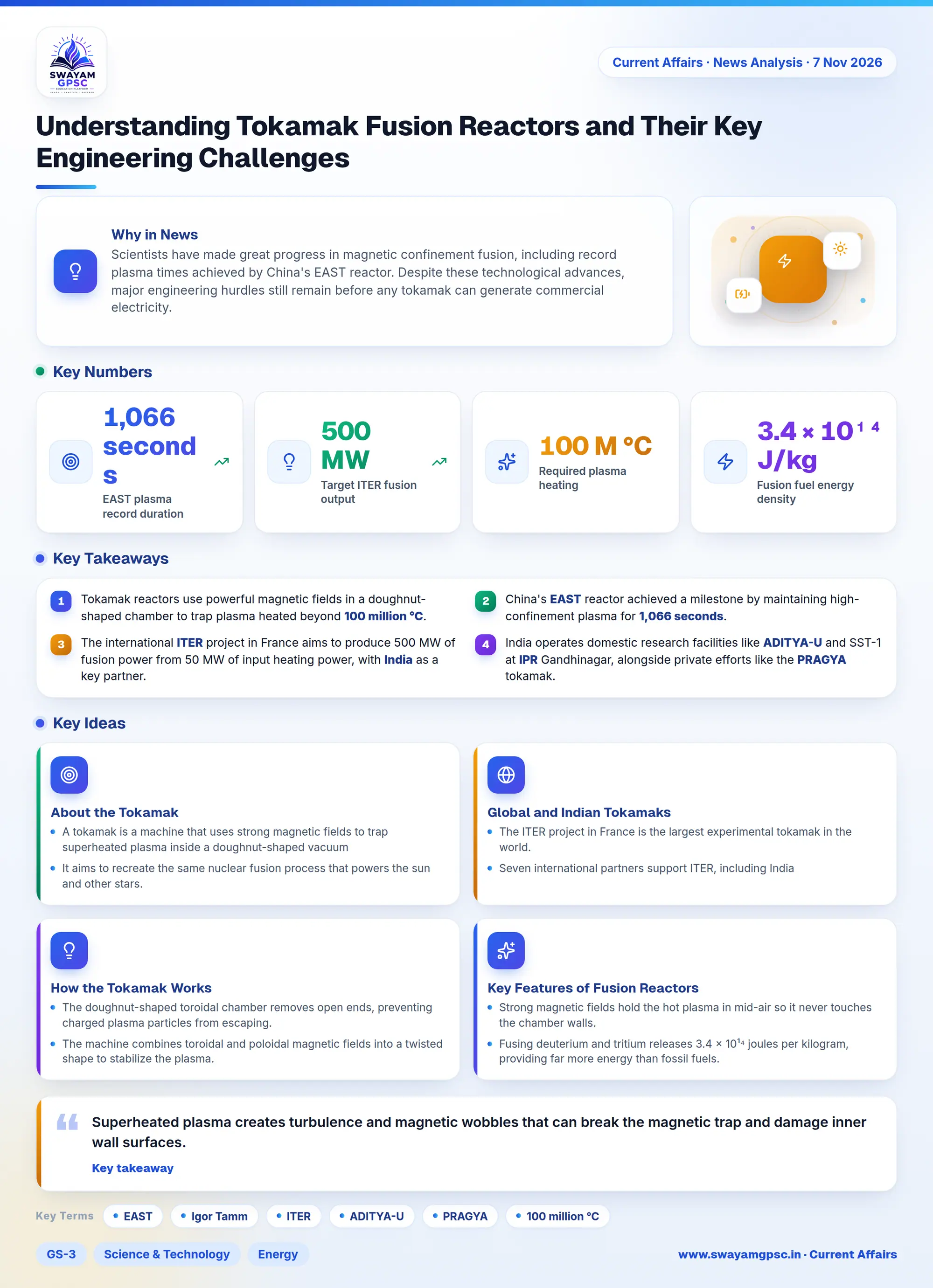
Understanding Tokamak Fusion Reactors and Their Key Engineering Challenges
#GS-3 #Science & Technology #Energy #Tokamak #Nuclear Fusion #ITER #ADITYA-U
Key takeaways
- Tokamak reactors use powerful magnetic fields in a doughnut-shaped chamber to trap plasma heated beyond 100 million °C.
- China's EAST reactor achieved a milestone by maintaining high-confinement plasma for 1,066 seconds.
- The international ITER project in France aims to produce 500 MW of fusion power from 50 MW of input heating power, with India as a key partner.
- India operates domestic research facilities like ADITYA-U and SST-1 at IPR Gandhinagar, alongside private efforts like the PRAGYA tokamak.
- Fusing deuterium and tritium yields 3.4 × 10¹⁴ joules per kilogram, but structural wall damage and plasma instabilities still prevent net commercial power generation.
Why in News
- Scientists have made great progress in magnetic confinement fusion, including record plasma times achieved by China's EAST reactor.
- Despite these technological advances, major engineering hurdles still remain before any tokamak can generate commercial electricity.
About the Tokamak
- A tokamak is a machine that uses strong magnetic fields to trap superheated plasma inside a doughnut-shaped vacuum chamber.
- It aims to recreate the same nuclear fusion process that powers the sun and other stars.
- The name Tokamak comes from a Russian phrase meaning toroidal chamber with magnetic coils.
- Soviet physicists Igor Tamm and Andrei Sakharov first came up with this concept in the early 1950s.
Global and Indian Tokamaks
- The ITER project in France is the largest experimental tokamak in the world.
- Seven international partners support ITER, including India, aiming to produce 500 MW of fusion power using 50 MW of input heat.
- China's EAST reactor in Hefei set a world record by holding high-confinement plasma for 1,066 seconds.
- In India, the Institute for Plasma Research (IPR) in Gandhinagar operates the ADITYA-U and SST-1 tokamaks.
- A Bengaluru-based private company called Pranos Fusion built PRAGYA, which is a compact research tokamak.
How the Tokamak Works
- The doughnut-shaped toroidal chamber removes open ends, preventing charged plasma particles from escaping.
- The machine combines toroidal and poloidal magnetic fields into a twisted shape to stabilize the plasma.
- Operators heat deuterium and tritium fuel past 100 million °C using electric currents, radio waves, and particle beams.
- High-energy neutrons from fusion heat a lithium blanket, which runs steam turbines to make electricity and breeds more tritium fuel.
Key Features of Fusion Reactors
- Strong magnetic fields hold the hot plasma in mid-air so it never touches the chamber walls.
- Fusing deuterium and tritium releases 3.4 × 10¹⁴ joules per kilogram, providing far more energy than fossil fuels.
- Lithium blankets absorb outgoing neutrons to make new tritium, helping the reactor generate its own future fuel.
- The system holds very little fuel at any moment, so any operational failure quickly stops the reaction without risk of an explosion.
Challenges and Limitations
- Superheated plasma creates turbulence and magnetic wobbles that can break the magnetic trap and damage inner wall surfaces.
- Fast-moving neutrons constantly hit the reactor walls, weakening the structural materials over time.
- Running advanced cooling systems and powerful superconducting magnets costs huge amounts of energy and money.
- Because of these technical hurdles, no tokamak in the world has delivered net electricity to the power grid yet.