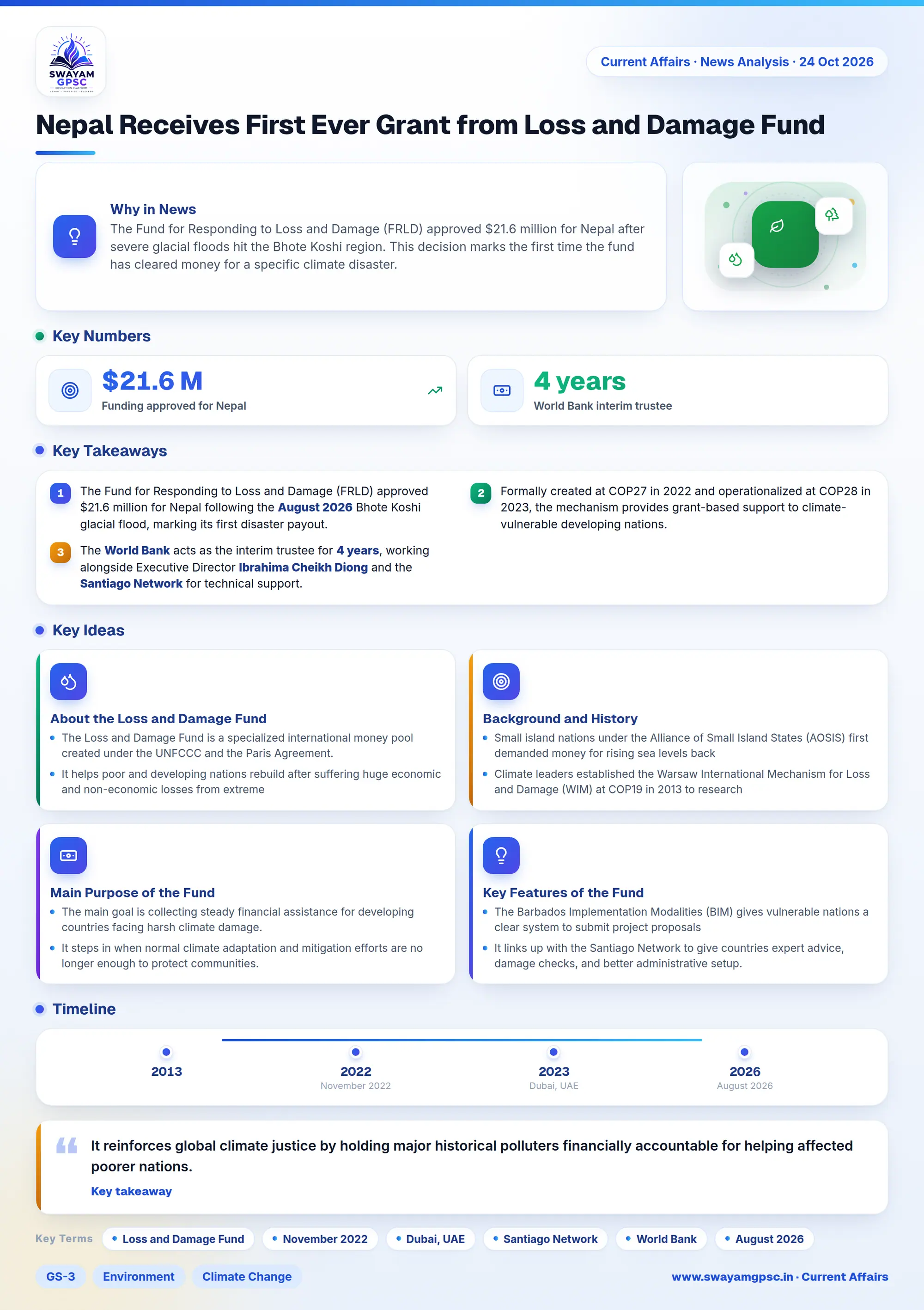
Nepal Receives First Ever Grant from Loss and Damage Fund
#GS-3 #Environment #Climate Change #UNFCCC #Loss and Damage Fund #COP27 #COP28 #International Organizations
Key takeaways
- The Fund for Responding to Loss and Damage (FRLD) approved $21.6 million for Nepal following the August 2026 Bhote Koshi glacial flood, marking its first disaster payout.
- Formally created at COP27 in 2022 and operationalized at COP28 in 2023, the mechanism provides grant-based support to climate-vulnerable developing nations.
- The World Bank acts as the interim trustee for 4 years, working alongside Executive Director Ibrahima Cheikh Diong and the Santiago Network for technical support.
Why in News
- The Fund for Responding to Loss and Damage (FRLD) approved $21.6 million for Nepal after severe glacial floods hit the Bhote Koshi region.
- This decision marks the first time the fund has cleared money for a specific climate disaster.
About the Loss and Damage Fund
- The Loss and Damage Fund is a specialized international money pool created under the UNFCCC and the Paris Agreement.
- It helps poor and developing nations rebuild after suffering huge economic and non-economic losses from extreme climate events.
- World leaders formally created this fund in November 2022 during the COP27 climate summit held in Sharm el-Sheikh, Egypt.
- Governments made it fully operational at COP28 in Dubai, UAE in 2023 by collecting initial cash promises and selecting the World Bank as temporary caretaker.
Background and History
- Small island nations under the Alliance of Small Island States (AOSIS) first demanded money for rising sea levels back in 1991.
- Climate leaders established the Warsaw International Mechanism for Loss and Damage (WIM) at COP19 in 2013 to research these climate harms.
- Delegates later set up the Santiago Network during COP25 to offer technical assistance and expertise to affected nations.
Main Purpose of the Fund
- The main goal is collecting steady financial assistance for developing countries facing harsh climate damage.
- It steps in when normal climate adaptation and mitigation efforts are no longer enough to protect communities.
Key Features of the Fund
- The Barbados Implementation Modalities (BIM) gives vulnerable nations a clear system to submit project proposals directly to the fund board.
- It links up with the Santiago Network to give countries expert advice, damage checks, and better administrative setup.
- The mechanism focuses mostly on grant-based aid so poor nations can rebuild without taking on heavy new loans.
- The World Bank will manage the cash as interim trustee for 4 years, while Executive Director Ibrahima Cheikh Diong and an independent board run daily operations.
- Because rich nations donate voluntarily, total funding can easily drop during global political changes or tight budgets.
Significance of the Fund
- It reinforces global climate justice by holding major historical polluters financially accountable for helping affected poorer nations.
- The fund fills a critical financial gap beyond basic adaptation, offering vital help against rising oceans and sudden flood disasters.