Understanding Section 69(A) of the IT Act, 2000
#GS-2 #Indian Polity & Constitution #Constitution #Governance & Social Justice #Good Governance #GS-3 #Science & Technology #ICT #Cyber Security #Current Events #National
Key takeaways
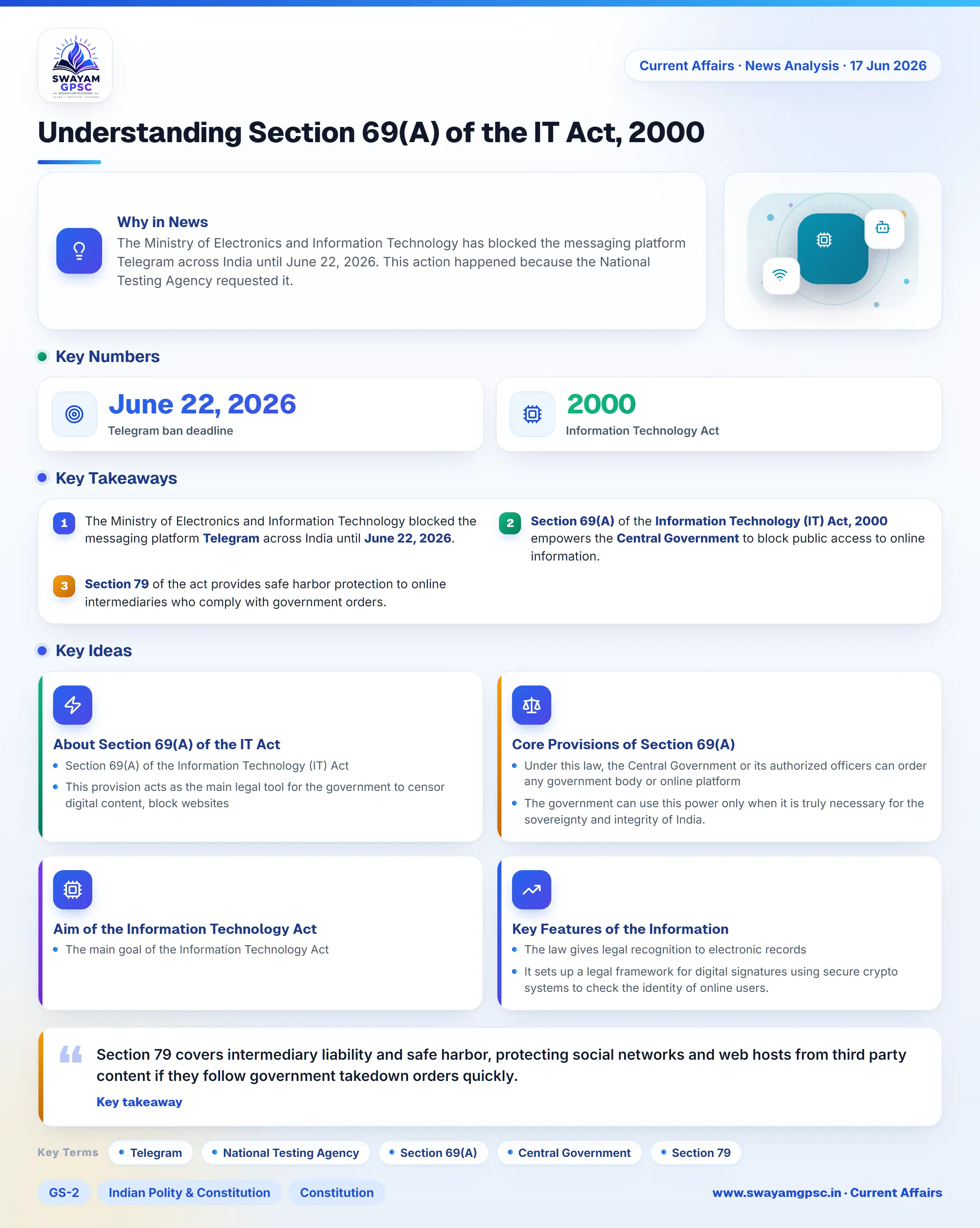
- The Ministry of Electronics and Information Technology blocked the messaging platform Telegram across India until June 22, 2026.
- Section 69(A) of the Information Technology (IT) Act, 2000 empowers the Central Government to block public access to online information.
- Section 79 of the act provides safe harbor protection to online intermediaries who comply with government orders.
Why in News
- The Ministry of Electronics and Information Technology has blocked the messaging platform Telegram across India until June 22, 2026.
- This action happened because the National Testing Agency requested it.
About Section 69(A) of the IT Act, 2000
- Section 69(A) of the Information Technology (IT) Act, 2000 is a powerful legal provision that lets the Central Government order the blocking of public access to online information.
- This provision acts as the main legal tool for the government to censor digital content, block websites, and ban apps in India.
Core Provisions of Section 69(A)
- Under this law, the Central Government or its authorized officers can order any government body or online platform to block specific content.
- The government can use this power only when it is truly necessary for the sovereignty and integrity of India.
- It also applies when protection involves the defense of India and the security of the State.
- Another ground includes maintaining friendly relations with foreign nations.
- Finally, the government can use it to protect public order or to stop people from encouraging serious crimes related to these topics.
Aim of the Information Technology Act, 2000
- The main goal of the Information Technology Act, 2000 is to give legal status to business deals done through electronic data exchange and online communication.
Key Features of the Information Technology Act, 2000
- The law gives legal recognition to electronic records, treating digital contracts and data logs the same as paper documents.
- It sets up a legal framework for digital signatures using secure crypto systems to check the identity of online users.
- Section 79 covers intermediary liability and safe harbor, protecting social networks and web hosts from third party content if they follow government takedown orders quickly.
- The law sets up a strict system of penalties for cyber crimes like hacking, identity theft, and digital fraud.
- It creates cyber appellate infrastructure, including adjudicating officers and tribunals, to resolve tech-related disputes and data breaches.