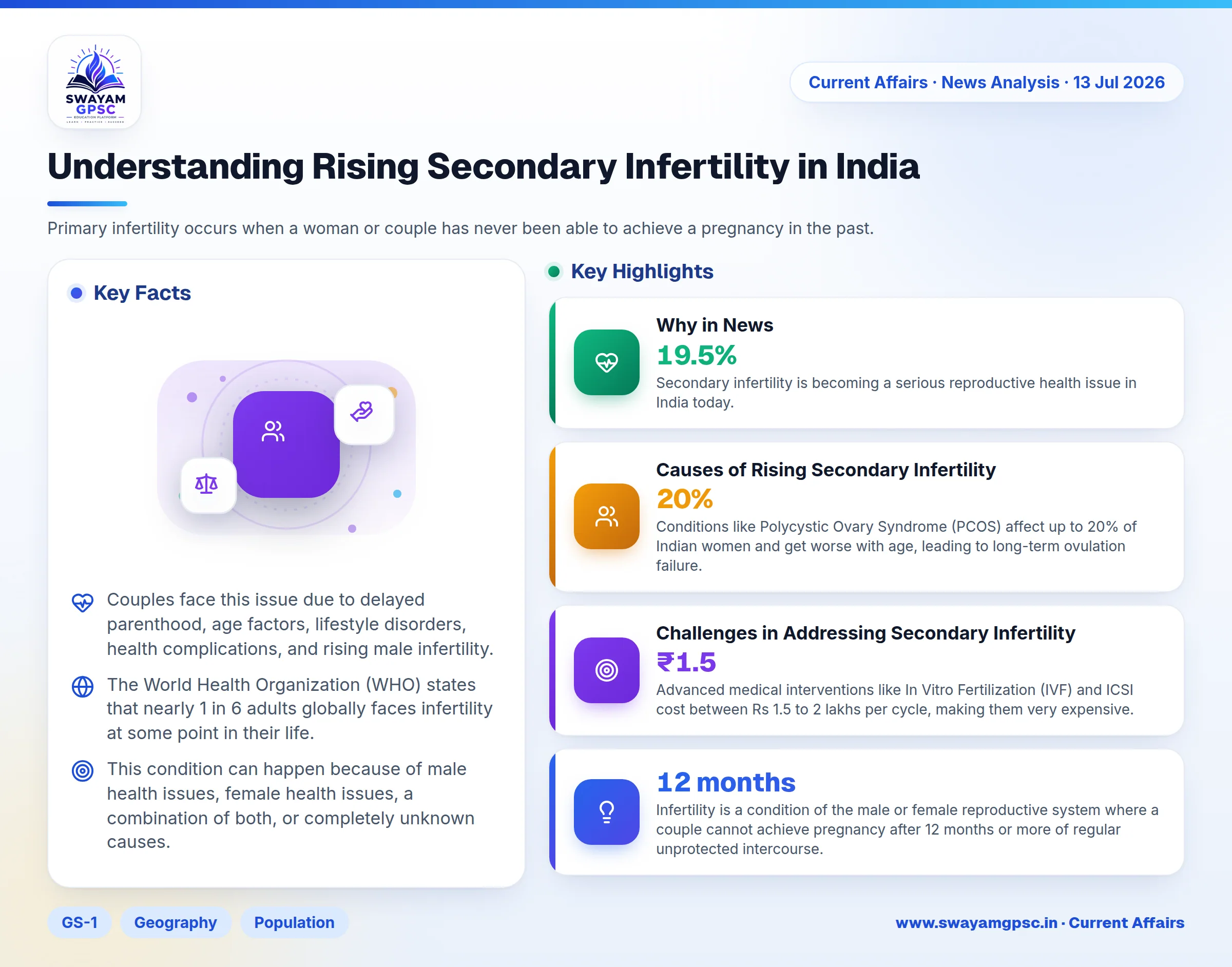
Understanding Rising Secondary Infertility in India
#GS-1 #Geography #Population #GS-2 #Governance & Social Justice #Health #Indian Society #Women #GS-3 #Current Events #National
Why in News
- Secondary infertility is becoming a serious reproductive health issue in India today. Data from the National Family Health Survey (NFHS) shows its prevalence grew from 19.5% in the early 1990s to 28.6% in 2015-16.
- Couples face this issue due to delayed parenthood, age factors, lifestyle disorders, health complications, and rising male infertility.
What is Infertility
- Infertility is a condition of the male or female reproductive system where a couple cannot achieve pregnancy after 12 months or more of regular unprotected intercourse.
- The World Health Organization (WHO) states that nearly 1 in 6 adults globally faces infertility at some point in their life.
- This condition can happen because of male health issues, female health issues, a combination of both, or completely unknown causes.
- Primary infertility occurs when a woman or couple has never been able to achieve a pregnancy in the past.
- Secondary infertility happens when a couple has already had at least one successful pregnancy before, but struggles to conceive again later.
Causes of Rising Secondary Infertility
- Career demands, urban movement, and financial constraints lead couples to delay having their first child until their early 30s.
- When planning a second child, women are frequently over 35 years old, which leads to lower egg quality and reduced ovarian reserve, while older paternal age increases sperm DNA damage.
- Earlier pregnancies and natural child deliveries can cause physical structural changes in the female reproductive system.
- Higher rates of Caesarean sections create uterine scars like isthmocele or pelvic adhesions, which block successful embryo implantation.
- Infections after childbirth that remain untreated can turn into Pelvic Inflammatory Disease (PID) and cause fallopian tube blockages.
- Health conditions like endometriosis and uterine fibroids often develop or grow worse during the years between first and second pregnancies.
- Post-birth weight gain and inactive daily routines alter hormonal balance along the Hypothalamic-Pituitary-Ovarian axis, disrupting normal ovulation.
- Conditions like Polycystic Ovary Syndrome (PCOS) affect up to 20% of Indian women and get worse with age, leading to long-term ovulation failure.
- Thyroid issues after delivery, such as hypothyroidism, can alter normal menstrual cycles and damage overall fertility.
- Male fertility often declines after the first child because of stress, smoking, alcohol, and weight gain, which reduce sperm count and movement.
- Long-term contact with pesticides, microplastics, and industrial chemicals disrupts hormone signals and damages egg and sperm quality.
- High levels of urban air pollution, especially PM2.5 particles and heavy metals, cause oxidative stress that harms both egg and sperm function.
Challenges in Addressing Secondary Infertility
- Current laws on assisted reproduction in India create accidental hurdles for couples suffering from secondary infertility.
- The Surrogacy (Regulation) Act, 2021 prevents couples with an existing healthy biological or adopted child from accessing surrogacy services.
- This legal ban severely limits medical choices for affected couples and raises concerns regarding reproductive autonomy protected by Article 21.
- Broader public health plans across India completely ignore the management and care of infertility.
- Advanced medical interventions like In Vitro Fertilization (IVF) and ICSI cost between Rs 1.5 to 2 lakhs per cycle, making them very expensive.
- Key government insurance programs like Ayushman Bharat-Pradhan Mantri Jan Arogya Yojana (AB-PMJAY) do not cover these expensive treatments.
- Major national health programs like RMNCH+A focus almost entirely on contraception and maternal health while ignoring infertility rights.
- Modern fertility clinics and specialized Assisted Reproductive Technology (ART) centers operate mostly in private setups within Tier-1 and Tier-2 cities.
- Public district hospitals do not have advanced embryology laboratories or specialized endocrinologists to handle complex reproductive problems.
- Society often minimizes the emotional pain of couples who already have one child, leading to social isolation and delayed medical assistance.
- A widespread false belief exists that if a man fathered one child earlier, his reproductive health remains perfect forever.
- Because men delay or refuse basic semen analysis tests, couples lose valuable years during which treatments could have worked.
- Enforcing rules under the ART (Regulation) Act, 2021 remains weak across many private medical practices.
- Unregulated private clinics use social media platforms to make fake claims of guaranteed success, exploiting vulnerable couples emotionally.
- Many families in rural regions spend crucial years trying unverified home remedies before consulting proper medical doctors.
Key Initiatives Addressing Infertility in India
- The Assisted Reproductive Technology (Regulation) Act, 2021 regulates fertility clinics and banks to ensure standard practices.
- The Surrogacy (Regulation) Act, 2021 creates legal conditions and ethical guidelines around surrogacy options in India.
- The Jiyo Parsi Scheme, run by the Ministry of Minority Affairs, offers financial support for fertility care to stop population decline in the Parsi community.
- The Employees' State Insurance Corporation (ESIC) Scheme provides fully covered IVF treatments to eligible insured female workers.
- The Central Government Health Scheme (CGHS) offers partial reimbursement for IVF expenses incurred by central government employees.
- Several states have launched focused initiatives, including the Goa Free IVF Scheme, Tamil Nadu ART Scheme, and Rajasthan ART Policy.
Way Forward
- India should transition toward a rights-based framework for secondary infertility care by amending restrictive clauses in current surrogacy rules.
- Expanding medical insurance under AB-PMJAY and adding infertility care to RMNCH+A will make modern treatments accessible to poorer families.
- Upgrading district government hospitals with advanced labs and specialist doctors will reduce dependence on private centers.
- Awareness campaigns must eliminate cultural taboos surrounding male infertility and encourage timely diagnostic testing.
- Implementing these policy updates will protect reproductive freedoms under Article 21 and ensure fair medical care for every family.