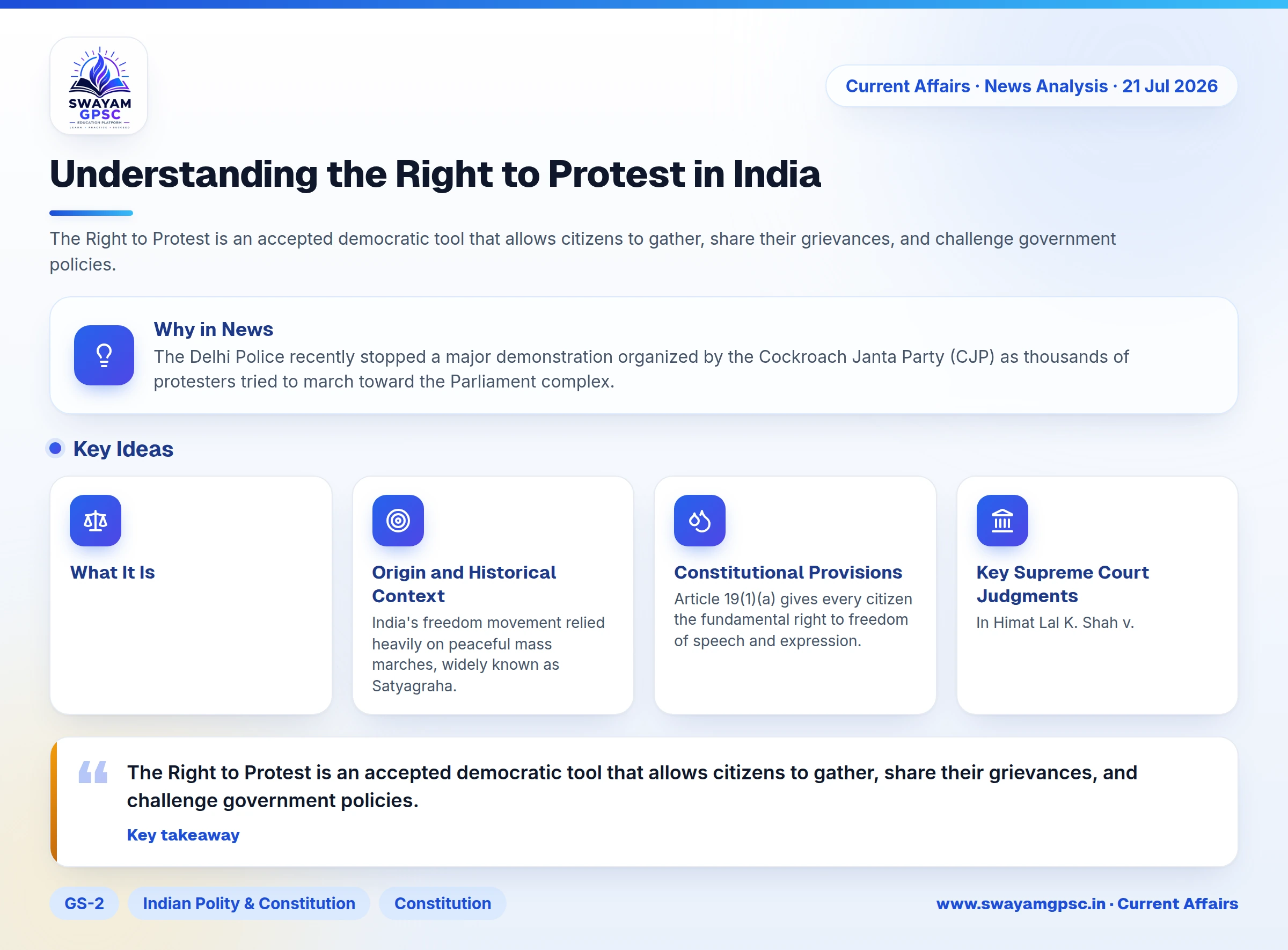
Understanding the Right to Protest in India
#GS-2 #Indian Polity & Constitution #Constitution #Judiciary #Fundamental Rights #Right to Protest
Why in News
- The Delhi Police recently stopped a major demonstration organized by the Cockroach Janta Party (CJP) as thousands of protesters tried to march toward the Parliament complex.
What It Is
- The Right to Protest is an accepted democratic tool that allows citizens to gather, share their grievances, and challenge government policies. However, this freedom is not absolute, as the Constitution balances it with public order, safety, and the rights of other citizens.
Origin and Historical Context
- India's freedom movement relied heavily on peaceful mass marches, widely known as Satyagraha.
- After independence, the Constitution makers included this right in our democratic structure so that citizens could express disagreement peacefully even outside of elections.
Constitutional Provisions
- Article 19(1)(a) gives every citizen the fundamental right to freedom of speech and expression.
- Article 19(1)(b) grants citizens the fundamental right to gather peacefully without weapons.
- Under Article 19(2) and Article 19(3), the government can put reasonable restrictions on protests to protect national sovereignty, state security, friendly foreign relations, public order, and court dignity.
Key Supreme Court Judgments
- In Himat Lal K. Shah v. Commissioner of Police (1973), the court ruled that peaceful assembly is vital for democracy, distinguishing reasonable traffic management from total bans.
- In Mazdoor Kisan Shakti Sangathan v. Union of India (2018), the court set clear guidelines for protests near high-security sites like Parliament and the Supreme Court, while banning weapons and lathis at demonstration sites.
- In Amit Sahni v. Commissioner of Police (2020), also known as the Shaheen Bagh Case, the court held that protests cannot block public roads indefinitely and must stay within designated protest zones.
Key Legal and Operational Features
- Organizers must obtain prior approval from local administration and police so officers can control crowd size, manage traffic, and ensure safety.
- Local authorities direct major rallies to specific grounds like Jantar Mantar and Ramlila Maidan in New Delhi, or Azad Maidan in Mumbai, to protect general public movement.
- Authorities can issue prohibitory orders using statutory tools like Section 163 of the Bharatiya Nagarik Suraksha Sanhita (BNSS) to prevent unauthorized assemblies during immediate threats to peace.