Understanding the Right to be Forgotten in India
#GS-2 #Indian Polity & Constitution #Judiciary #Constitution #Governance & Social Justice #Current Events #National #Right to be Forgotten #Data Protection
Key takeaways
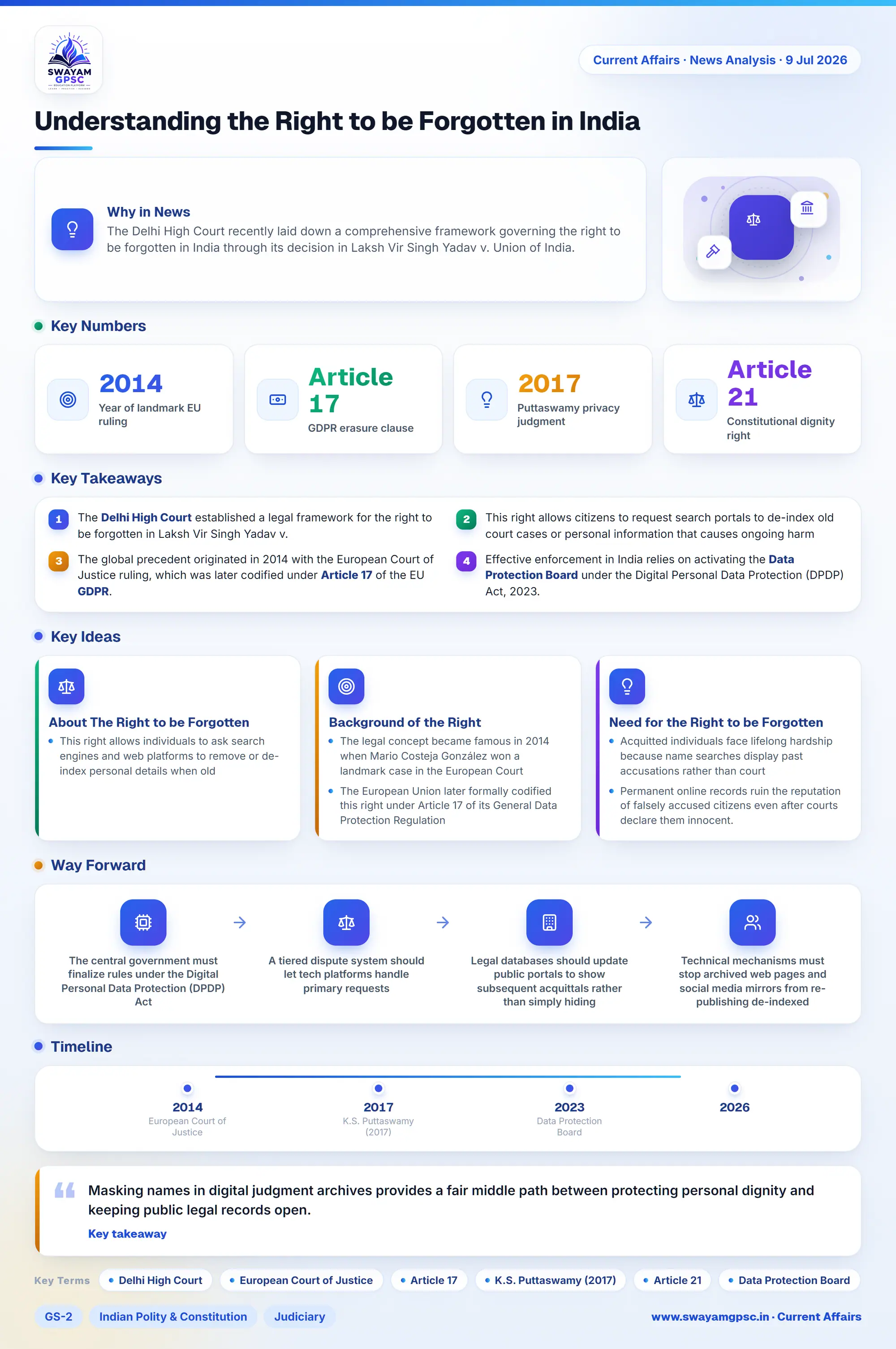
- The Delhi High Court established a legal framework for the right to be forgotten in Laksh Vir Singh Yadav v. Union of India, anchoring it to personal dignity under Article 21.
- This right allows citizens to request search portals to de-index old court cases or personal information that causes ongoing harm after legal exoneration.
- The global precedent originated in 2014 with the European Court of Justice ruling, which was later codified under Article 17 of the EU GDPR.
- Effective enforcement in India relies on activating the Data Protection Board under the Digital Personal Data Protection (DPDP) Act, 2023.
Why in News
- The Delhi High Court recently laid down a comprehensive framework governing the right to be forgotten in India through its decision in Laksh Vir Singh Yadav v. Union of India.
About The Right to be Forgotten
- This right allows individuals to ask search engines and web platforms to remove or de-index personal details when old legal records cause harm without serving public interest.
Background of the Right to be Forgotten
- The legal concept became famous in 2014 when Mario Costeja González won a landmark case in the European Court of Justice against Google to erase old debt notices.
- The European Union later formally codified this right under Article 17 of its General Data Protection Regulation (GDPR).
- In India, the foundation was established by the Supreme Court in the K.S. Puttaswamy (2017) case, which recognized privacy as a fundamental right under Article 21.
- Before 2026, India lacked a single law on this issue, leading different High Courts to deliver conflicting decisions regarding name masking.
Need for the Right to be Forgotten in India
- Acquitted individuals face lifelong hardship because name searches display past accusations rather than court acquittals.
- Permanent online records ruin the reputation of falsely accused citizens even after courts declare them innocent.
- Private matrimonial and family disputes stay publicly visible on search engines, creating unnecessary social embarrassment.
- People who are only peripherally named in court documents often face public judgment due to online search visibility.
Court Judgments
- In K.S. Puttaswamy v. Union of India (2017), the Supreme Court declared informational privacy and control over personal data as part of Article 21.
- In Laksh Vir Singh Yadav v. Union of India (2026), the Delhi High Court ruled that dignity under Article 21 allows citizens to enforce de-indexing against private tech companies.
- The High Court instituted a proportionality test to balance an individual's right to privacy against the public interest in open justice.
Way Forward
- The central government must finalize rules under the Digital Personal Data Protection (DPDP) Act, 2023 and activate the Data Protection Board.
- A tiered dispute system should let tech platforms handle primary requests, escalating unresolved cases to the Data Protection Board before going to court.
- Legal databases should update public portals to show subsequent acquittals rather than simply hiding documents.
- Technical mechanisms must stop archived web pages and social media mirrors from re-publishing de-indexed personal data.
- The Supreme Court must issue a authoritative national standard to resolve conflicting High Court judgments across India.
Conclusion
- Masking names in digital judgment archives provides a fair middle path between protecting personal dignity and keeping public legal records open.
- Effective implementation will depend on compliance from global tech firms and active enforcement of the DPDP Act, 2023.