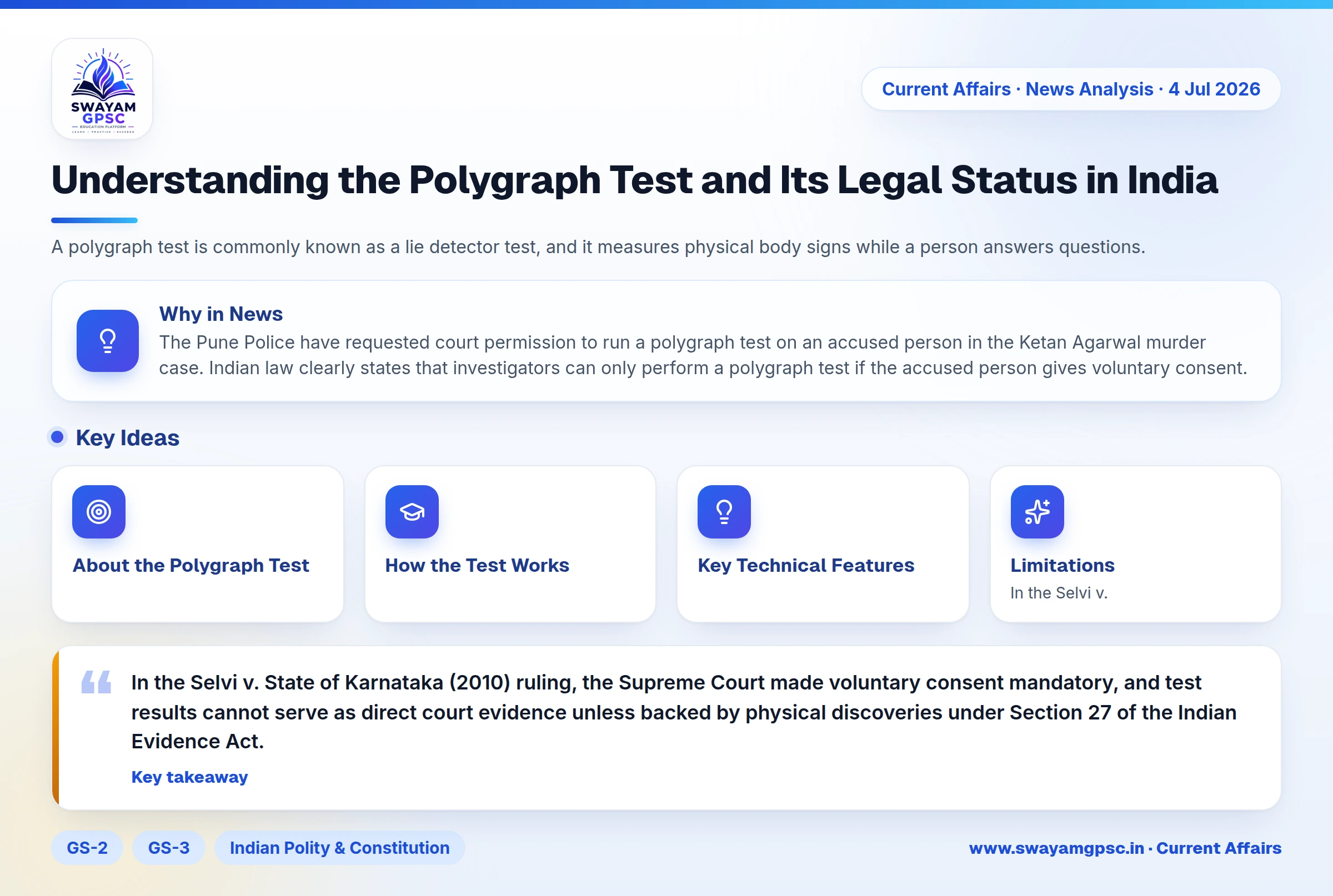
Understanding the Polygraph Test and Its Legal Status in India
#GS-2 #GS-3 #Indian Polity & Constitution #Judiciary #Executive #Science & Technology #Current Events #National #Polygraph Test
Why in News
- The Pune Police have requested court permission to run a polygraph test on an accused person in the Ketan Agarwal murder case.
- Indian law clearly states that investigators can only perform a polygraph test if the accused person gives voluntary consent.
About the Polygraph Test
- A polygraph test is commonly known as a lie detector test, and it measures physical body signs while a person answers questions.
- The test relies on the psychological idea that telling a lie creates involuntary emotional stress, which changes normal body reactions.
- Investigators use this test to find new clues, check if a suspect's story is true, and focus their investigation on the right path.
How the Test Works
- In the pre-test interview, the examiner explains the whole process to the suspect and helps them feel calm before starting.
- During baseline recording, the suspect answers simple truth questions so the machine can note normal heart rate, breathing, blood pressure, and sweating levels.
- The examiner then asks irrelevant, control, and relevant questions to compare how the suspect reacts to normal topic questions versus crime-related questions.
- In waveform analysis, the examiner reviews all the recorded charts to find stress signals that might suggest the suspect is lying.
Key Technical Features
- Pneumograph Tubes wrapped around the chest and stomach track breathing speed and depth to catch sudden changes in breathing.
- A Cardiovascular Cuff monitors blood pressure, pulse, and heart rate continuously to check for stress variations.
- Galvanic Skin Response (GSR) Sensors attached to the fingers measure skin conductivity, which goes up when extra sweat forms during emotional stress.
- A Photoplethysmograph (PPG) uses an infrared sensor on the finger or earlobe to measure changes in blood circulation caused by stress.
Limitations
- The test has limited scientific reliability because it measures physical stress caused by anxiety rather than measuring direct lying.
- It can produce false positives if an innocent person gets nervous, or false negatives if a habitual liar remains calm under questioning.
- Suspects can trick the test by using physical or mental tricks, which lowers the accuracy of the overall results.
- In the Selvi v. State of Karnataka (2010) ruling, the Supreme Court made voluntary consent mandatory, and test results cannot serve as direct court evidence unless backed by physical discoveries under Section 27 of the Indian Evidence Act.