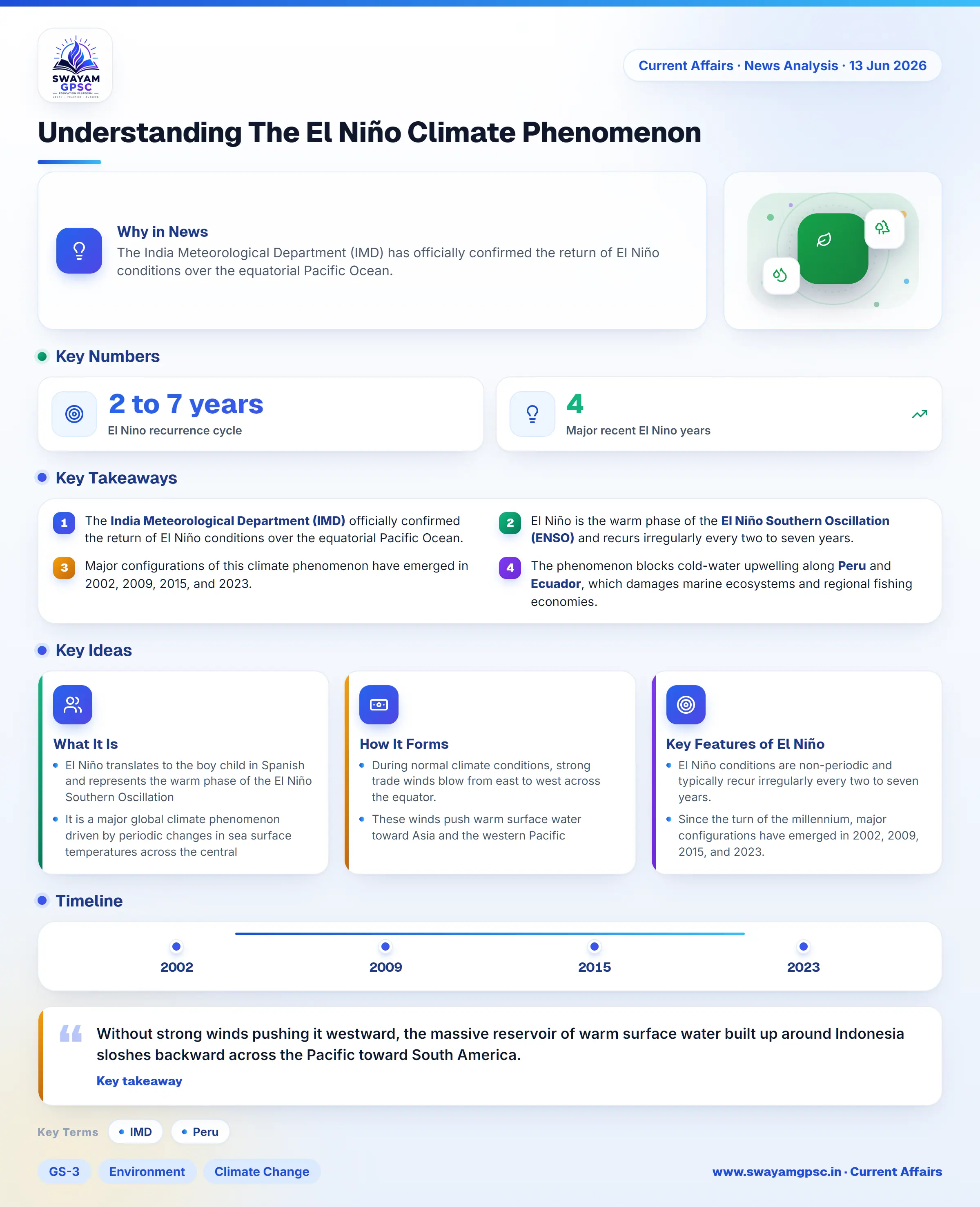
Understanding The El Niño Climate Phenomenon
#GS-3 #Environment #Climate Change #Geography #Physical Geography
Key takeaways
- The India Meteorological Department (IMD) officially confirmed the return of El Niño conditions over the equatorial Pacific Ocean.
- El Niño is the warm phase of the El Niño Southern Oscillation (ENSO) and recurs irregularly every two to seven years.
- Major configurations of this climate phenomenon have emerged in 2002, 2009, 2015, and 2023.
- The phenomenon blocks cold-water upwelling along Peru and Ecuador, which damages marine ecosystems and regional fishing economies.
Why in News
- The India Meteorological Department (IMD) has officially confirmed the return of El Niño conditions over the equatorial Pacific Ocean.
What It Is
- El Niño translates to the boy child in Spanish and represents the warm phase of the El Niño Southern Oscillation (ENSO).
- It is a major global climate phenomenon driven by periodic changes in sea surface temperatures across the central and eastern tropical Pacific Ocean.
- This warming phase contrasts directly with La Niña which is the cooling phase and alternating neutral phases.
How It Forms
- During normal climate conditions, strong trade winds blow from east to west across the equator.
- These winds push warm surface water toward Asia and the western Pacific, allowing cold water to well up from the deep ocean along the South American coast.
- An El Niño state develops through a disruption of this important oceanic and atmospheric balance.
- The steady easterly trade winds weaken or completely reverse direction and begin blowing from west to east.
- Without strong winds pushing it westward, the massive reservoir of warm surface water built up around Indonesia sloshes backward across the Pacific toward South America.
- As this warm water pools over the central and eastern equatorial Pacific, it depresses the thermocline.
- The thermocline is the underwater boundary layer separating warm surface water from cold deep water.
- This process blocks the normal upwelling of nutrient-rich cold water along the coasts of Peru and Ecuador.
- The atmosphere responds immediately to these warming sea surface temperatures.
- The primary zone of rising air and thunderstorm activity shifts eastward from the western Pacific into the central ocean expanse.
- This shift alters the planetary jet streams and changes global weather patterns significantly.
Key Features of El Niño
- El Niño conditions are non-periodic and typically recur irregularly every two to seven years.
- Since the turn of the millennium, major configurations have emerged in 2002, 2009, 2015, and 2023.
- Because it releases massive amounts of oceanic heat into the upper atmosphere, El Niño exerts a temporary warming effect across the entire planet.
- This warming often pushes global average temperatures to record-breaking highs.
- The phenomenon weakens or tears apart the normal Walker Circulation.
- The Walker Circulation is the tropical atmospheric loop of air rising in the west and sinking in the east, which reverses localized pressure cells.
- The loss of cold-water upwelling starves marine ecosystems of nutrients.
- This causes massive drop-offs in fish populations, particularly anchovetas, along South American coastlines and damages regional fishing economies.