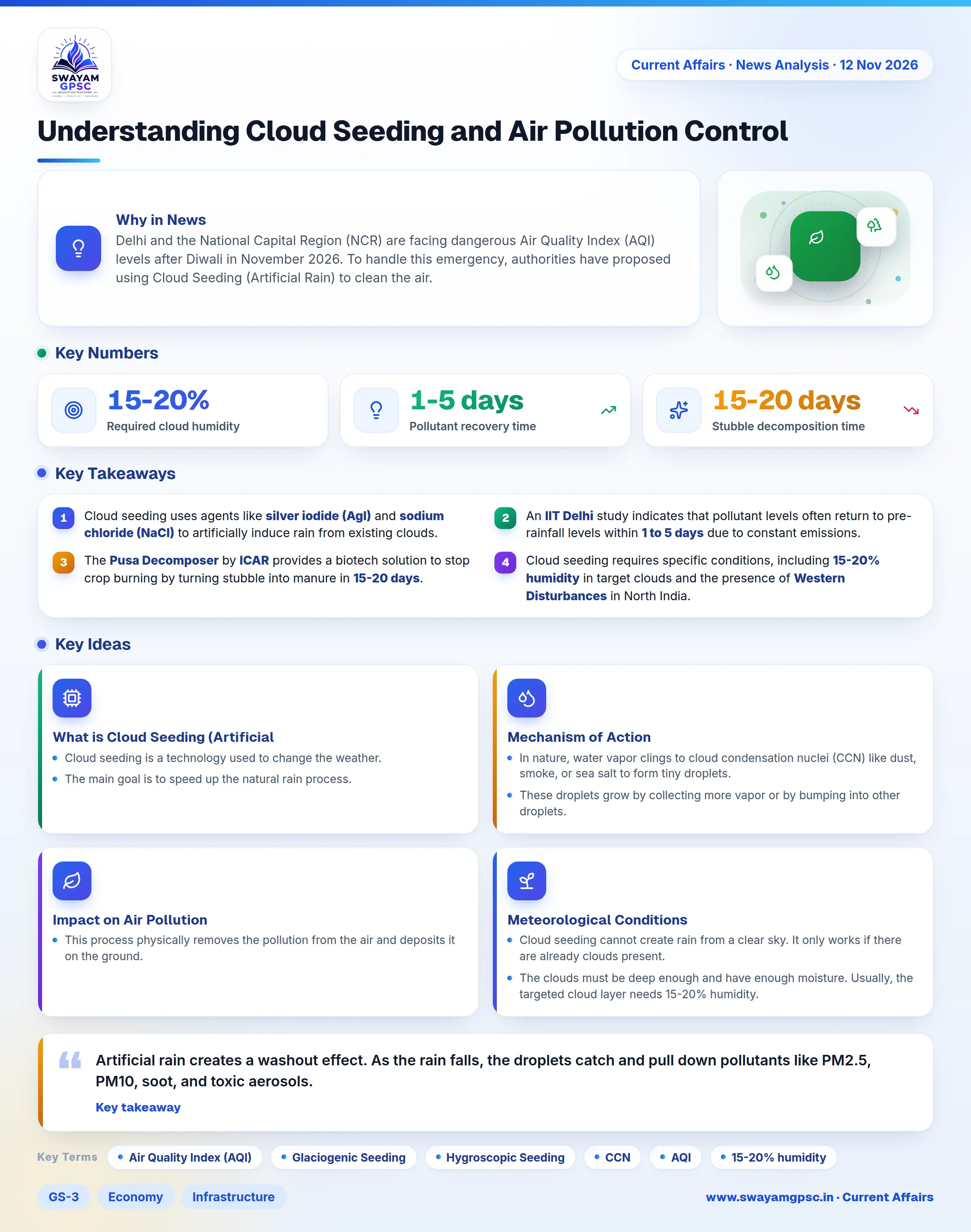
Understanding Cloud Seeding and Air Pollution Control
#GS-3 #Economy #Infrastructure #Environment #Pollution #Current Events #National
Key takeaways
- Cloud seeding uses agents like silver iodide (AgI) and sodium chloride (NaCl) to artificially induce rain from existing clouds.
- An IIT Delhi study indicates that pollutant levels often return to pre-rainfall levels within 1 to 5 days due to constant emissions.
- The Pusa Decomposer by ICAR provides a biotech solution to stop crop burning by turning stubble into manure in 15-20 days.
- Cloud seeding requires specific conditions, including 15-20% humidity in target clouds and the presence of Western Disturbances in North India.
Why in News
- Delhi and the National Capital Region (NCR) are facing dangerous Air Quality Index (AQI) levels after Diwali in November 2026.
- To handle this emergency, authorities have proposed using Cloud Seeding (Artificial Rain) to clean the air.
- Many people doubt if this will work because trials in October 2025 produced very little rain and did not improve air quality for long.
What is Cloud Seeding (Artificial Rain)?
- Cloud seeding is a technology used to change the weather. It forces or increases rain by adding certain chemicals, called seeding agents, into existing clouds.
- The main goal is to speed up the natural rain process. This helps in managing droughts, fighting heavy air pollution, or stopping hail.
- There are two main types of seeding. Glaciogenic Seeding uses agents like silver iodide (AgI) to create ice crystals in cold clouds, which leads to snow or rain.
- The second type is Hygroscopic Seeding. It uses particles like sodium chloride (NaCl) in warm clouds to help water droplets grow and fall as rain.
Mechanism of Action
- In nature, water vapor clings to cloud condensation nuclei (CCN) like dust, smoke, or sea salt to form tiny droplets.
- These droplets grow by collecting more vapor or by bumping into other droplets. Once they get heavy enough, they fall as rain.
- In cold clouds, vapor can turn directly into ice crystals. These either fall as snow or melt into rain as they descend.
- During cloud seeding, chemicals are spread using drones, aircraft, or ground generators. These chemicals act as artificial CCN or ice nuclei.
- These artificial agents provide a strong base for water vapor to freeze or condense quickly. This speeds up the process and creates artificial rain or snow.
Impact on Air Pollution
- Artificial rain creates a washout effect. As the rain falls, the droplets catch and pull down pollutants like PM2.5, PM10, soot, and toxic aerosols.
- This process physically removes the pollution from the air and deposits it on the ground. As a result, the AQI and visibility improve quickly, though only for a short time.
Meteorological Conditions
- Cloud seeding cannot create rain from a clear sky. It only works if there are already clouds present.
- The clouds must be deep enough and have enough moisture. Usually, the targeted cloud layer needs 15-20% humidity.
- In North India during winter, this process depends on Western Disturbances. These are storms from the Mediterranean that bring the needed moisture and clouds.
Challenges
- It only provides short-term relief. An IIT Delhi study showed that pollutant levels often return to normal within 1 to 5 days because emissions continue.
- The study also suggested that ground-level ozone might actually increase after the rain.
- Success depends on unpredictable weather. Winter clouds over Delhi are often too thin or dry to produce much rain, even with seeding.
- The cost is very high. Using specialized planes and pyrotechnic flares costs crores of rupees for a small area.
- There are ecological risks. Using silver iodide for a long time can leave heavy metals in the soil and water, harming fish and crops.
- It can lead to rain theft. Changing weather in one area might stop rain from falling in nearby regions that are already struggling with drought.
- It has a carbon footprint. Flying planes and using dry ice (carbon dioxide) adds to greenhouse gas emissions.
Global Examples of Cloud Seeding Programmes
- The United Arab Emirates (UAE) has flown about 1,000 hours of seeding flights every year since the 1990s to increase groundwater and desert rain.
- Australia uses this technology in the Snowy Mountains and Tasmania to boost hydropower and water supplies.
- In the United States, states like Texas, Colorado, and California use it to increase snow in mountains for irrigation and reservoirs.
- China runs one of the largest programs in the world. They use drones, planes, and artillery to fight droughts and stop hail.
Alternative Solutions (Beyond Cloud Seeding)
- The CSIR-NEERI developed the Wind Augmentation Purifying Unit (WAYU). These are placed at busy traffic lights to remove pollutants using filters and UV systems.
- Smog Towers use huge filters, including HEPA or electrostatic filters, to pull in dirty air from the top and release clean air at the bottom.
- Smog-eating paints use Titanium Dioxide (TiO2). When sunlight hits the paint, it breaks down toxic Nitrogen Oxides (NOx) into harmless salts.
- Anti-smog guns spray tiny water droplets (50-100 microns) at high speeds. This settles dust and PM particles at construction and mining sites.
- The ICAR developed the Pusa Decomposer. This is a liquid made of fungi that turns paddy stubble into manure in 15-20 days, so farmers do not need to burn it.
- Smart traffic management using AI and IoT can stop cars from idling at red lights. This reduces NOx and Carbon Monoxide at junctions.
- Urban greening through the Miyawaki method creates dense forests that act as natural filters for dust.
- In-situ management uses machines like Happy Seeders and Super SMS to manage crop waste in Punjab, Haryana, and UP without burning.
- Moving to Electric Vehicles (EVs) and better public transport helps reduce tailpipe emissions.