Understanding Chariot-1 Foundation Models
#GS-2 #Governance & Social Justice #E-Governance #GS-3 #Science & Technology #Artificial Intelligence #ICT #Current Events #National #Prelims
Key takeaways
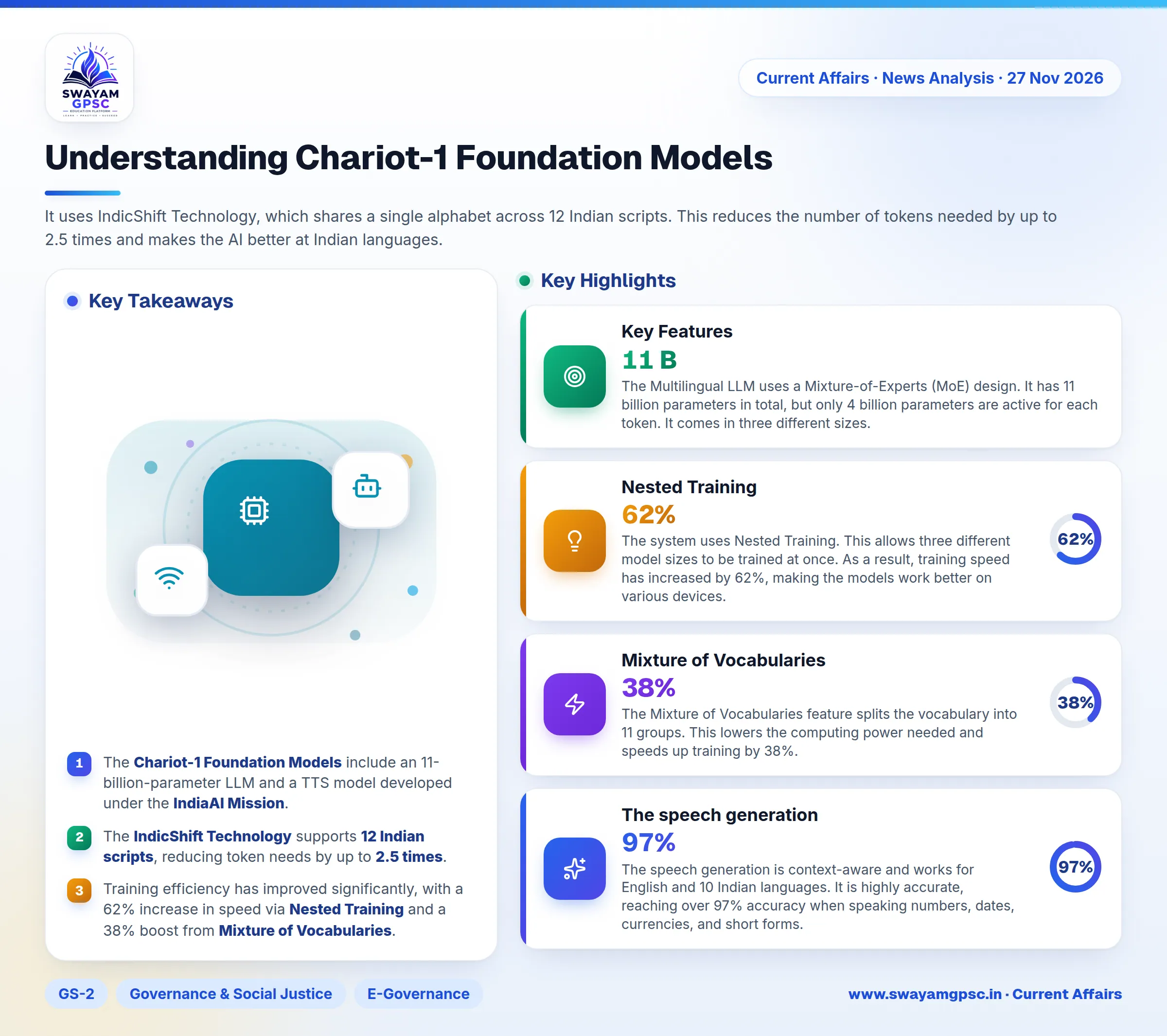
- The Chariot-1 Foundation Models include an 11-billion-parameter LLM and a TTS model developed under the IndiaAI Mission.
- The IndicShift Technology supports 12 Indian scripts, reducing token needs by up to 2.5 times.
- Training efficiency has improved significantly, with a 62% increase in speed via Nested Training and a 38% boost from Mixture of Vocabularies.
- The speech generation system supports English and 10 Indian languages with over 97% accuracy for specific formats like dates and currencies.
Why in News
- The Ministry of Electronics and Information Technology (MeitY) recently introduced the Chariot-1 Foundation Models. This launch happened under the IndiaAI Mission to boost India's own skills in multilingual AI and speech generation.
About Chariot-1 Foundation Models
- These models are a home-grown set of AI tools. They include a Large Language Model (LLM) and a Text-to-Speech (TTS) model. India built these from the ground up to meet the country's specific language and tech needs.
- The company Chariot Artificial Intelligence Pvt. Ltd. developed these models with support from the IndiaAI Mission.
Key Features
- The Multilingual LLM uses a Mixture-of-Experts (MoE) design. It has 11 billion parameters in total, but only 4 billion parameters are active for each token. It comes in three different sizes.
- It uses IndicShift Technology, which shares a single alphabet across 12 Indian scripts. This reduces the number of tokens needed by up to 2.5 times and makes the AI better at Indian languages.
- The system uses Nested Training. This allows three different model sizes to be trained at once. As a result, training speed has increased by 62%, making the models work better on various devices.
- The Mixture of Vocabularies feature splits the vocabulary into 11 groups. This lowers the computing power needed and speeds up training by 38%.
- The speech generation is context-aware and works for English and 10 Indian languages. It is highly accurate, reaching over 97% accuracy when speaking numbers, dates, currencies, and short forms.
Significance
- It promotes technological sovereignty. By building its own AI, India reduces its need to rely on models made in other countries.
- It helps with linguistic inclusivity. More people speaking different Indian languages can now use AI, which helps close the digital gap.
- It is computationally efficient. This lowers the cost of training and allows AI to run on everything from large data centres to laptops, smartphones, and small edge devices.