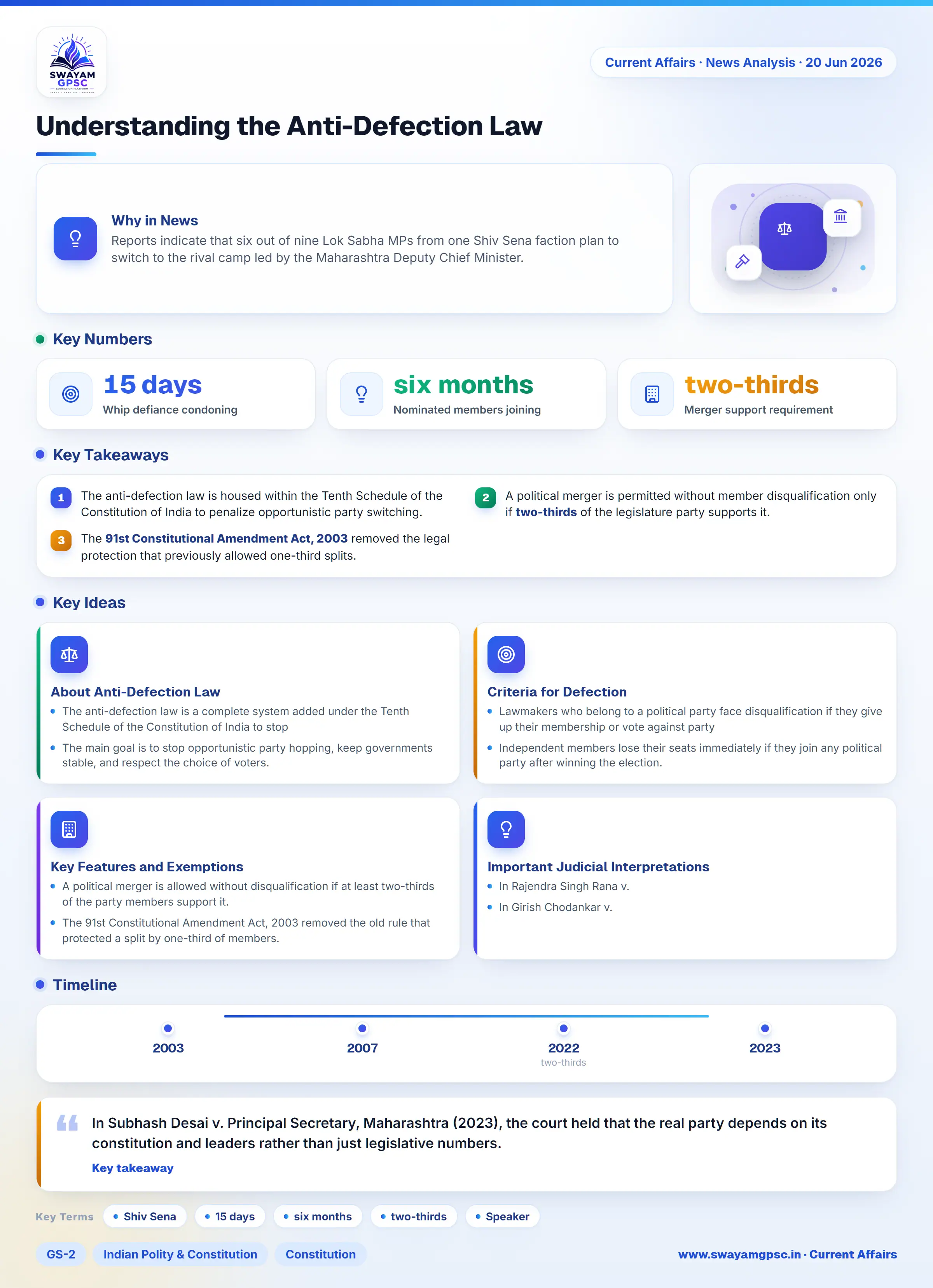
Understanding the Anti-Defection Law
#GS-2 #Indian Polity & Constitution #Constitution #Parliament #Executive #Anti-Defection Law
Key takeaways
- The anti-defection law is housed within the Tenth Schedule of the Constitution of India to penalize opportunistic party switching.
- A political merger is permitted without member disqualification only if two-thirds of the legislature party supports it.
- The 91st Constitutional Amendment Act, 2003 removed the legal protection that previously allowed one-third splits.
Why in News
- Reports indicate that six out of nine Lok Sabha MPs from one Shiv Sena faction plan to switch to the rival camp led by the Maharashtra Deputy Chief Minister.
About Anti-Defection Law
- The anti-defection law is a complete system added under the Tenth Schedule of the Constitution of India to stop lawmakers from switching sides after winning elections.
- The main goal is to stop opportunistic party hopping, keep governments stable, and respect the choice of voters.
Criteria for Defection and Disqualification
- Lawmakers who belong to a political party face disqualification if they give up their membership or vote against party orders without permission within 15 days.
- Independent members lose their seats immediately if they join any political party after winning the election.
- Nominated members must join a party within the first six months, or face disqualification if they join one later.
Key Features and Exemptions
- A political merger is allowed without disqualification if at least two-thirds of the party members support it.
- The 91st Constitutional Amendment Act, 2003 removed the old rule that protected a split by one-third of members.
- The Speaker and Deputy Speaker can step away from their parties while in office to show complete neutrality.
Important Judicial Interpretations
- In Rajendra Singh Rana v. Swami Prasad Maurya (2007), the court ruled that defection is clear from a member actions even without a formal resignation letter.
- In Girish Chodankar v. Speaker, Goa Assembly (2022), the court accepted a two-thirds split group joining another party as a valid merger.
- In Subhash Desai v. Principal Secretary, Maharashtra (2023), the court held that the real party depends on its constitution and leaders rather than just legislative numbers.