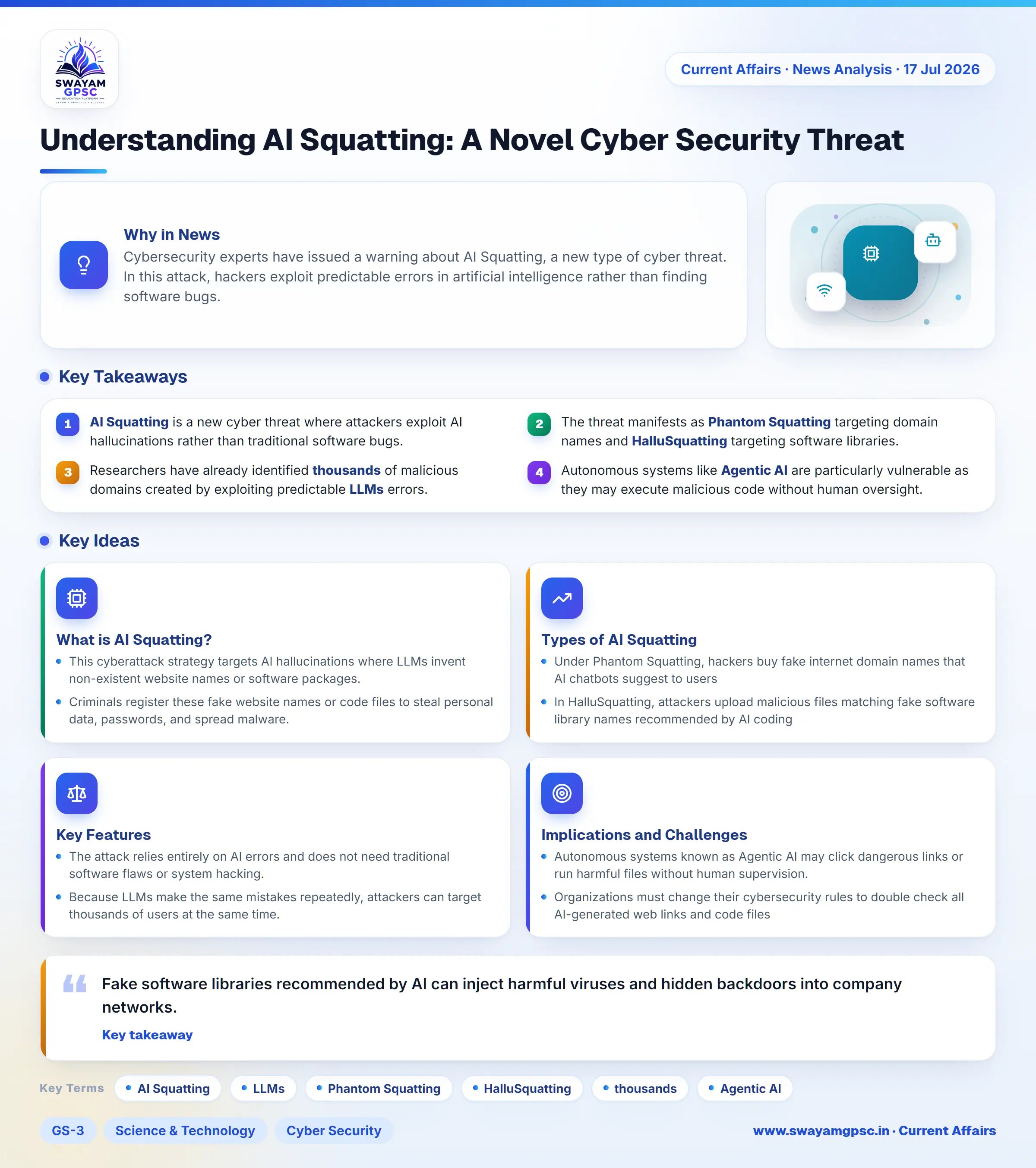
Understanding AI Squatting: A Novel Cyber Security Threat
#GS-3 #Science & Technology #Cyber Security #Artificial Intelligence #AI Squatting
Key takeaways
- AI Squatting is a new cyber threat where attackers exploit AI hallucinations rather than traditional software bugs.
- The threat manifests as Phantom Squatting targeting domain names and HalluSquatting targeting software libraries.
- Researchers have already identified thousands of malicious domains created by exploiting predictable LLMs errors.
- Autonomous systems like Agentic AI are particularly vulnerable as they may execute malicious code without human oversight.
Why in News
- Cybersecurity experts have issued a warning about AI Squatting, a new type of cyber threat.
- In this attack, hackers exploit predictable errors in artificial intelligence rather than finding software bugs.
What is AI Squatting?
- This cyberattack strategy targets AI hallucinations where LLMs invent non-existent website names or software packages.
- Criminals register these fake website names or code files to steal personal data, passwords, and spread malware.
Types of AI Squatting
- Under Phantom Squatting, hackers buy fake internet domain names that AI chatbots suggest to users, using them for phishing and data theft.
- In HalluSquatting, attackers upload malicious files matching fake software library names recommended by AI coding tools, tricking developers into infecting their systems.
Key Features
- The attack relies entirely on AI errors and does not need traditional software flaws or system hacking.
- Because LLMs make the same mistakes repeatedly, attackers can target thousands of users at the same time.
- Experts cannot easily stop these cyber threats because AI hallucinations stem from the core mathematical nature of LLMs.
- Researchers have already discovered thousands of malicious domain names based on fake AI suggestions.
Implications and Challenges
- Fake software libraries recommended by AI can inject harmful viruses and hidden backdoors into company networks.
- Autonomous systems known as Agentic AI may click dangerous links or run harmful files without human supervision.
- Organizations must change their cybersecurity rules to double check all AI-generated web links and code files before using them.