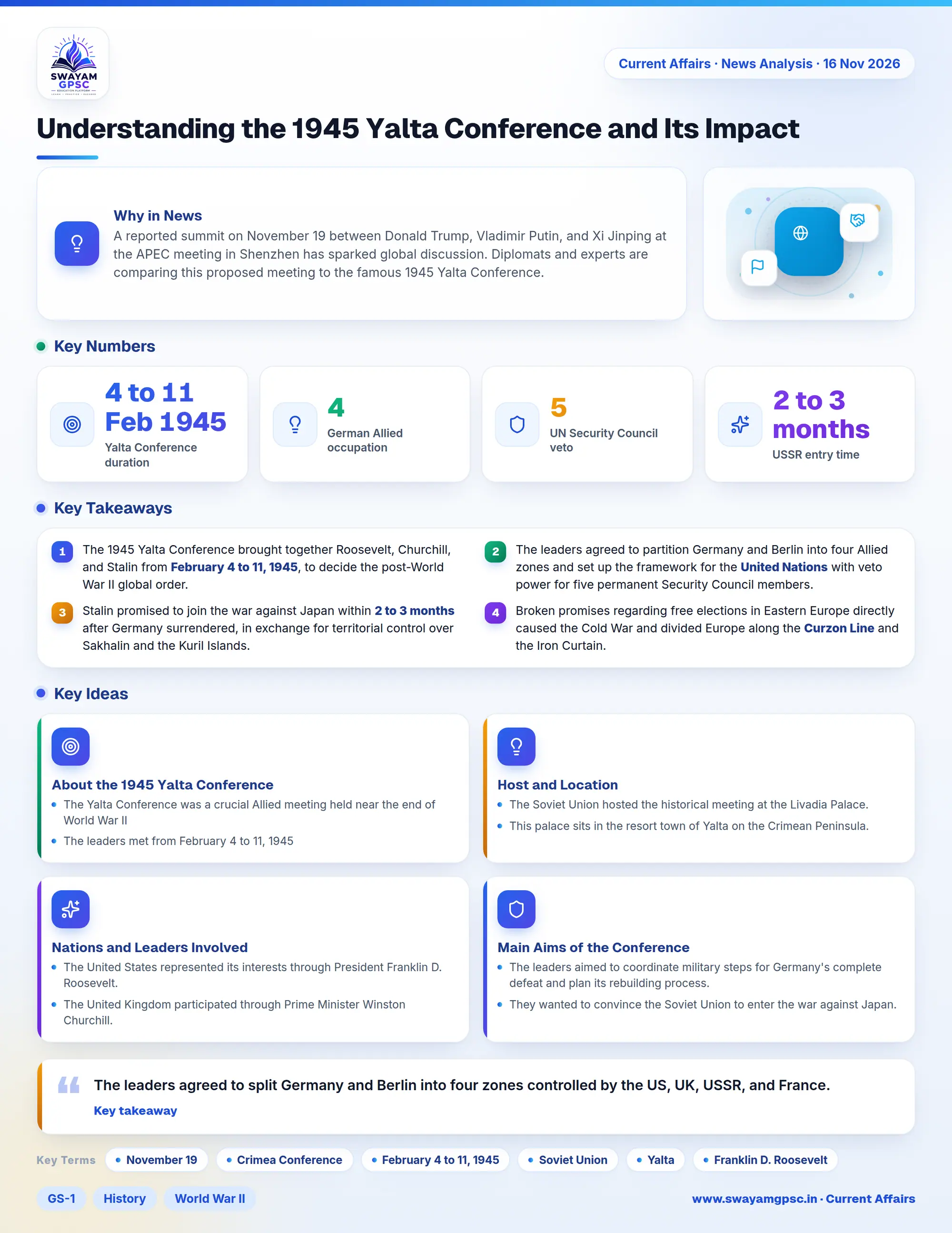
Understanding the 1945 Yalta Conference and Its Impact
#GS-1 #History #World War II #Yalta Conference #International Relations #Current Events
Key takeaways
- The 1945 Yalta Conference brought together Roosevelt, Churchill, and Stalin from February 4 to 11, 1945, to decide the post-World War II global order.
- The leaders agreed to partition Germany and Berlin into four Allied zones and set up the framework for the United Nations with veto power for five permanent Security Council members.
- Stalin promised to join the war against Japan within 2 to 3 months after Germany surrendered, in exchange for territorial control over Sakhalin and the Kuril Islands.
- Broken promises regarding free elections in Eastern Europe directly caused the Cold War and divided Europe along the Curzon Line and the Iron Curtain.
Why in News
- A reported summit on November 19 between Donald Trump, Vladimir Putin, and Xi Jinping at the APEC meeting in Shenzhen has sparked global discussion.
- Diplomats and experts are comparing this proposed meeting to the famous 1945 Yalta Conference.
About the 1945 Yalta Conference
- The Yalta Conference was a crucial Allied meeting held near the end of World War II, also called the Crimea Conference.
- The leaders met from February 4 to 11, 1945, to plan the final defeat of Nazi Germany and structure the post-war world order.
Host and Location
- The Soviet Union hosted the historical meeting at the Livadia Palace.
- This palace sits in the resort town of Yalta on the Crimean Peninsula.
Nations and Leaders Involved
- The United States represented its interests through President Franklin D. Roosevelt.
- The United Kingdom participated through Prime Minister Winston Churchill.
- The Soviet Union participated through Premier Joseph Stalin.
Main Aims of the Conference
- The leaders aimed to coordinate military steps for Germany's complete defeat and plan its rebuilding process.
- They wanted to convince the Soviet Union to enter the war against Japan.
- They planned to create a working framework for establishing the United Nations.
Key Outcomes of the Yalta Conference
- The leaders agreed to split Germany and Berlin into four zones controlled by the US, UK, USSR, and France.
- They agreed to remove Nazi influence, disarm Germany, and prosecute war criminals.
- They finalized the structure of the United Nations, giving veto power to five permanent Security Council members.
- They granted individual General Assembly seats to Ukraine and Byelorussia.
- Premier Stalin agreed to attack Japan within 2 to 3 months after Germany surrendered.
- In return, the Soviet Union gained control over Sakhalin, the Kuril Islands, and key assets in Manchuria.
- The leaders signed the Declaration on Liberated Europe to ensure free elections in freed European nations.
- They accepted Soviet control in Eastern Europe and fixed Poland's eastern boundary at the Curzon Line.
- They formed a Reparations Commission in Moscow to take industrial equipment and resources from Germany as war damages.
Significance and Long-Term Impact
- The Soviet Union broke its promises about free elections in Eastern Europe, which quickly led to the Cold War.
- This division created a political barrier across Europe known as the Iron Curtain.
- Yalta remains a symbol of powerful countries deciding the future of smaller nations without asking for their permission.