Understanding the 1.5°C Climate Overshoot Narrative
#Environment #Climate Change #Economy #International #GS-3 #GS-2
Key takeaways
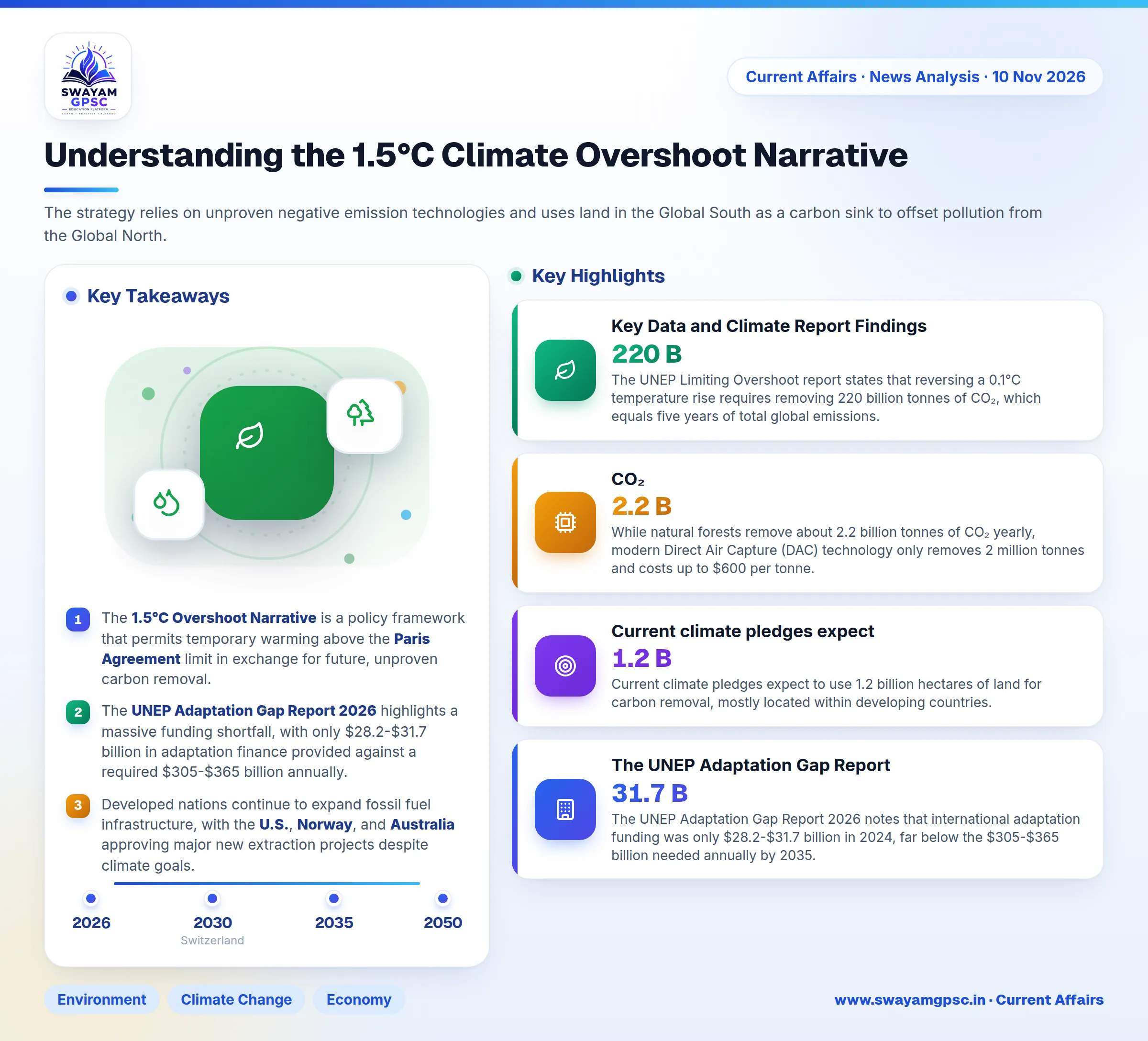
- The 1.5°C Overshoot Narrative is a policy framework that permits temporary warming above the Paris Agreement limit in exchange for future, unproven carbon removal.
- The UNEP Adaptation Gap Report 2026 highlights a massive funding shortfall, with only $28.2-$31.7 billion in adaptation finance provided against a required $305-$365 billion annually.
- Developed nations continue to expand fossil fuel infrastructure, with the U.S., Norway, and Australia approving major new extraction projects despite climate goals.
- The newly adopted Climate Finance Work Programme (CFWP) at COP31 aims to enforce Article 9.1 obligations, pushing for grant-based aid instead of commercial loans.
Defining the 1.5°C Overshoot Narrative
- The 1.5°C Overshoot Narrative is a climate policy framework where global temperatures temporarily rise above the Paris Agreement limit of 1.5°C.
- It relies on the theoretical hope that we can bring temperatures back down by the year 2100 using large-scale Carbon Dioxide Removal (CDR) technologies.
- In reality, this narrative serves as a political tool for wealthy nations to avoid making immediate, deep cuts to their own carbon emissions.
- The strategy relies on unproven negative emission technologies and uses land in the Global South as a carbon sink to offset pollution from the Global North.
Key Data and Climate Report Findings
- The UNEP Limiting Overshoot report states that reversing a 0.1°C temperature rise requires removing 220 billion tonnes of CO₂, which equals five years of total global emissions.
- While natural forests remove about 2.2 billion tonnes of CO₂ yearly, modern Direct Air Capture (DAC) technology only removes 2 million tonnes and costs up to $600 per tonne.
- Current climate pledges expect to use 1.2 billion hectares of land for carbon removal, mostly located within developing countries.
- The UNEP Adaptation Gap Report 2026 notes that international adaptation funding was only $28.2-$31.7 billion in 2024, far below the $305-$365 billion needed annually by 2035.
- As of 2025, fossil fuels still provide 83% of energy in the United States and 73% in the European Union.
Contradictions in Developed Nations' Commitments
- Instead of phasing out fossil fuels, major economies continue to approve new extraction projects, such as offshore drilling in the U.S. and new blocks in Norway.
- Other examples include the UK approving the Jackdaw field and Australia greenlighting 37 fossil fuel projects since 2022.
- Developed nations claim they provided $137 billion in climate finance in 2024, but independent reviews suggest the true grant value is only $33-45 billion.
- About 65% of this reported finance consists of commercial loans that create debt rather than genuine aid.
- Some nations are reducing their support, such as the U.S. rescinding $4 billion in pledges to the Green Climate Fund (GCF).
- Wealthy nations often use cheap foreign credits to offset their emissions instead of cutting them at home, as seen in Switzerland planning to meet one-third of its 2030 NDC through overseas projects.
- Trade measures like the EU’s Carbon Border Adjustment Mechanism (CBAM) penalize industrial growth in developing countries by imposing high carbon tariffs.
COP31 Agenda and Outcomes
- Delegates formally adopted a Climate Finance Work Programme (CFWP) to track the obligations of developed nations under Article 9.1.
- The demand to triple adaptation finance was removed from the formal agenda and moved to informal talks, ignoring the concerns of developing nations.
- Debates over trade policies like CBAM were sent to a three-year dialogue platform, delaying action on the conflict between trade penalties and Common But Differentiated Responsibilities (CBDR).
- The seventh review of the financial mechanism was pushed to COP32, keeping the GCF replenishment within standard tracks.
- Members agreed to hold research consultations on mountain ecosystems alongside the Subsidiary Body for Scientific and Technological Advice (SBSTA).
The Way Forward
- Climate negotiations should focus on a fair-share allocation of the remaining global carbon budget based on historical emissions.
- Developed nations must reach net-zero well before 2050 and achieve domestic net-negative emissions without using foreign land.
- The CFWP must ensure that the $300 billion target for the New Collective Quantified Goal (NCQG) is delivered as grants rather than debt-creating loans.
- The UNFCCC should create mechanisms to transfer green technology and grid storage patents to the Global South without commercial costs.
- All proposed overshoot scenarios must undergo scientific reviews to assess risks like land dispossession and food security threats.