UN Sustainable Development Report 2026: India Ranks 94th
#GS-3 #Environment #Sustainable Development #Economy #Growth #Current Events #National #Inclusive Growth
Why in News
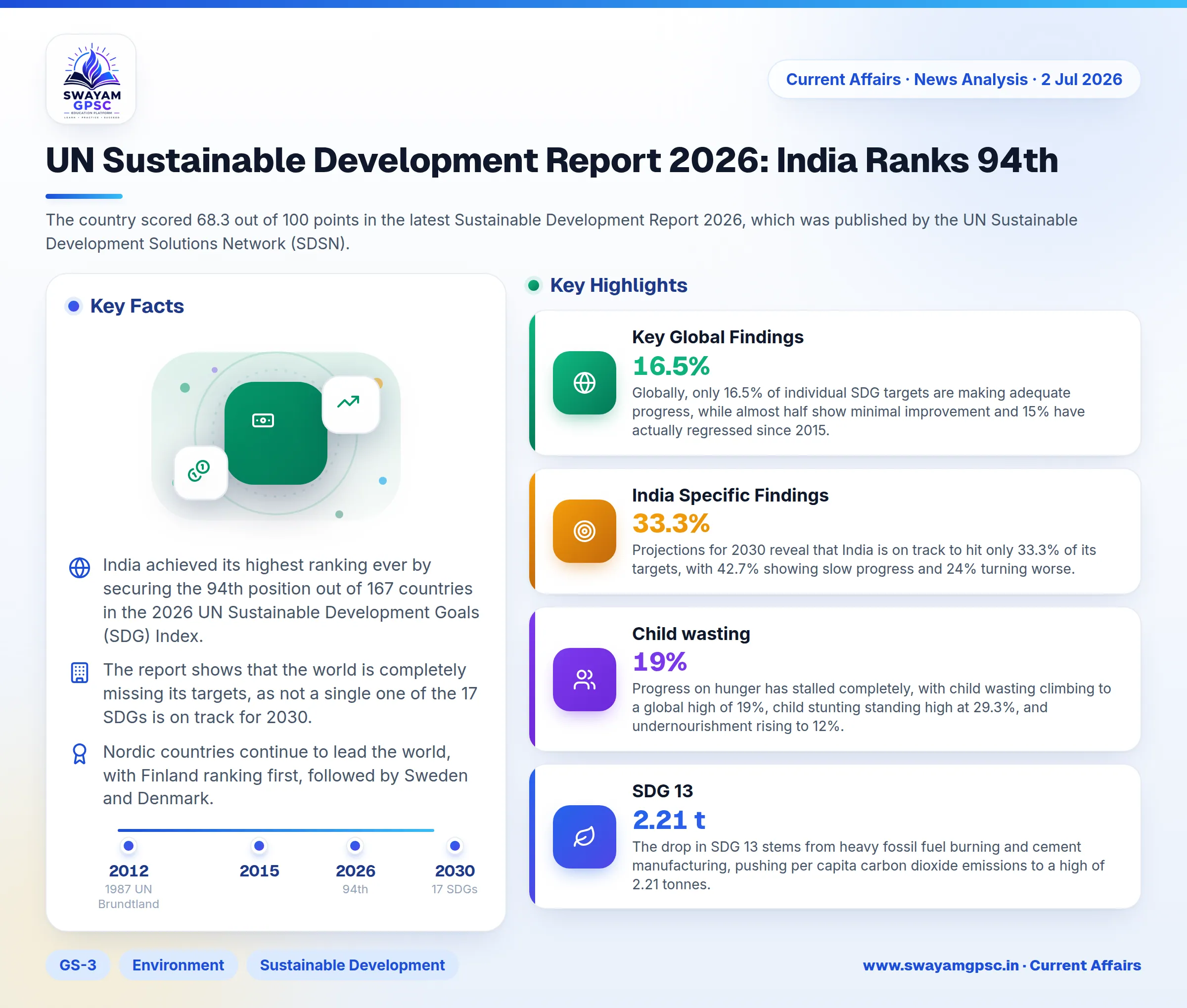
- India achieved its highest ranking ever by securing the 94th position out of 167 countries in the 2026 UN Sustainable Development Goals (SDG) Index.
- The country scored 68.3 out of 100 points in the latest Sustainable Development Report 2026, which was published by the UN Sustainable Development Solutions Network (SDSN).
Key Global Findings
- The report shows that the world is completely missing its targets, as not a single one of the 17 SDGs is on track for 2030.
- Globally, only 16.5% of individual SDG targets are making adequate progress, while almost half show minimal improvement and 15% have actually regressed since 2015.
- Nordic countries continue to lead the world, with Finland ranking first, followed by Sweden and Denmark.
- Conflict and political instability have pushed Chad, the Central African Republic, and South Sudan to the bottom of the list.
- The goals suffering the worst stagnation globally include SDG 2 (Zero Hunger), SDG 11 (Sustainable Cities), SDG 14 (Life Below Water), SDG 15 (Life on Land), and SDG 16 (Peace, Justice, and Strong Institutions).
- Barbados took the top spot for its dedication to UN multilateralism, whereas the United States ranked last due to its opposition to the 2030 Agenda and withdrawal from international bodies.
India Specific Findings
- India has made steady progress since the adoption of the goals in 2015, jumping 18 spots from 112th to 94th rank to become a top improver along with China.
- Despite this climb, India still lags behind neighboring South Asian nations such as Bhutan, Maldives, Nepal, and Sri Lanka.
- Projections for 2030 reveal that India is on track to hit only 33.3% of its targets, with 42.7% showing slow progress and 24% turning worse.
- Food security remains a huge concern, making SDG 2 (Zero Hunger) the most urgent issue for India today.
- Progress on hunger has stalled completely, with child wasting climbing to a global high of 19%, child stunting standing high at 29.3%, and undernourishment rising to 12%.
- Structural obstacles persist, leading to major challenges across 7 core goals, including SDG 2, SDG 3, SDG 5, SDG 11, SDG 14, SDG 15, and SDG 16.
- Under SDG 16, India experienced a severe decline on the Press Freedom Index, falling from 59.51 in 2015 down to 31.96 in 2026.
- Health indicators under SDG 3 worsened due to rising deaths from air pollution and non-communicable lifestyle diseases.
- Environmental performance is slipping as India recorded lower scores in SDG 12 (Responsible Consumption and Production) and SDG 13 (Climate Action).
- The drop in SDG 13 stems from heavy fossil fuel burning and cement manufacturing, pushing per capita carbon dioxide emissions to a high of 2.21 tonnes.
- On a positive note, India registered remarkable global growth in expanding electricity access under SDG 7 and boosting mobile broadband connections under SDG 9.
Overview of SDGs
- Adopted by 193 UN Member States in 2015 under the 2030 Agenda for Sustainable Development, the SDGs consist of 17 goals and 169 targets to combat poverty, inequality, and climate change.
- The core objective is to deliver long-term peace, shared prosperity, and environmental protection across the globe by 2030.
- Sustainable development gained initial definition in the 1987 UN Brundtland Commission, evolving through the 2000 Millennium Development Goals (MDGs), the 2002 Johannesburg Declaration (Rio+10), and the 2012 Rio+20 Summit.
- Key guiding principles of the framework include universality, integration, leaving no one behind, multi-stakeholder participation, and routine reviews via the Global Sustainable Development Report (GSDR).
- The model relies on the 5 Ps, which stand for People, Planet, Prosperity, Peace, and Partnership, to drive inclusive economic development and environmental protection.
India's Domestic SDG Architecture
- NITI Aayog serves as the primary body overseeing national implementation, managing the SDG India Index & Dashboard to foster competitive and cooperative federalism among states.
- The Ministry of Statistics and Programme Implementation (MoSPI) monitors national progress using the National Indicator Framework (NIF) with 277 indicators, supported by the Data for Development Coordination Forum (DDCF) and the UN Resident Coordinator Office.
- The Ministry of Panchayati Raj drives rural adoption across 9 themes through the Local Indicator Framework (LIF) and the Panchayat Advancement Index (PAI), rating over 2.5 lakh Gram Panchayats on a 100-point scale.
Frequently Asked Questions
- Published by the UN Sustainable Development Solutions Network (SDSN), the Sustainable Development Report 2026 evaluates progress across 167 nations toward the 17 SDGs.
- Designed by NITI Aayog, the SDG India Index tracks performance levels of States and Union Territories to encourage healthy competition and federal cooperation.
- Created by MoSPI, the National Indicator Framework (NIF) monitors India's progress across all goals using 277 targeted metrics.
- The latest evaluation highlights severe challenges for India in SDG 2 (Zero Hunger), SDG 3 (Good Health), SDG 5 (Gender Equality), SDG 11 (Sustainable Cities), SDG 13 (Climate Action), SDG 14 (Life Below Water), SDG 15 (Life on Land), and SDG 16 (Peace, Justice & Strong Institutions).