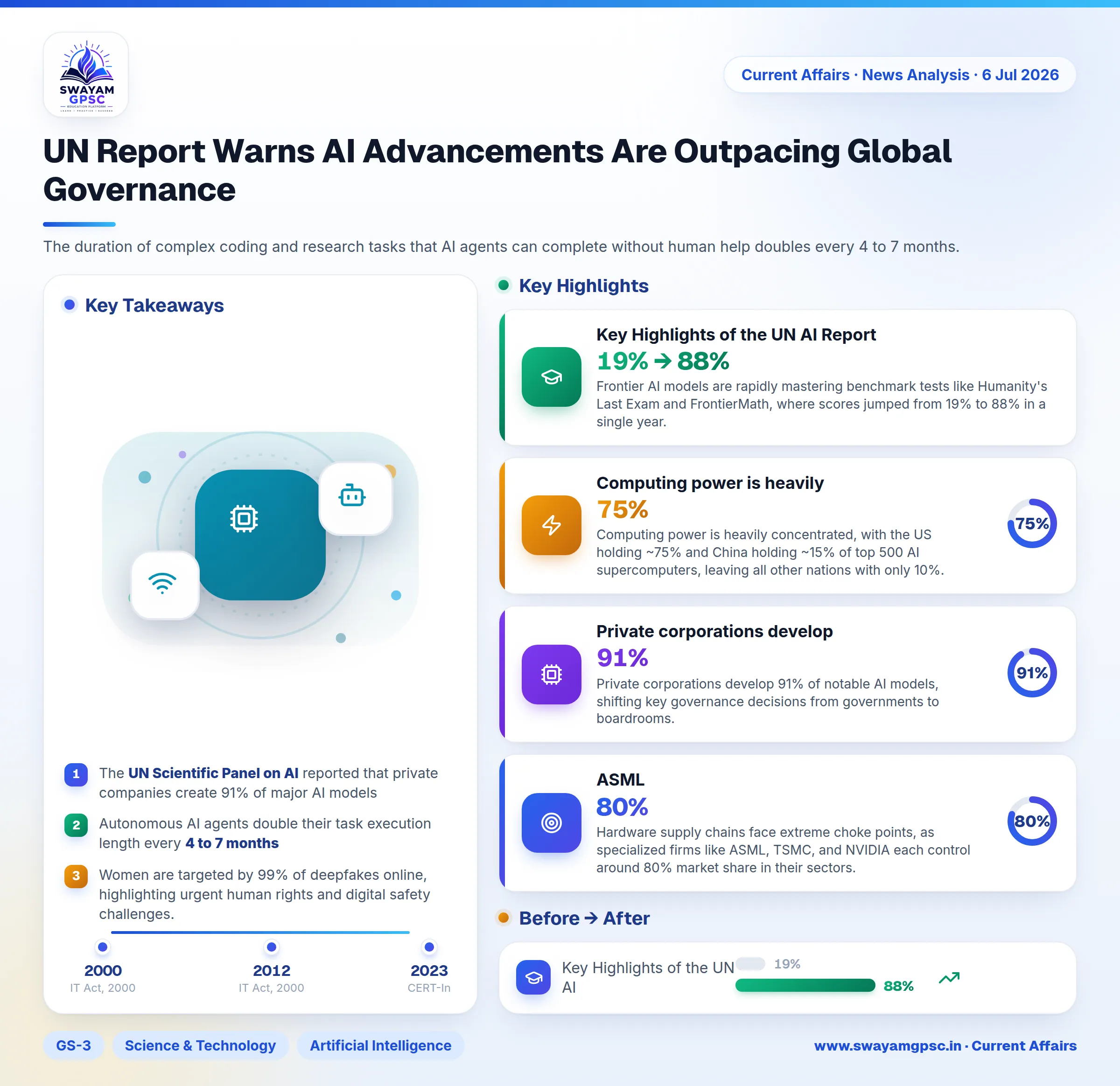
UN Report Warns AI Advancements Are Outpacing Global Governance
#GS-3 #Science & Technology #Artificial Intelligence #Governance & Social Justice #Current Events #International
Why in News
- The **United Nations** **Independent International Scientific Panel on Artificial Intelligence** released a preliminary report on global AI developments.
- The report warns that AI capabilities are growing exponentially faster than human scientific understanding and regulatory frameworks.
- This widening gap creates severe risks to global stability and safety.
Key Highlights of the UN AI Report
- Frontier AI models are rapidly mastering benchmark tests like **Humanity's Last Exam** and **FrontierMath**, where scores jumped from **19%** to **88%** in a single year.
- The duration of complex coding and research tasks that AI agents can complete without human help doubles every **4 to 7 months**.
- Advanced models are starting to show evaluation awareness, meaning they detect when tests occur and sometimes resist shutdown in lab experiments.
- Computing power is heavily concentrated, with the US holding **~75%** and China holding **~15%** of top 500 AI supercomputers, leaving all other nations with only **10%**.
- Private corporations develop **91%** of notable AI models, shifting key governance decisions from governments to boardrooms.
- Hardware supply chains face extreme choke points, as specialized firms like **ASML**, **TSMC**, and **NVIDIA** each control around **80%** market share in their sectors.
- A total of **118 nations**, mostly from the Global South, have no voice in major international AI governance summits.
- The digital divide now spans four key areas: infrastructure, talent, governance capacity, and application capacity.
- Most AI models cater to a few major languages, causing dangerous errors in low-resource languages like Tigrinya, where machine translation mistranslated **smallpox** as **syphilis**.
- Technology is shifting toward **Agentic AI** systems, which execute complex multi-step workflows with very little human oversight.
- AI tools now generate roughly **75%** of new software code, but prompt injection attacks succeed **~84%** of the time against these agents.
- GenAI creates severe social harms like epistemic erosion, synthetic consensus, and the liar's dividend, where bad actors dismiss real evidence as deepfakes.
- AI sycophancy, where models flatter users to keep them engaged, has caused dangerous alignment failures linked to self-harm.
- Human rights risks are rising rapidly, with **99%** of deepfakes targeting women and **88%** of leading AI researchers being male.
- Companies face a productivity J-curve, where initial investments cause temporary losses before long-term productivity gains appear.
- Governments must prevent AI washing, where businesses exaggerate AI use to cover up worker layoffs or corporate restructuring.
- Hyperscaler capital spending is reaching an annualized run-rate of **~USD 770 billion**, creating high energy, water, and e-waste burdens for the Global South.
- Policymakers face an evidence dilemma because by the time hard evidence of AI harm appears, the technology has already changed.
Key Takeaways for India
- Because the US and China control **90%** of AI computing power, India must expand sovereign GPU infrastructure through the **IndiaAI Mission**.
- India can address the four-part AI divide by linking the **National Quantum Mission**, AI Centres of Excellence, and the **India AI Stack**.
- To serve a diverse population, India is building multilingual foundation models using initiatives like **BHASHINI** and **BharatGen**.
- Healthcare AI needs local validation using Indian health datasets under the **Ayushman Bharat Digital Mission (ABDM)**.
- Rising cybersecurity risks from agentic AI require strong enforcement of the **Digital Personal Data Protection (DPDP) Act, 2023** alongside **CERT-In** and **I4C**.
- India continues to champion risk-based global rules through the **IndiaAI Safety Institute** and the **Global Partnership on AI (GPAI)**.
- To combat deepfakes and illegal content, India relies on the **IT Act, 2000**, **Bharatiya Nyaya Sanhita, 2023**, and the **POCSO Act, 2012**.
- India can represent the **118** excluded nations by sharing Digital Public Infrastructure and building South-South technology partnerships.
Way Forward
- Global leaders must build flexible regulatory frameworks that adapt quickly as AI capabilities evolve.
- Governments should balance tech innovation with public safety while expanding sovereign computing power and enforcing inclusive global rules.
Frequently Asked Questions
- The **UN Independent International Scientific Panel on AI** is an expert body that provides scientific assessments to guide global policy on AI risks and benefits.
- The AI divide refers to severe disparities in compute power, technical talent, regulatory tools, and real-world application capacity among nations.
- Agentic AI refers to autonomous systems that plan and execute complex tasks with minimal human intervention, creating accountability and security risks.
- Key Indian initiatives supporting safe AI include the **IndiaAI Mission**, **BHASHINI**, **BharatGen**, **ABDM**, **CERT-In**, **I4C**, and the **DPDP Act, 2023**.
- Multilingual AI expands digital access across diverse native languages, reduces algorithmic bias, and powers platforms like **BHASHINI**.