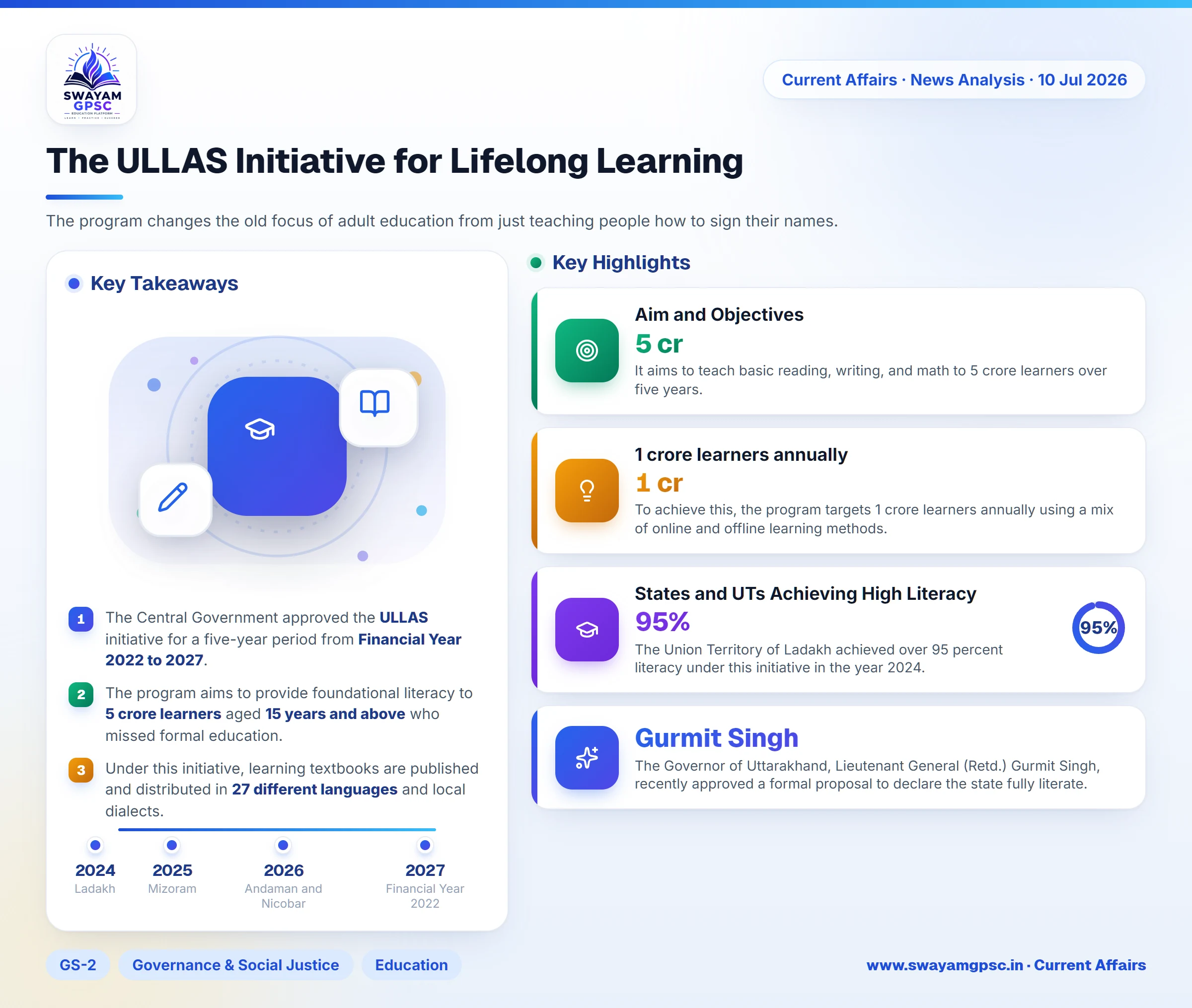
The ULLAS Initiative for Lifelong Learning
#GS-2 #Governance & Social Justice #Education #Current Events #National
Key takeaways
- The Central Government approved the ULLAS initiative for a five-year period from Financial Year 2022 to 2027.
- The program aims to provide foundational literacy to 5 crore learners aged 15 years and above who missed formal education.
- Under this initiative, learning textbooks are published and distributed in 27 different languages and local dialects.
- Uttarakhand recently became India's sixth fully literate State after its Governor approved the formal proposal in 2026.
Why in News
- The Governor of Uttarakhand, Lieutenant General (Retd.) Gurmit Singh, recently approved a formal proposal to declare the state fully literate.
- With this official approval, Uttarakhand has now become India's sixth fully literate State under the national literacy guidelines.
About the ULLAS Initiative
- The acronym ULLAS stands for Understanding of Lifelong Learning for All in Society.
- This centrally sponsored scheme is also known as the New India Literacy Programme or Nav Bharat Saaksharta Karyakram.
- The program changes the old focus of adult education from just teaching people how to sign their names.
- Instead, it defines literacy as having practical daily skills and basic life knowledge.
- The Central Government approved this nationwide program for a five-year period from Financial Year 2022 to 2027.
- The Department of School Education and Literacy (DoSEL) under the Union Ministry of Education manages this entire initiative.
Aim and Objectives
- The scheme targets non-literate adults who are 15 years and above and could not complete formal schooling.
- It aims to teach basic reading, writing, and math to 5 crore learners over five years.
- To achieve this, the program targets 1 crore learners annually using a mix of online and offline learning methods.
- The initiative wants to turn adult learning into a shared civic duty, known as Kartavya Bodh.
- This approach relies on community volunteers instead of relying only on strict government rules.
Key Features
- The new literacy standard tests if a person can read, write, do basic math, use smartphones, and understand simple money matters.
- Local schools serve as the main centers for classes.
- Unused classrooms, village libraries, or panchayat offices are converted into Samajik Chetna Kendras to conduct these classes.
- Learners can register and track their progress easily using the ULLAS Mobile App and Portal.
- Study materials are available in local languages through digital platforms like the centralized DIKSHA portal.
- The government publishes and distributes learning books, called Primers, in 27 different languages and local dialects.
- The program conducts the Foundational Literacy and Numeracy Assessment Test (FLNAT) twice a year to test learning levels.
- Students who pass this test get an official certificate signed by the National Institute of Open Schooling (NIOS) and DoSEL.
- To help learners find local jobs, successful students are linked with skill training at local Jan Shikshan Sansthans (JSS).
States and UTs Achieving High Literacy
- The Union Territory of Ladakh achieved over 95 percent literacy under this initiative in the year 2024.
- In the year 2025, several states and UTs reached this high literacy mark, including Mizoram, Goa, Tripura, Himachal Pradesh, and Chandigarh.
- By the year 2026, other regions like Andaman and Nicobar Islands, Sikkim, and Uttarakhand successfully achieved over 95 percent literacy.