The UDISE Report 2025-26: Key Findings and Gaps
#GS-2 #Governance & Social Justice #Education #GS-3 #Infrastructure #Current Events #National
Key takeaways
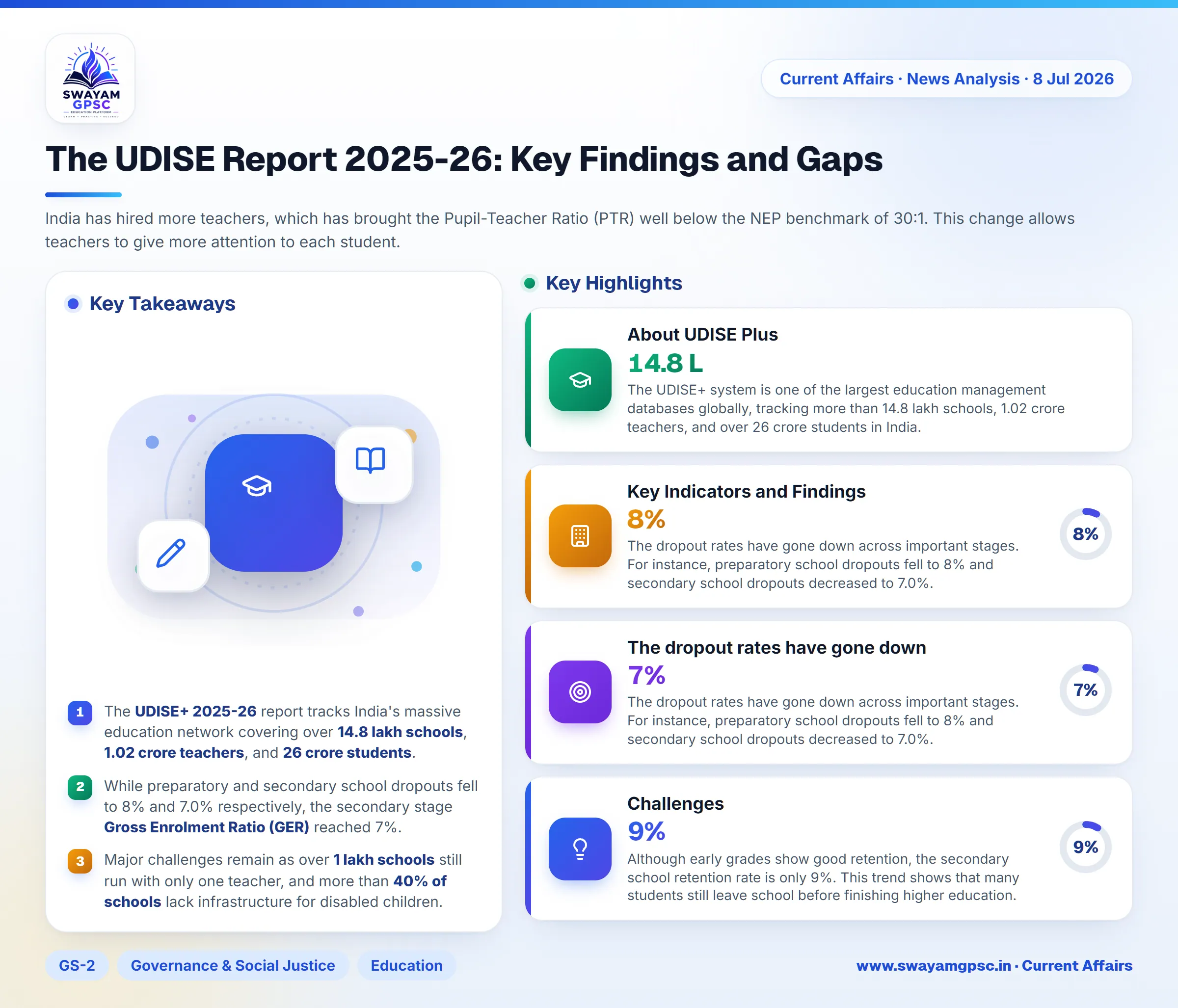
- The UDISE+ 2025-26 report tracks India's massive education network covering over 14.8 lakh schools, 1.02 crore teachers, and 26 crore students.
- While preparatory and secondary school dropouts fell to 8% and 7.0% respectively, the secondary stage Gross Enrolment Ratio (GER) reached 7%.
- Major challenges remain as over 1 lakh schools still run with only one teacher, and more than 40% of schools lack infrastructure for disabled children.
- Environmentally sustainable measures are lagging, with only 30% of schools equipped with rainwater harvesting systems.
Why in News
- The Union Ministry of Education has officially released the comprehensive report on the Unified District Information System for Education Plus (UDISE+) for the academic year 2025-26.
About UDISE Plus
- The UDISE+ system is one of the largest education management databases globally, tracking more than 14.8 lakh schools, 1.02 crore teachers, and over 26 crore students in India.
- This platform is the main data repository for school education under the Department of School Education and Literacy. It helps the government track progress, allocate budgets, and design policies in line with the National Education Policy (NEP).
Key Indicators and Findings
- The dropout rates have gone down across important stages. For instance, preparatory school dropouts fell to 8% and secondary school dropouts decreased to 7.0%.
- Student retention has improved at the middle and secondary levels. Additionally, the Gross Enrolment Ratio (GER) at the secondary stage has risen to 7%.
- Students are moving more smoothly from one school level to the next. This improvement in transition rates from foundational to preparatory, middle, and secondary levels reduces school dropouts.
- India has hired more teachers, which has brought the Pupil-Teacher Ratio (PTR) well below the NEP benchmark of 30:1. This change allows teachers to give more attention to each student.
- The government has merged unviable schools, such as those with zero enrolment or only one teacher. This step has improved resource use and school administration.
- Many more schools now have computers and active internet connections. This expansion helps schools deliver digital learning and technology-based lessons.
- Almost all schools now have electricity, clean drinking water, and working toilets. Furthermore, female teachers now make up the majority of the teaching workforce.
Challenges
- Although early grades show good retention, the secondary school retention rate is only 9%. This trend shows that many students still leave school before finishing higher education.
- While digital tools have improved, the percentage of schools with working playgrounds has decreased slightly. This shortage affects the physical growth and sports activities of students.
- More than 40% of schools do not have proper facilities for disabled students. This gap limits equal learning opportunities for children with special needs.
- Green infrastructure is growing slowly in schools. Currently, only about 30% of schools have rainwater harvesting systems installed.
- More than 1 lakh schools across India still run with just a single teacher. This situation places too much burden on one person and lowers education quality.
Way Forward
- The government should set up secondary and senior secondary schools at the block level in backward areas. This step will make high schools easier to reach and reduce dropouts.
- India needs a dedicated campaign to build ramps, accessible toilets, and barrier-free spaces in all remaining schools for children with special needs.
- The state should make rainwater harvesting and rooftop solar panels mandatory in schools. This can be funded using government budgets and corporate social responsibility funds.
- The education department must ensure that every active school has at least two full-time teachers to improve teaching quality.
- Schools with internet access should connect directly to digital learning platforms. These include the National Digital Library and PM e-VIDYA systems.
Conclusion
- Low high-school retention and single-teacher schools remain major hurdles. Addressing these infrastructure gaps while focusing on accessibility and digital equity is vital to achieve the goals of the National Education Policy.