UDISE+ and Performance Grading Index 2.0 Reports 2025-26
#GS-2 #GS-3 #Governance & Social Justice #Education #Human Resource #Government Policies & Interventions #Economy #Infrastructure
Why in News
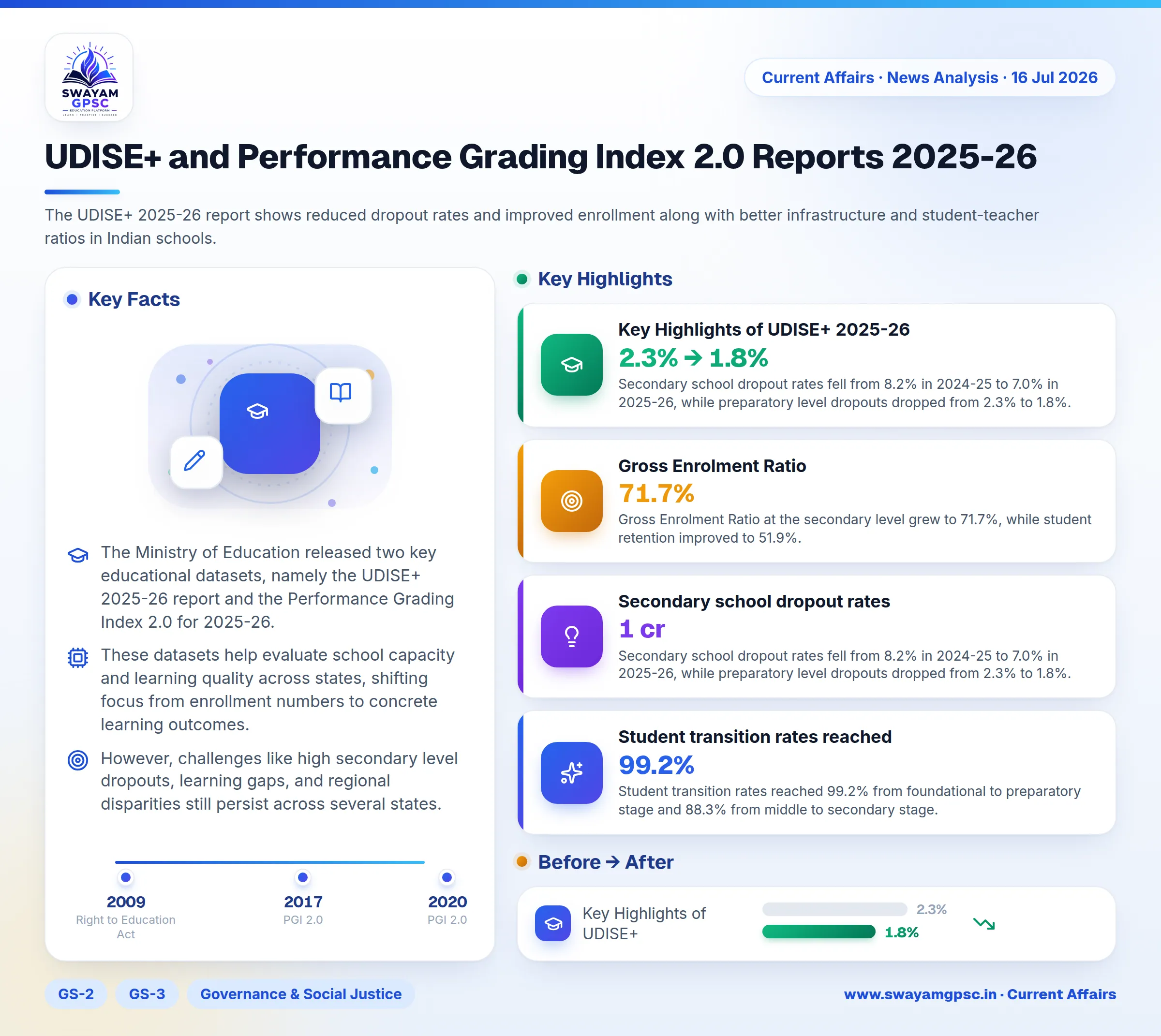
- The Ministry of Education released two key educational datasets, namely the UDISE+ 2025-26 report and the Performance Grading Index 2.0 for 2025-26.
- These datasets help evaluate school capacity and learning quality across states, shifting focus from enrollment numbers to concrete learning outcomes.
Executive Summary
- The UDISE+ 2025-26 report shows reduced dropout rates and improved enrollment along with better infrastructure and student-teacher ratios in Indian schools.
- However, challenges like high secondary level dropouts, learning gaps, and regional disparities still persist across several states.
- The PGI 2.0 index shows that no state achieved the highest performance grades, highlighting the need for data driven reforms aligned with the NEP 2020.
Key Highlights of UDISE+ 2025-26
- Secondary school dropout rates fell from 8.2% in 2024-25 to 7.0% in 2025-26, while preparatory level dropouts dropped from 2.3% to 1.8%.
- Ladakh, Gujarat, Chhattisgarh, and Karnataka recorded the highest secondary level dropout rates among all states and union territories.
- Gross Enrolment Ratio at the secondary level grew to 71.7%, while student retention improved to 51.9%.
- India crossed the milestone of 1 crore school teachers, achieving 1.02 crore total teachers across the nation.
- The Pupil-Teacher Ratio remains well within the NEP 2020 limit of 30:1, standing at 10:1 for Foundational and 21:1 for Secondary level.
- Student transition rates reached 99.2% from foundational to preparatory stage and 88.3% from middle to secondary stage.
- Digital access expanded significantly, with 69.9% of schools having computers and 67.4% having active internet connections.
- Basic infrastructure improved, with 95% of schools having electricity, 99.5% having drinking water, and 98.5% providing girls toilets.
- While 90.5% of schools have functional libraries, only 58.2% feature ramps with handrails for disabled children.
- Female representation stands strong with women making up 54.9% of teachers and girls accounting for 48.4% of student enrolment.
About UDISE+
- The Ministry of Education developed UDISE+ as a comprehensive national digital database for school statistics across government and private institutions.
- It tracks data from pre-primary to higher secondary levels to enable effective policy design and resource allocation.
- This platform supplies real-time data to monitor key national education programs including NEP 2020 and Samagra Shiksha.
Key Highlights of Performance Grading Index 2.0
- No State or Union Territory managed to score high enough to enter the top three grade bands of Utkarsh, Uttam-1, or Uttam-2.
- Chandigarh achieved the highest score nationwide, placing in the Uttam-3 grade band.
- All States and Union Territories scored above the lowest bands, ensuring no region fell into Akanshi-2 or Akanshi-3.
About Performance Grading Index 2.0
- Developed by the Department of School Education and Literacy, PGI 2.0 serves as a composite tool to evaluate state education systems.
- First introduced in 2017, this system was revised under PGI 2.0 to match the goals of NEP 2020.
- The framework assesses states across 73 indicators spread over 6 domains worth a cumulative 1,000 points.
- It integrates with portals like UDISE+, National Achievement Survey, PM POSHAN, and Vidyanjali for direct data verification.
- States are classified into 10 levels ranging from Utkarsh down to Akanshi-3 to highlight educational quality over physical facilities.
Challenges
- Student retention drops sharply from 98.5% at early levels down to 51.9% at the Secondary stage, creating a massive drop-off cliff.
- Weak foundational reading skills in early grades prevent students from coping with higher classes, driving learning poverty and dropouts by Class 9.
- The lack of Foundational Literacy and Numeracy creates learning fatigue among students entering complex secondary curricula.
- Over 1 lakh schools in India continue to operate with a single teacher, creating structural burnout and low teaching quality.
- More than 40% of schools lack necessary disability friendly infrastructure for Children with Special Needs.
- High structural infrastructure access has not translated into quality learning outcomes as shown by low overall PGI scores.
- A large 31.4% performance gap separates top performer Chandigarh from lower ranked states like Meghalaya, Bihar, and West Bengal.
- Low scoring districts lack financial resources and administrative support required to upgrade classrooms and train teachers.
Government Initiatives to Prevent Dropouts
- Implementation of the mandatory schooling rights under the Right to Education Act, 2009.
- Funding school interventions and infrastructure through the flagship Samagra Shiksha Abhiyan.
- Nutritional support through the nationwide PM POSHAN scheme to retain students in class.
- Targeted residential schooling for underprivileged girls through Kasturba Gandhi Balika Vidyalayas.
Way Forward
- Merge single-teacher schools into consolidated cluster schools and expand the APAAR unique student identity framework.
- Accelerate the NIPUN Bharat Mission for early numeracy while utilizing the PARAKH competency evaluation framework.
- Fill teacher vacancies through mission mode recruitment and mandate continuous training via the DIKSHA digital portal.
- Introduce vocational training from Class VI onwards while improving infrastructure for Children with Special Needs.
- Institute third party academic audits at the Panchayat level to tie Samagra Shiksha funding directly to verified learning results.
Conclusion
- India has expanded structural school access significantly, but fulfilling NEP 2020 targets requires shifting complete administrative focus toward quality learning outcomes and inclusive regional development.