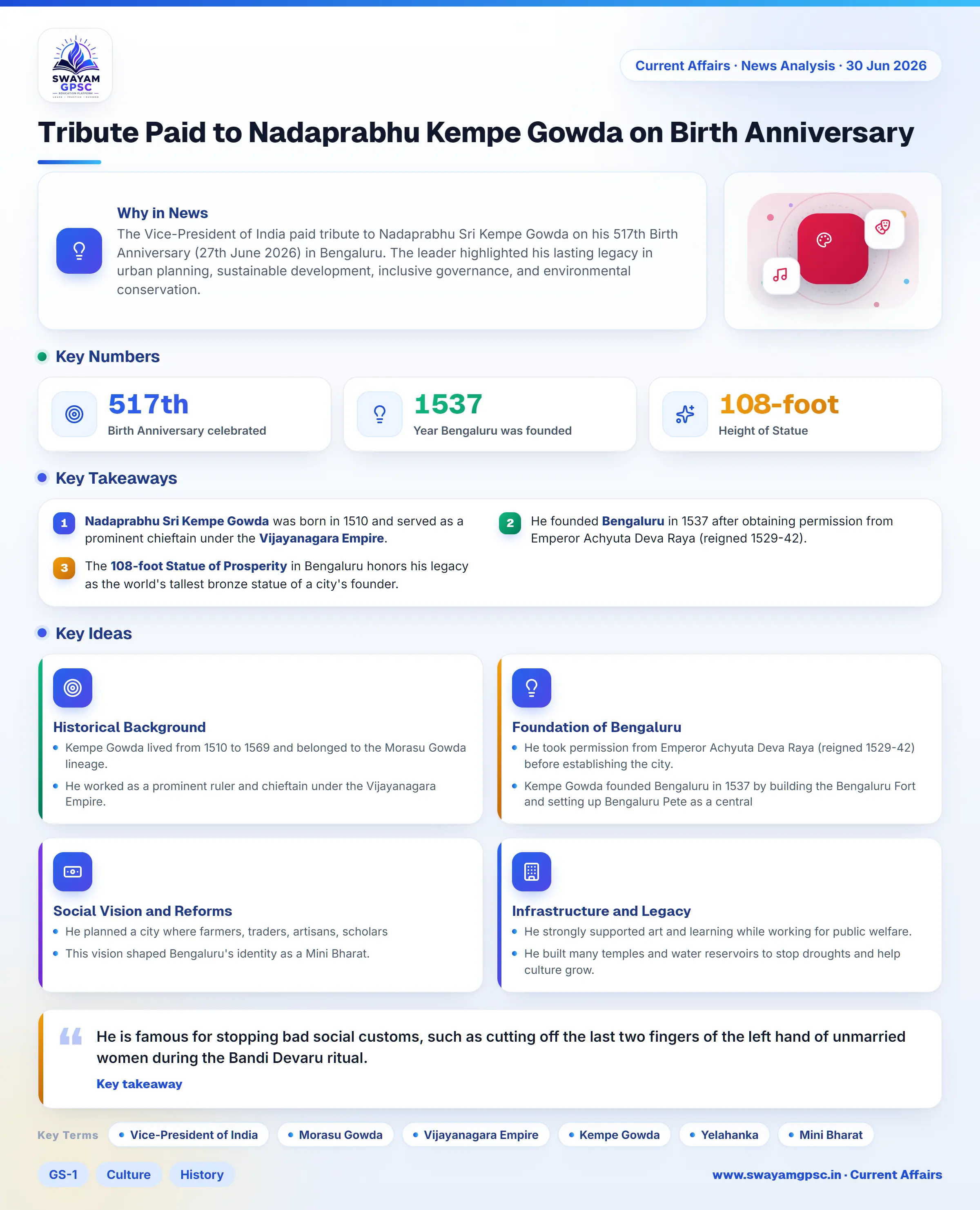
Tribute Paid to Nadaprabhu Kempe Gowda on Birth Anniversary
#GS-1 #Culture #History #Modern India #Heritage #Gujarat
Key takeaways
- Nadaprabhu Sri Kempe Gowda was born in 1510 and served as a prominent chieftain under the Vijayanagara Empire.
- He founded Bengaluru in 1537 after obtaining permission from Emperor Achyuta Deva Raya (reigned 1529-42).
- The 108-foot Statue of Prosperity in Bengaluru honors his legacy as the world's tallest bronze statue of a city's founder.
Why in News
- The Vice-President of India paid tribute to Nadaprabhu Sri Kempe Gowda on his 517th Birth Anniversary (27th June 2026) in Bengaluru.
- The leader highlighted his lasting legacy in urban planning, sustainable development, inclusive governance, and environmental conservation.
Historical Background
- Kempe Gowda lived from 1510 to 1569 and belonged to the Morasu Gowda lineage.
- He worked as a prominent ruler and chieftain under the Vijayanagara Empire.
Foundation of Bengaluru
- He took permission from Emperor Achyuta Deva Raya (reigned 1529-42) before establishing the city.
- Kempe Gowda founded Bengaluru in 1537 by building the Bengaluru Fort and setting up Bengaluru Pete as a central market.
- He shifted his capital from Yelahanka, which laid the groundwork for the modern city we see today.
Social Vision and Reforms
- He planned a city where farmers, traders, artisans, scholars, and people of different faiths could live together and grow.
- This vision shaped Bengaluru's identity as a Mini Bharat.
- He is famous for stopping bad social customs, such as cutting off the last two fingers of the left hand of unmarried women during the Bandi Devaru ritual.
- This custom was common among the Morasu Vokkaligas before he banned it.
Infrastructure and Legacy
- He strongly supported art and learning while working for public welfare.
- He built many temples and water reservoirs to stop droughts and help culture grow.
- The 108-foot Statue of Prosperity in Bengaluru honors his memory.
- The World Book of Records recognizes it as the world's tallest bronze statue of a city's founder.