The Transparency And Credibility In Public Institutions
#GS-2 #Governance & Social Justice #Good Governance #Education #Economy
Key takeaways
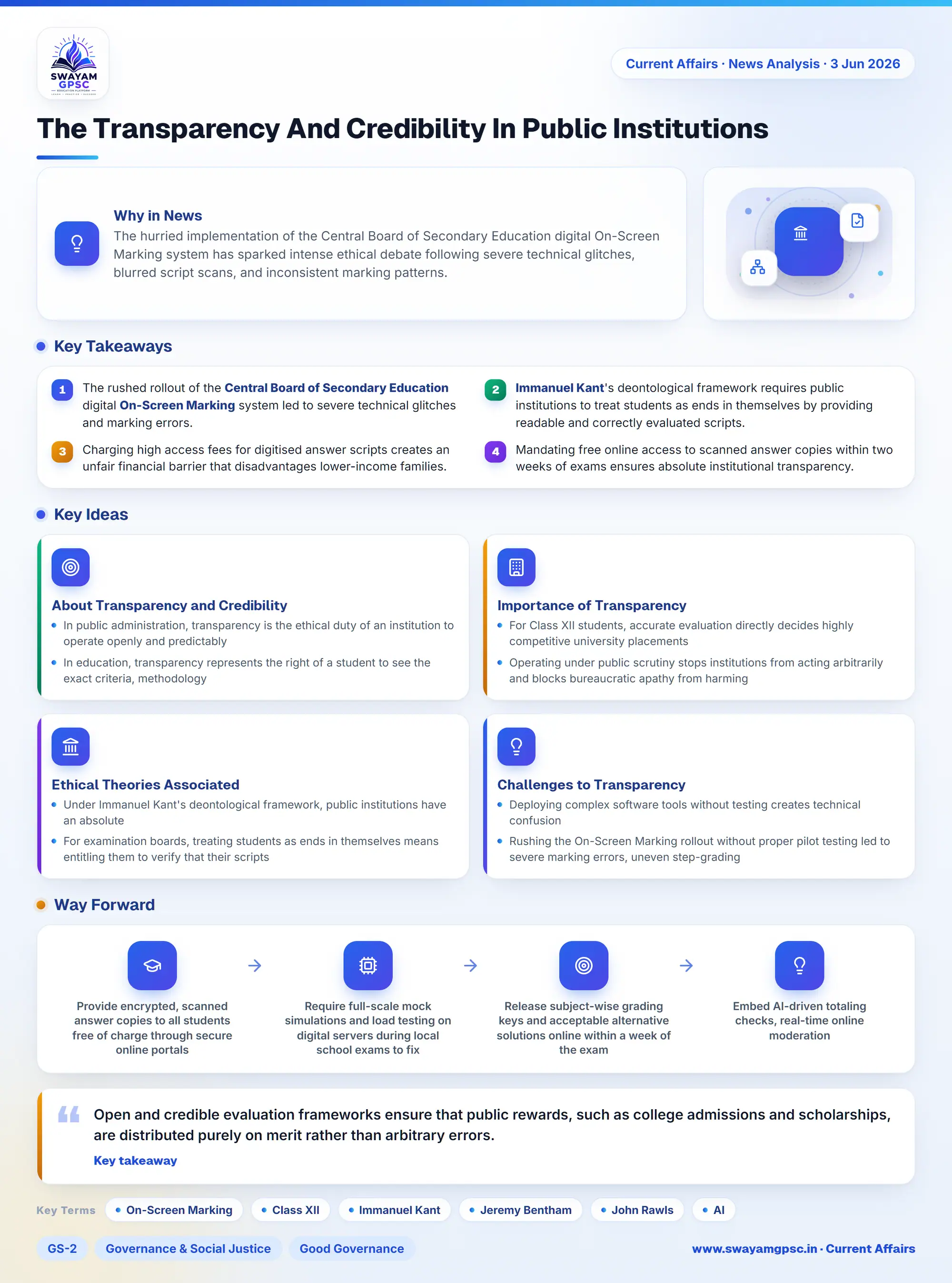
- The rushed rollout of the Central Board of Secondary Education digital On-Screen Marking system led to severe technical glitches and marking errors.
- Immanuel Kant's deontological framework requires public institutions to treat students as ends in themselves by providing readable and correctly evaluated scripts.
- Charging high access fees for digitised answer scripts creates an unfair financial barrier that disadvantages lower-income families.
- Mandating free online access to scanned answer copies within two weeks of exams ensures absolute institutional transparency.
Why in News
- The hurried implementation of the Central Board of Secondary Education digital On-Screen Marking system has sparked intense ethical debate following severe technical glitches, blurred script scans, and inconsistent marking patterns.
About Transparency and Credibility
- In public administration, transparency is the ethical duty of an institution to operate openly and predictably, ensuring unfettered access to information, standard operating procedures, and decision-making workflows.
- In education, transparency represents the right of a student to see the exact criteria, methodology, and steps used by an evaluator to assess their work.
- Credibility is the moral capital an institution earns over time, built on reliability, fairness, expertise, and consistency.
- When an institution has high credibility, society accepts its certificates, evaluations, and judgments as valid and just benchmarks for human progress.
Importance of Transparency and Credibility
- Open and credible evaluation frameworks ensure that public rewards, such as college admissions and scholarships, are distributed purely on merit rather than arbitrary errors.
- For Class XII students, accurate evaluation directly decides highly competitive university placements, making institutional fairness an absolute prerequisite for societal equity.
- Operating under public scrutiny stops institutions from acting arbitrarily and blocks bureaucratic apathy from harming individual citizens.
- Releasing comprehensive subject marking schemes within a week prevents examiners from applying personal bias, forcing them to follow uniform guidelines.
- When public bodies operate with absolute clarity, it builds social harmony and reinforces public faith in state systems.
- Proactively providing scanned answer books to all students free of cost eliminates public suspicion and reduces legal disputes over grading.
- Open tracking networks expose structural flaws early, allowing public institutions to fix technical and operational issues before they escalate.
- Using digital audit trails and anomaly-detection systems allows supervisors to catch evaluation errors instantly, ensuring consistent grading standards.
Ethical Theories Associated with Public Governance
- Under Immanuel Kant's deontological framework, public institutions have an absolute, non-negotiable moral duty to protect the rights of individuals, regardless of administrative effort.
- For examination boards, treating students as ends in themselves means entitling them to verify that their scripts are complete, readable, and evaluated strictly according to established rules.
- Jeremy Bentham and John Stuart Mill's utilitarian focus demands that public systems optimize the greatest happiness for the greatest number.
- Hurried digital rollouts that create server errors and grading anomalies violate this principle by causing widespread distress among millions of students and families.
- True utilitarian value is achieved only when robust, fully simulated infrastructure delivers accurate results, maximizing trust and system stability.
- John Rawls' theory of justice as fairness states that institutional rules must be designed to protect the most vulnerable stakeholders.
- Charging high fees to access digitised answer scripts creates an unfair financial barrier that discriminates against lower-income families.
- A just system must provide free, equal access to these scripts to ensure fairness across all socio-economic backgrounds.
Challenges to Transparency and Credibility
- Deploying complex software tools without testing creates technical confusion, undercutting the accuracy of public evaluations.
- Rushing the On-Screen Marking rollout without proper pilot testing led to severe marking errors, uneven step-grading, and left answers unchecked.
- Charging citizens high fees to access their own records acts as a financial barrier that blocks accountability.
- Forcing students to pay fees to view their own digitised answer scripts protects bad evaluations while penalizing lower-income applicants.
- Using under-powered servers or low-quality hardware introduces data errors that compromise institutional accuracy.
- Using poor-quality scanning equipment produced blurred and incomplete digital files, making it impossible for evaluators to grade fairly.
- Operating within isolated bureaucratic silos allows errors to multiply undetected, damaging long-term credibility.
- The absence of real-time independent moderation allowed arbitrary marking variations to slip through, sparking public controversy.
Way Forward
- Provide encrypted, scanned answer copies to all students free of charge through secure online portals within two weeks of their exams to ensure absolute transparency.
- Require full-scale mock simulations and load testing on digital servers during local school exams to fix portal bugs before a national rollout.
- Release subject-wise grading keys and acceptable alternative solutions online within a week of the exam to eliminate evaluator subjectivity.
- Embed AI-driven totaling checks, real-time online moderation, and anomaly-detection trackers within the evaluation software to ensure grading consistency.
- Require all evaluators, scanning operators, and system managers to complete formal training in digital handling and ethical grading practices before reviewing scripts.