Transmission Bottlenecks in India's Renewable Energy Sector
#GS-3 #Economy #Infrastructure #Energy #Renewable Energy #Environment #Climate Change
Key takeaways
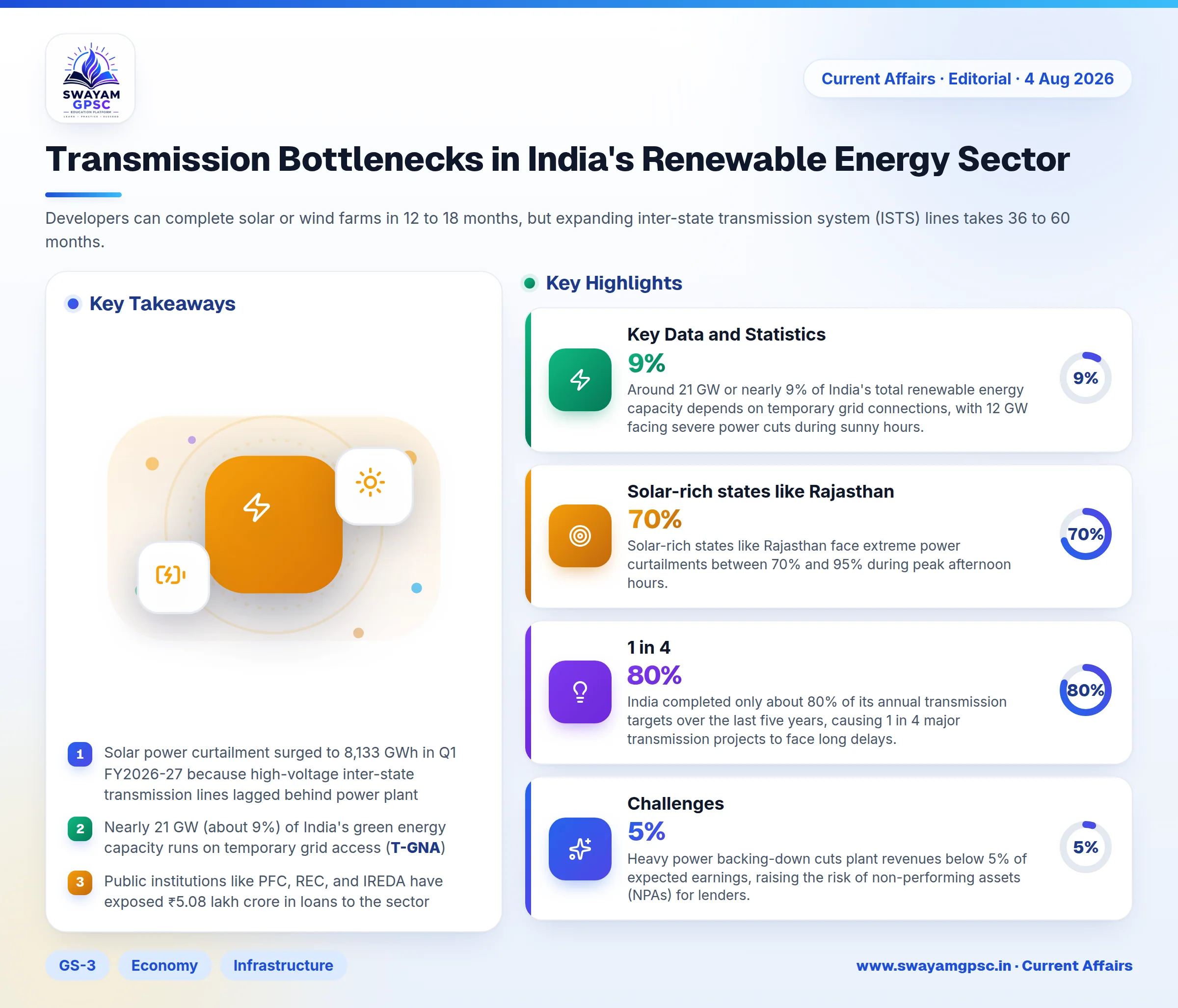
- Solar power curtailment surged to 8,133 GWh in Q1 FY2026-27 because high-voltage inter-state transmission lines lagged behind power plant construction.
- Nearly 21 GW (about 9%) of India's green energy capacity runs on temporary grid access (T-GNA), causing peak-hour generation cuts of 70% to 95% in Rajasthan.
- Public institutions like PFC, REC, and IREDA have exposed ₹5.08 lakh crore in loans to the sector, escalating non-performing asset (NPA) risks as project revenues drop.
- Achieving India's 2030 non-fossil capacity target of 500 GW requires synchronized transmission planning, 3-4 GW of grid battery storage, and debt restructuring for developers.
Why in News
- The Sustainable Project Developers Association (SPDA) recently reached out to the Ministry of New and Renewable Energy (MNRE) for financial relief.
- This request came after grid operators curtailed 8,133 GWh of solar electricity between April and June 2026 because transmission lines were not ready.
What are Transmission Bottlenecks?
- Transmission bottlenecks happen when companies build solar and wind plants much faster than the government builds high-voltage power lines.
- Developers can complete solar or wind farms in 12 to 18 months, but expanding inter-state transmission system (ISTS) lines takes 36 to 60 months.
- Because of this delay, power plants must run on Temporary General Network Access (T-GNA), which only allows them to supply power when spare grid capacity exists during non-peak hours.
Key Data and Statistics
- Around 21 GW or nearly 9% of India's total renewable energy capacity depends on temporary grid connections, with 12 GW facing severe power cuts during sunny hours.
- Grid capacity shortages forced power operators to waste 6,900 GWh of green power in FY2025-26 and 8,133 GWh in just the first quarter of FY2026-27.
- Solar-rich states like Rajasthan face extreme power curtailments between 70% and 95% during peak afternoon hours.
- India completed only about 80% of its annual transmission targets over the last five years, causing 1 in 4 major transmission projects to face long delays.
Reasons for Transmission Bottlenecks
- Renewable power plants take under 18 months to build, while transmission lines require up to 60 months due to slow civil work and equipment buying.
- Getting land rights for transmission lines causes friction, as local farmers frequently protest against power towers crossing their fields.
- Clearances for lines passing through sensitive wildlife areas take very long, such as underground cabling rules protecting the Great Indian Bustard in Rajasthan and Gujarat.
- Global shortages of high-voltage direct current (HVDC) transformers and circuit breakers delay key grid projects.
- Concentrating solar and wind plants in resource-rich areas like Rajasthan and Gujarat overloads local power pooling stations.
Challenges
- Heavy power backing-down cuts plant revenues below 5% of expected earnings, raising the risk of non-performing assets (NPAs) for lenders.
- Unpredictable grid access drops internal rates of return (IRRs), making foreign investors reluctant to fund new solar projects.
- Public lenders like PFC, REC, and IREDA have extended over ₹5.08 lakh crore in loans to green energy projects, creating financial risks for the banking system.
- Wasting clean electricity forces power utilities to burn coal to meet electricity demand, making green energy goals harder to achieve.
- Persistent grid delays threaten India's goal of reaching 500 GW of non-fossil fuel power capacity by 2030.
Initiatives Taken So Far
- The Central Electricity Regulatory Commission (CERC) introduced General Network Access (GNA) rules to grant reliable, long-term grid access to power plants.
- The government launched Green Energy Corridors Phase-I and Phase-II to carry renewable power across state boundaries.
- Authorities expanded power grid targets to 25,146 circuit kilometers for FY2026-27 to clear transmission backlogs.
- Regulators introduced T-GNA rules as a stopgap option so completed solar plants could sell extra power instead of remaining completely shut.
Way Forward
- Planning committees must coordinate solar project approvals directly with transmission line construction schedules.
- Installing 3 to 4 GW of battery energy storage systems (BESS) at crowded grid sub-stations can store excess afternoon power for evening use.
- The RBI and financial bodies should offer debt restructuring and lower-cost bridge loans to developers affected by grid delays.
- Grid companies should use dynamic line rating (DLR) tools and modern conductors to boost line capacity without building new towers.
- Regulators need to create clear financial compensation rules for power projects forced to stop generation due to grid overload.
Conclusion
- Transmission delays present real operational and financial risks to India's clean energy goals.
- Building power lines on time, deploying energy storage, and offering financial support to power producers will safeguard investments and help reach climate targets for 2030.