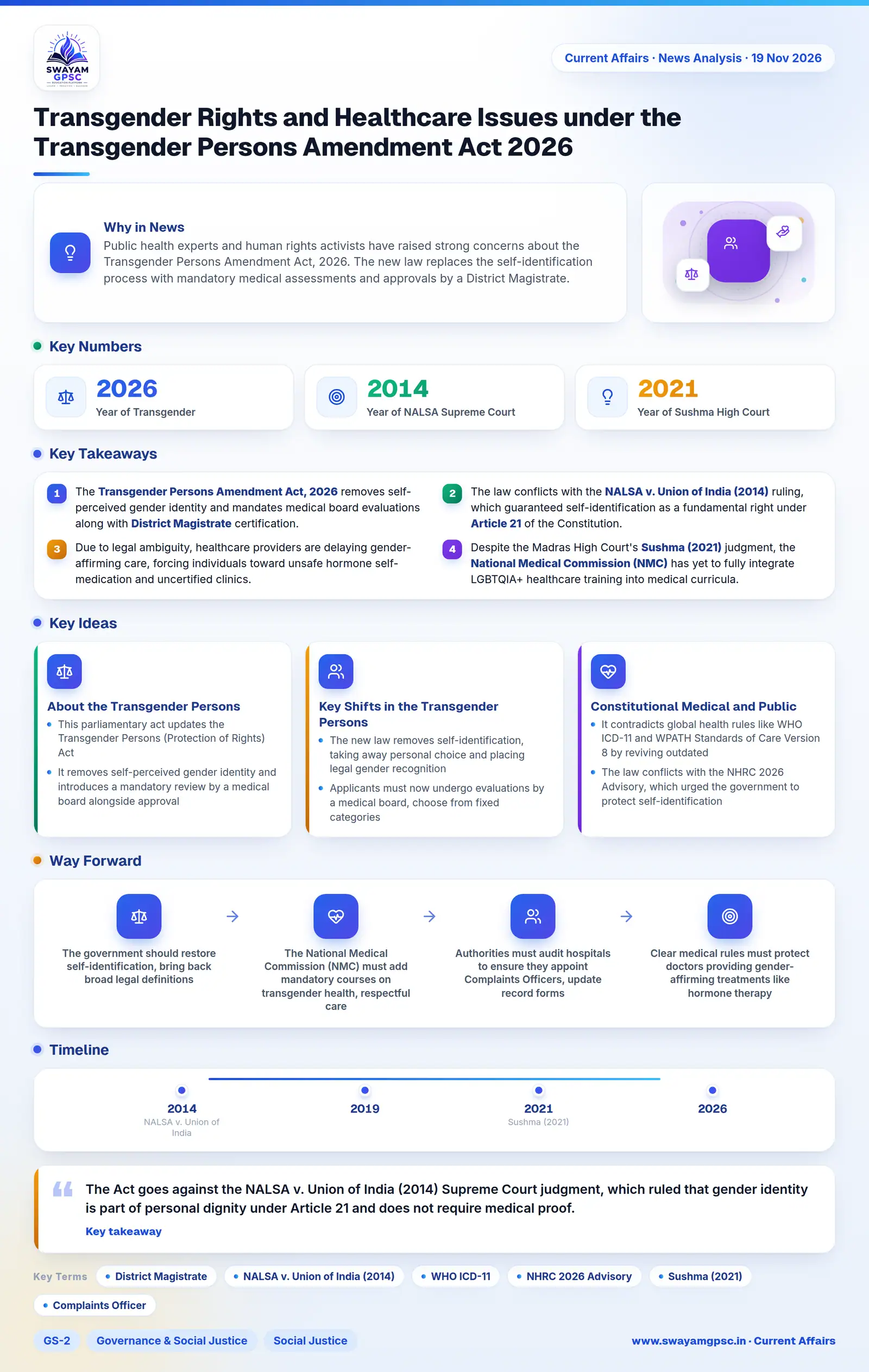
Transgender Rights and Healthcare Issues under the Transgender Persons Amendment Act 2026
#GS-2 #Governance & Social Justice #Social Justice #Vulnerable Sections #Health #Human Rights #Transgender Rights
Key takeaways
- The Transgender Persons Amendment Act, 2026 removes self-perceived gender identity and mandates medical board evaluations along with District Magistrate certification.
- The law conflicts with the NALSA v. Union of India (2014) ruling, which guaranteed self-identification as a fundamental right under Article 21 of the Constitution.
- Due to legal ambiguity, healthcare providers are delaying gender-affirming care, forcing individuals toward unsafe hormone self-medication and uncertified clinics.
- Despite the Madras High Court's Sushma (2021) judgment, the National Medical Commission (NMC) has yet to fully integrate LGBTQIA+ healthcare training into medical curricula.
Why in News
- Public health experts and human rights activists have raised strong concerns about the Transgender Persons Amendment Act, 2026.
- The new law replaces the self-identification process with mandatory medical assessments and approvals by a District Magistrate.
About the Transgender Persons Amendment Act 2026
- This parliamentary act updates the Transgender Persons (Protection of Rights) Act, 2019 to change how India legally recognizes gender identity.
- It removes self-perceived gender identity and introduces a mandatory review by a medical board alongside approval from a District Magistrate.
- The law also limits the statutory definition of transgender to specific biological conditions and a few cultural identities.
Key Shifts in the Transgender Persons Amendment Act 2026
- The new law removes self-identification, taking away personal choice and placing legal gender recognition under medical and official control.
- Applicants must now undergo evaluations by a medical board, choose from fixed categories, and get a formal certificate from a District Magistrate.
- The Act removes broad terms like trans men, trans women, and genderqueer, limiting legal status to specific sex characteristic variations and select cultural groups.
- The law offers no independent appeal process to challenge medical board rejections or administrative delays, even though this certificate controls access to welfare, jobs, and education.
Constitutional Medical and Public Health Implications
- The Act goes against the NALSA v. Union of India (2014) Supreme Court judgment, which ruled that gender identity is part of personal dignity under Article 21 and does not require medical proof.
- It contradicts global health rules like WHO ICD-11 and WPATH Standards of Care Version 8 by reviving outdated psychiatric assessments.
- The law conflicts with the NHRC 2026 Advisory, which urged the government to protect self-identification, create grievance panels, and cut administrative hurdles.
- Uncertainty around gender-affirming care has led doctors to stop services, driving people toward unsafe surgeries, self-medication, and unqualified workers.
- Helplines report higher levels of anxiety, depression, sleep issues, and suicidal thoughts caused by official delays and systemic exclusion.
- Transgender people face stigma, lack of privacy, and untrained staff when seeking basic care for everyday health issues like diabetes, hypertension, or emergency treatment.
Existing Legal and Institutional Gaps in Healthcare
- Although the Madras High Court ordered gender sensitivity training in the Sushma (2021) case, the National Medical Commission (NMC) has not built this into medical courses.
- Most public and private hospitals have failed to appoint a Complaints Officer, even though the 2019 Act explicitly requires it.
- Hospital record systems remain rigid, making it impossible to record a patient's preferred name and gender identity alongside necessary medical data.
Way Forward
- The government should restore self-identification, bring back broad legal definitions, and create an independent appeals process for rejected applications.
- The National Medical Commission (NMC) must add mandatory courses on transgender health, respectful care, and gender-affirming treatment to medical and nursing training.
- Authorities must audit hospitals to ensure they appoint Complaints Officers, update record forms, and offer gender-neutral restrooms and hospital wards.
- Clear medical rules must protect doctors providing gender-affirming treatments like hormone therapy and surgeries, keeping patients away from unsafe providers.
Conclusion
- Replacing self-identification with administrative gatekeeping under the 2026 Amendment hurts personal dignity and public health.
- Access to rights and welfare schemes should never force individuals to give up bodily dignity or safe healthcare.
- India must align its laws with the NALSA ruling, international health standards, and hospital reforms to protect transgender citizens from marginalization.