Transforming India Through Integrated Infrastructure Development
#GS-3 #Infrastructure #Inclusive Growth #Economy #Growth #Agriculture #Energy #Science & Technology #ICT #Environment
Key takeaways
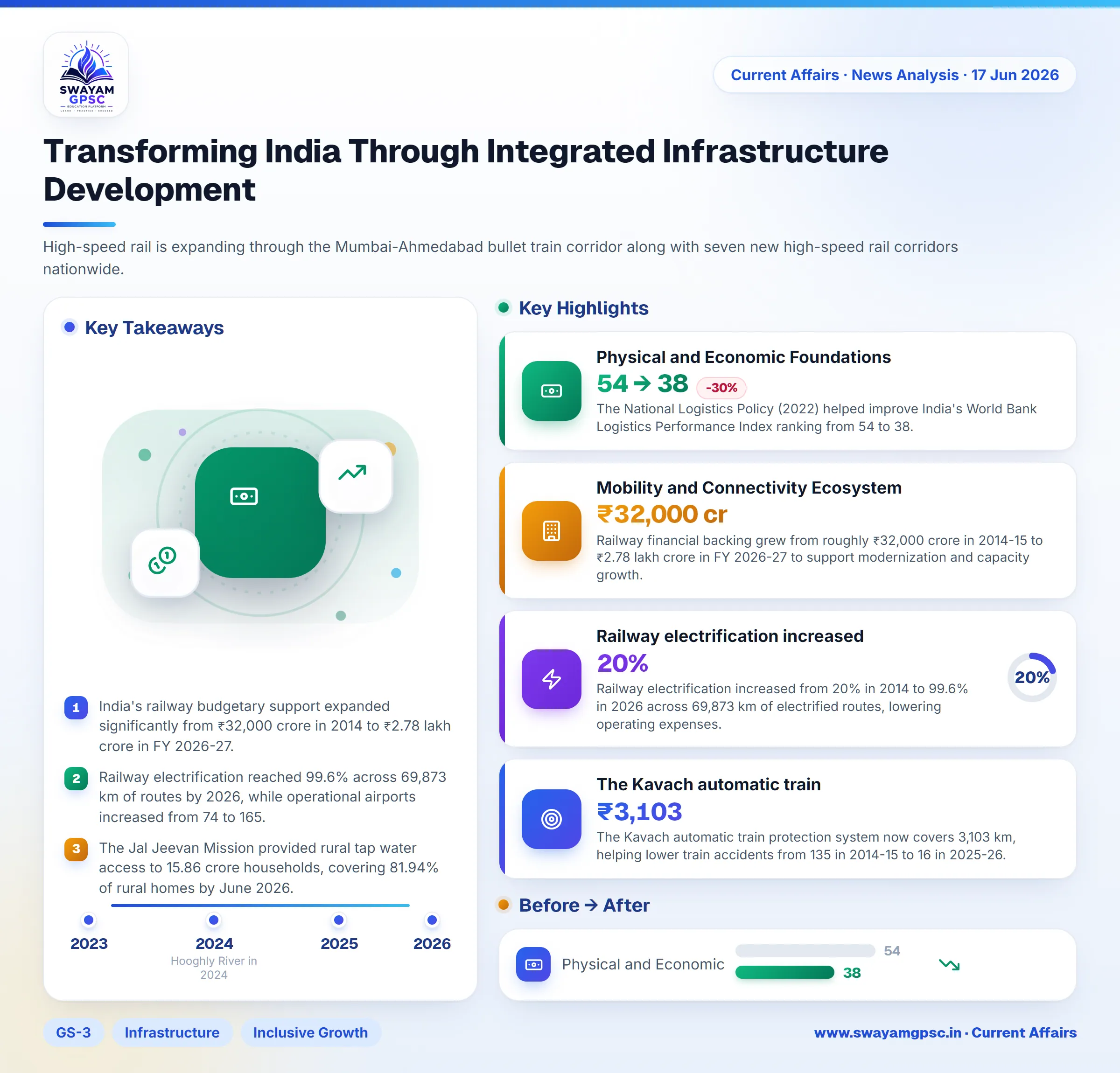
- India's railway budgetary support expanded significantly from ₹32,000 crore in 2014 to ₹2.78 lakh crore in FY 2026-27.
- Railway electrification reached 99.6% across 69,873 km of routes by 2026, while operational airports increased from 74 to 165.
- The Jal Jeevan Mission provided rural tap water access to 15.86 crore households, covering 81.94% of rural homes by June 2026.
- India's total installed power capacity reached 532.74 GW by March 2026, backed by major clean energy expansions.
Why in News
- India has focused heavily on large-scale infrastructure growth across transport, housing, water, energy, logistics, and digital systems over the past ten years.
- Major programmes like PM GatiShakti, PRAGATI, and the National Logistics Policy have boosted connectivity and created a modern economy.
Mobility and Connectivity Ecosystem
- Railway financial backing grew from roughly ₹32,000 crore in 2014-15 to ₹2.78 lakh crore in FY 2026-27 to support modernization and capacity growth.
- Railway electrification increased from 20% in 2014 to 99.6% in 2026 across 69,873 km of electrified routes, lowering operating expenses.
- India introduced modern indigenous trains like Vande Bharat and Amrit Bharat Express, with 162 Vande Bharat services and 60 Amrit Bharat trains running successfully.
- High-speed rail is expanding through the Mumbai-Ahmedabad bullet train corridor along with seven new high-speed rail corridors nationwide.
- The Amrit Bharat Station Scheme (2023) has upgraded 208 out of 1,338 identified stations with better passenger facilities.
- The Kavach automatic train protection system now covers 3,103 km, helping lower train accidents from 135 in 2014-15 to 16 in 2025-26.
- Freight logistics have expanded under PM Gati Shakti through 139 operational cargo terminals and 300 approved terminals.
- India now operates the second-largest road network globally, spanning 63.73 lakh km.
- National Highways grew from 91,287 km in 2014 to 1,46,572 km by March 2026.
- High-capacity roads with four or more lanes increased from 18,371 km in 2014 to 45,516 km in 2026.
- Access-controlled expressways now span 3,644 km, reducing travel time and highway congestion.
- Under the Pradhan Mantri Gram Sadak Yojana (PMGSY), 99.6% of eligible habitations are connected, with budget support rising to ₹19,000 crore in 2026-27.
- The Bharatmala Pariyojana has completed 22,590 km of roads to improve freight movement and border access.
- Operational airports expanded from 74 in 2014 to 165 in 2026.
- The UDAN Scheme connected 665 routes across 95 airports, helping over 1.64 crore passengers travel affordably.
- New greenfield airports include Mopa in Goa, Kannur in Kerala, Hollongi in Arunachal Pradesh, Navi Mumbai International Airport, and Noida Jewar Airport.
- Digital tools like DigiYatra enable paperless travel, while GAGAN improves navigation accuracy and safety.
- India has built the world’s third-largest metro network, expanding from 248 km in 2014 to 1,155 km in 2026 across 26 cities.
- The Metro Rail Policy (2017) encourages joint public-private projects and local manufacturing of metro coaches.
- Kolkata launched India's first underwater metro tunnel beneath the Hooghly River in 2024, Kochi started a Water Metro, and the Delhi-Meerut corridor introduced the Namo Bharat Rapid Rail.
- Maritime transport handles about 95% of India’s trade by volume and 70% by value.
- Major port capacity nearly doubled from 873 MMTPA in 2014 to 1,726 MMTPA in 2026, while vessel turnaround time dropped to 48.8 hours.
- The Sagarmala Programme (launched in 2015) links ports directly with industrial clusters to cut logistics expenses.
- National Waterways expanded from 5 in 2014 to 111 in 2026, moving 218 MMT of cargo.
- The Jal Marg Vikas Project and Arth Ganga Initiative improved National Waterway-1 on the Ganga-Bhagirathi-Hooghly system.
- Varanasi operationalized India's first hydrogen fuel cell vessel in 2025 to support clean water transport.
Physical and Economic Foundations
- India has mapped 4,220 industrial parks spanning 6.98 lakh hectares, with 1.33 lakh hectares still available for new investments.
- The country built 272 plug-and-play industrial parks, and plans 100 new parks under the BHAVYA scheme (2026) to speed up business setups.
- The government approved 20 Industrial Smart Cities across 7 major industrial corridors to boost advanced manufacturing.
- Sector-specific zones include 3 chemical parks, 7 PM MITRA textile parks, and the ₹10,000 crore Biopharma SHAKTI programme.
- The India Industrial Land Bank (IILB) offers a GIS-based digital platform for transparent land mapping.
- The PM GatiShakti National Master Plan (2021) coordinates planning across 58 Ministries and Departments using 3,202 data layers.
- The National Logistics Policy (2022) helped improve India's World Bank Logistics Performance Index ranking from 54 to 38.
- Platforms like ULIP (2022), the Logistics Data Bank (2016), and FASTag (2016) streamline supply chains and electronic toll collection.
- The PRAGATI platform (launched in 2015) reviewed 382 major infrastructure projects and resolved 2,958 bottlenecks.
- The Ministry of Jal Shakti (2019) combines drinking water, sanitation, and irrigation management under one roof.
- The Jal Jeevan Mission provided tap water connections to 15.86 crore households by June 2026, covering 81.94% of rural homes.
- Key projects like Pradhan Mantri Krishi Sinchayee Yojana (2015), Namami Gange Programme (2014), and the Ken-Betwa Link Project (2021) boost water security.
- Tools like the FloodWatch India App and the Dam Safety Act (2021) improve disaster readiness.
- Pradhan Mantri Awas Yojana Urban (2015) completed 98.10 lakh houses, with 96% allotted to women or jointly owned.
- Pradhan Mantri Awas Yojana Gramin (2016) finished 3.06 crore rural houses, with 75% of owners being women.
- The SWAMIH Fund (2019) used a corpus of ₹15,531 crore to finish 63,000 stalled housing units.
- AMRUT and AMRUT 2.0 (2015-26) sanctioned projects worth ₹2.79 lakh crore, adding 2.53 crore tap water connections.
Energy Security and Digital Connectivity
- India's installed power capacity reached 532.74 GW by March 2026, up from 248 GW in 2014.
- India ranks as the 3rd largest clean energy producer and holds the 4th largest wind energy capacity globally.
- Power shortages dropped from 4.2% in 2014 to 0.03% in 2025-26, while rural power supply increased to 22.6 hours per day.
- The PM Surya Ghar Scheme (2024) and GOBARdhan Scheme (2018) promote rooftop solar and waste-to-energy solutions.
- The Saubhagya Scheme (2017) provided electricity connections to 2.86 crore households.
- Global clean energy efforts are supported through the International Solar Alliance and the Global Biofuels Alliance (2026).
- National LPG coverage grew from 55.9% in 2014 to 107.2% in 2026, serving 33.39 crore consumers.
- Pradhan Mantri Ujjwala Yojana (2016) delivered 49.21 crore LPG refills and 25 lakh new connections using biometric verification.
- Telephone teledensity rose from 75.23% in 2014 to 86.23% in 2025, while internet users grew to 100.29 crore.
- The PM-WANI framework (2020) set up over 4.10 lakh public Wi-Fi hotspots, and 5G services reached 85% of the population by 2026.
- The JAM Trinity linked with UPI enabled real-time digital payments worth ₹29.53 lakh crore across eight countries.
- Digital platforms like DigiLocker, UMANG, Common Service Centres, and SWAYAM have improved public service delivery.