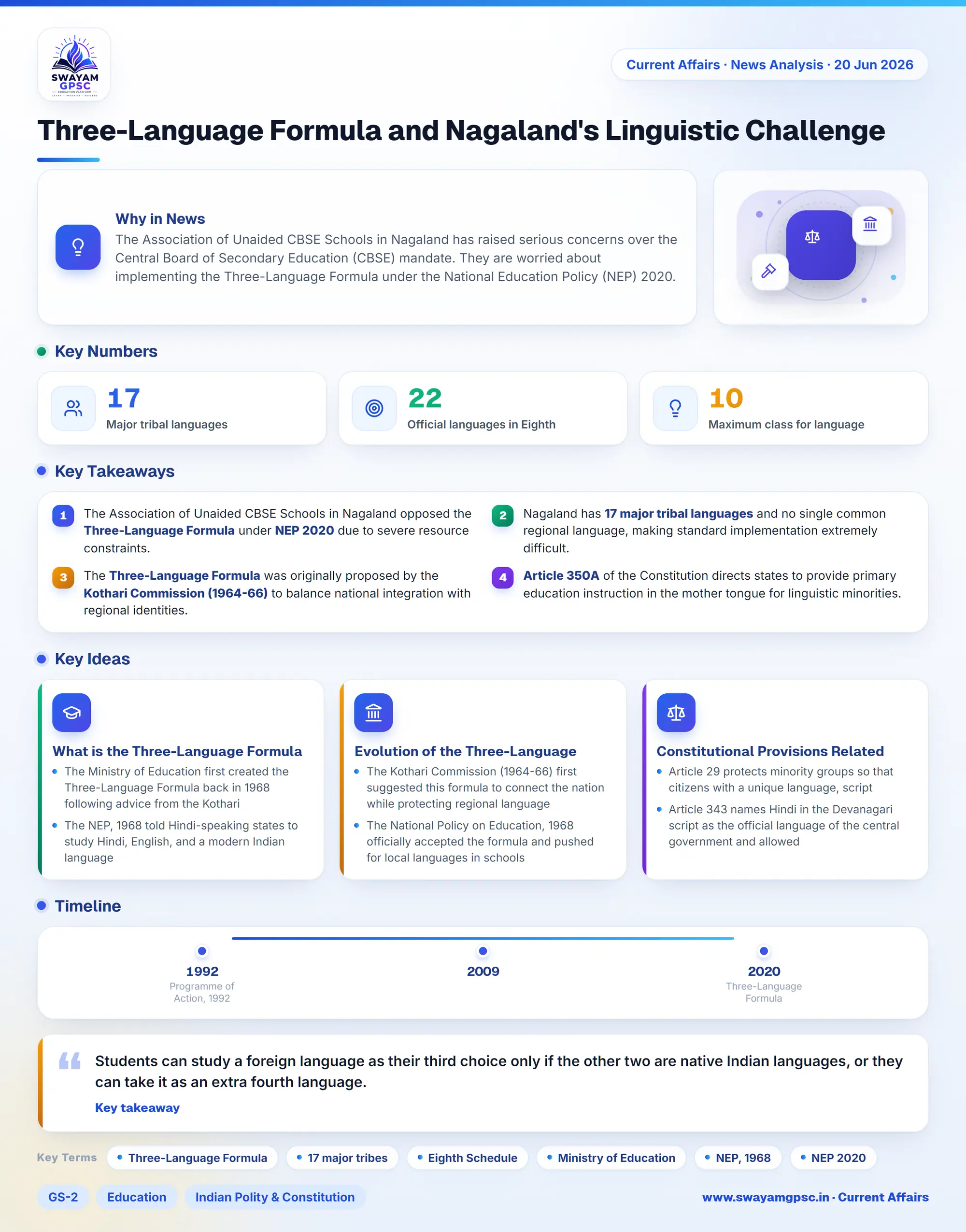
Three-Language Formula and Nagaland's Linguistic Challenge
#GS-2 #Education #Issues Arising Out of Design & Implementation of Policies #Indian Polity & Constitution #Constitutional Bodies #Current Events #National
Key takeaways
- The Association of Unaided CBSE Schools in Nagaland opposed the Three-Language Formula under NEP 2020 due to severe resource constraints.
- Nagaland has 17 major tribal languages and no single common regional language, making standard implementation extremely difficult.
- The Three-Language Formula was originally proposed by the Kothari Commission (1964-66) to balance national integration with regional identities.
- Article 350A of the Constitution directs states to provide primary education instruction in the mother tongue for linguistic minorities.
- The Eighth Schedule of the Indian Constitution currently recognizes 22 languages officially.
Why in News
- The Association of Unaided CBSE Schools in Nagaland has raised serious concerns over the Central Board of Secondary Education (CBSE) mandate.
- They are worried about implementing the Three-Language Formula under the National Education Policy (NEP) 2020.
- The local school association called this policy completely impractical for Nagaland because of its unique language setup and heavy shortage of resources.
- Nagaland does not have one common regional language because 17 major tribes speak completely different tribal languages.
- English is used as the official language and medium of teaching, but none of the local tribal languages are listed in the Eighth Schedule.
- Schools also struggle with a major shortage of trained teachers, proper textbooks, and uniform study material for diverse classrooms.
What is the Three-Language Formula
- The Ministry of Education first created the Three-Language Formula back in 1968 following advice from the Kothari Commission (1964-66).
- The NEP, 1968 told Hindi-speaking states to study Hindi, English, and a modern Indian language, and told non-Hindi states to study Hindi, English, and a regional language.
- The NEP 2020 version requires students to learn three different languages to support multilingualism while honoring regional cultures.
- At least two of the three chosen languages must be native Indian languages.
- Unlike the rigid old policy, NEP 2020 gives total freedom to states, regions, and students to pick whichever languages they want to study.
- Students can study a foreign language as their third choice only if the other two are native Indian languages, or they can take it as an extra fourth language.
- The National Curriculum Framework for School Education (NCF-SE) suggests that students must study three languages up to Class 10.
- Schools that lack qualified native language teachers can temporarily use existing staff who have basic working knowledge of that language.
- Schools are also advised to use creative teamwork like Sahodaya clusters, online classes, or hiring retired teachers.
Evolution of the Three-Language Formula Policy
- The Kothari Commission (1964-66) first suggested this formula to connect the nation while protecting regional language identities.
- The National Policy on Education, 1968 officially accepted the formula and pushed for local languages in schools and universities.
- The Programme of Action, 1992 stated that young children should learn and talk in their mother tongue at the pre-school stage.
- The Right to Education (RTE) Act, 2009 made it a rule that schools should teach children in their mother tongue whenever possible.
- The National Education Policy (NEP), 2020 strongly recommends using the home language, mother tongue, or local regional language for teaching.
Constitutional Provisions Related to Language
- Article 29 protects minority groups so that citizens with a unique language, script, or culture can save and protect it.
- Article 343 names Hindi in the Devanagari script as the official language of the central government and allowed English to continue for official work.
- Article 345 lets state governments choose one or more local languages or Hindi as their official state language.
- Article 346 decides how states talk to each other and with the center, allowing Hindi if both states agree.
- Article 347 gives the President power to officially recognize a state language if a large group of people asks for it.
- Article 350A orders every state and local body to provide proper school teaching in the mother tongue for children of linguistic minority groups.
- Article 351 gives the central government the duty to spread and develop the Hindi language.
- The Eighth Schedule names the official languages recognized by the Republic of India, which currently includes 22 languages.