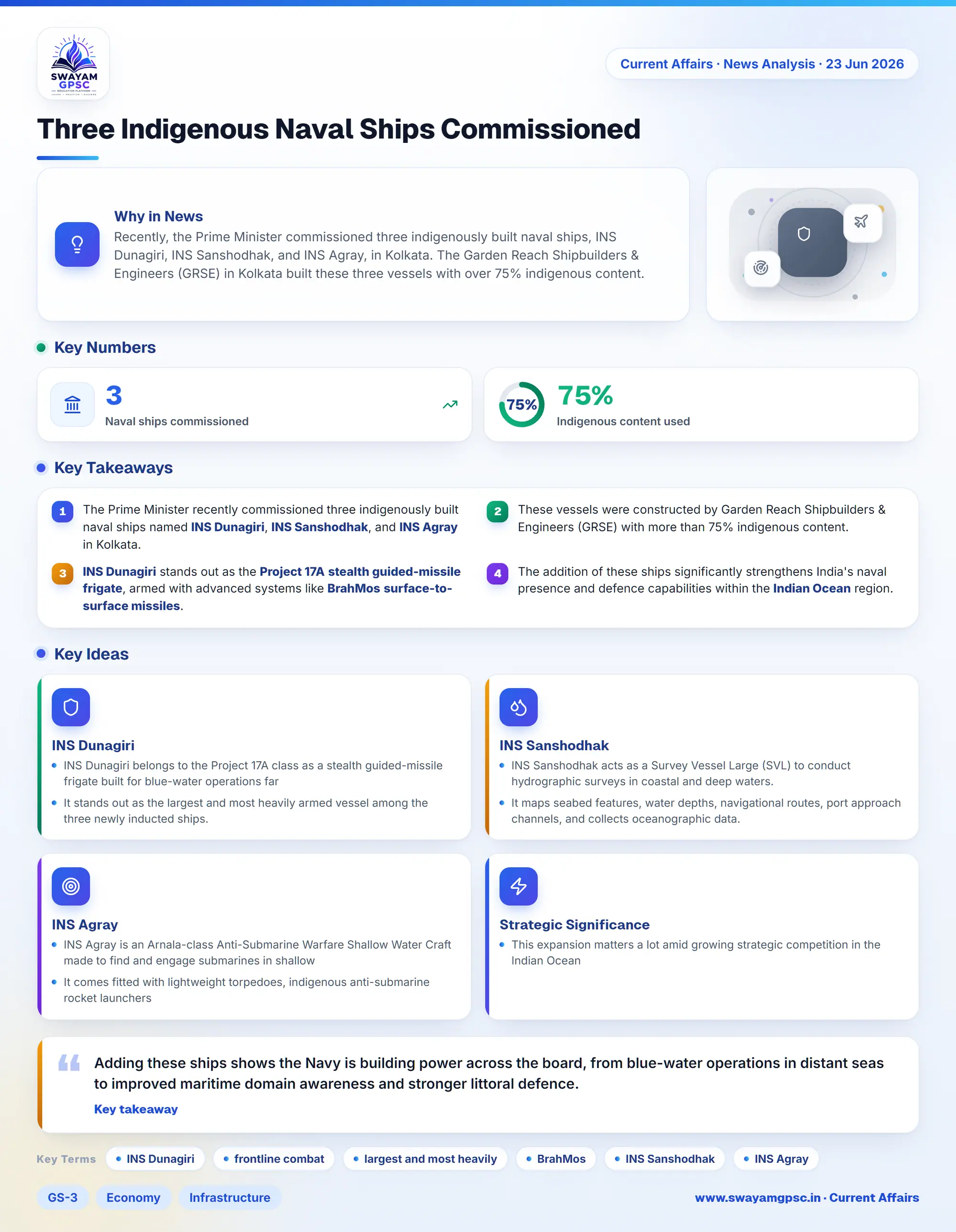
Three Indigenous Naval Ships Commissioned
#GS-3 #Economy #Infrastructure #Science & Technology #Defence #Current Events #National #Rapid Fire CA #Quick Facts For Prelims
Key takeaways
- The Prime Minister recently commissioned three indigenously built naval ships named INS Dunagiri, INS Sanshodhak, and INS Agray in Kolkata.
- These vessels were constructed by Garden Reach Shipbuilders & Engineers (GRSE) with more than 75% indigenous content.
- INS Dunagiri stands out as the Project 17A stealth guided-missile frigate, armed with advanced systems like BrahMos surface-to-surface missiles.
- The addition of these ships significantly strengthens India's naval presence and defence capabilities within the Indian Ocean region.
Why in News
- Recently, the Prime Minister commissioned three indigenously built naval ships, INS Dunagiri, INS Sanshodhak, and INS Agray, in Kolkata.
- The Garden Reach Shipbuilders & Engineers (GRSE) in Kolkata built these three vessels with over 75% indigenous content.
- These ships bring new strengths to the Navy, ranging from frontline combat to seabed mapping and coastal submarine detection.
INS Dunagiri
- INS Dunagiri belongs to the Project 17A class as a stealth guided-missile frigate built for blue-water operations far from the coast.
- It stands out as the largest and most heavily armed vessel among the three newly inducted ships.
- The ship carries advanced weapons and sensors like BrahMos surface-to-surface missiles, a Medium Range Surface-to-Air Missile system, MFSTAR radar, sonar, electronic warfare systems, and anti-submarine weapons.
- This warship boosts the Navy in fighting both conventional and non-conventional threats at sea.
INS Sanshodhak
- INS Sanshodhak acts as a Survey Vessel Large (SVL) to conduct hydrographic surveys in coastal and deep waters.
- It maps seabed features, water depths, navigational routes, port approach channels, and collects oceanographic data.
- Modern equipment on board includes autonomous underwater vehicles, remotely operated vehicles and multi-beam echo sounders.
- Collected data helps with naval operations, submarine route planning, port development, safe shipping, disaster relief, and ocean research.
INS Agray
- INS Agray is an Arnala-class Anti-Submarine Warfare Shallow Water Craft made to find and engage submarines in shallow coastal waters.
- It comes fitted with lightweight torpedoes, indigenous anti-submarine rocket launchers, and shallow-water sonar systems.
Strategic Significance
- Adding these ships shows the Navy is building power across the board, from blue-water operations in distant seas to improved maritime domain awareness and stronger littoral defence.
- This expansion matters a lot amid growing strategic competition in the Indian Ocean, which includes a rising naval presence from China and Pakistan.