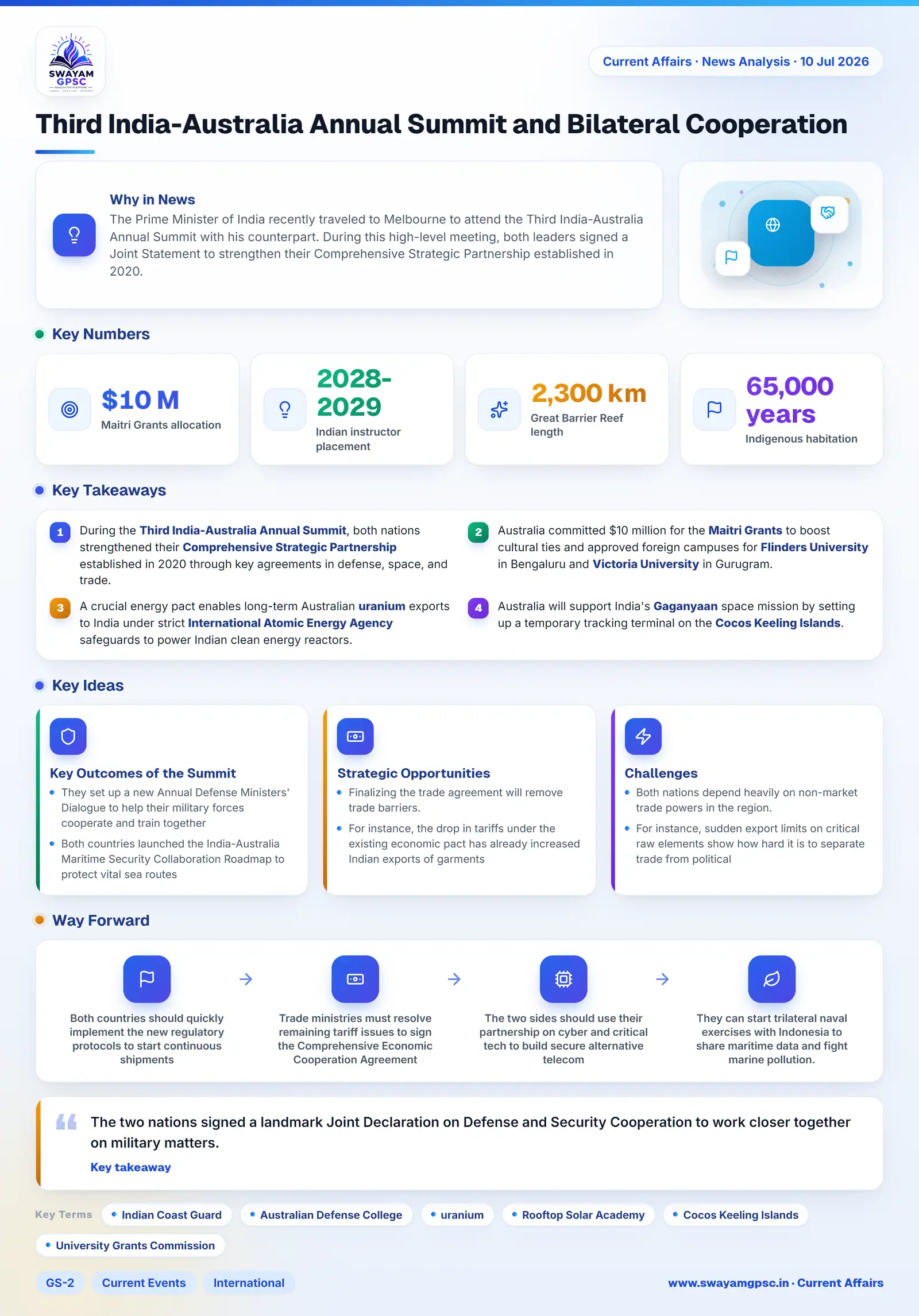
Third India-Australia Annual Summit and Bilateral Cooperation
#GS-2 #Current Events #International #GS-3 #Geography #Resources #India-Australia Relations #Bilateral Relations
Key takeaways
- During the Third India-Australia Annual Summit, both nations strengthened their Comprehensive Strategic Partnership established in 2020 through key agreements in defense, space, and trade.
- Australia committed $10 million for the Maitri Grants to boost cultural ties and approved foreign campuses for Flinders University in Bengaluru and Victoria University in Gurugram.
- A crucial energy pact enables long-term Australian uranium exports to India under strict International Atomic Energy Agency safeguards to power Indian clean energy reactors.
- Australia will support India's Gaganyaan space mission by setting up a temporary tracking terminal on the Cocos Keeling Islands.
- Geographically, Australia is the world's smallest continent and the sixth-largest country, rich in critical minerals like lithium and cobalt which are vital for India's green energy goals.
Why in News
- The Prime Minister of India recently traveled to Melbourne to attend the Third India-Australia Annual Summit with his counterpart.
- During this high-level meeting, both leaders signed a Joint Statement to strengthen their Comprehensive Strategic Partnership established in 2020.
Key Outcomes of the Summit
- The two nations signed a landmark Joint Declaration on Defense and Security Cooperation to work closer together on military matters.
- They set up a new Annual Defense Ministers' Dialogue to help their military forces cooperate and train together easily.
- Both countries launched the India-Australia Maritime Security Collaboration Roadmap to protect vital sea routes in the region.
- The Indian Coast Guard signed a formal agreement with the Australian Maritime Border Command to increase maritime safety.
- Both sides decided to finalize an agreement for sharing defense equipment and services.
- They will also station an Indian military instructor at the Australian Defense College in 2028-2029.
- Building on their current trade agreement, both leaders agreed to speed up negotiations for a full Comprehensive Economic Cooperation Agreement.
- They created investment channels between their government bodies and private companies to secure supplies of critical minerals.
- The leaders signed a key administrative arrangement under their bilateral Nuclear Cooperation Agreement.
- This allows Australia to export uranium to India for peaceful energy use under International Atomic Energy Agency safeguards.
- Both nations launched a Rooftop Solar Academy to help bring clean electricity to local communities.
- Australia will support India's Gaganyaan Human Space Flight Program by setting up a temporary tracking station on the Cocos Keeling Islands.
- The University Grants Commission issued letters allowing Flinders University to open a campus in Bengaluru and Victoria University in Gurugram.
- Australia committed $10 million for the Maitri Grants to build closer cultural and social connections between citizens.
- The Western Australian Government partnered with India to build a National Centre of Excellence for Skilling in Mining in Bhubaneswar.
Strategic Opportunities
- Finalizing the trade agreement will remove trade barriers. This will help companies expand across both massive consumer markets.
- For instance, the drop in tariffs under the existing economic pact has already increased Indian exports of garments and agricultural items.
- India can secure its domestic semiconductor and electric vehicle manufacturing by importing certified lithium and cobalt from Australia.
- Setting up island-based tracking stations will directly improve India's space tracking capabilities for its space missions.
- For example, the tracking terminal on the Cocos Keeling Islands offers real-time data for the upcoming Gaganyaan mission.
- India can use Australia's advanced training programs to upskill its local workforce in heavy engineering sectors.
- The new mining center in Bhubaneswar will train thousands of local technicians with recognized global certificates.
- Both countries can share logistics practices as Australia prepares for the 2032 Brisbane Olympics and India builds sports assets in Ahmedabad.
Challenges
- Both nations depend heavily on non-market trade powers in the region. This creates high vulnerability during international supply disruptions.
- For instance, sudden export limits on critical raw elements show how hard it is to separate trade from political issues.
- The rise of online radical networks and violent extremism poses a constant threat to democratic institutions in both countries.
- For example, the leaders condemned recent tragic acts of violence in Pahalgam and Bondi Beach.
- Geopolitical conflicts in West Asia threaten energy shipments and maritime shipping routes.
- Recent tensions near the Persian Gulf have driven up shipping costs and insurance premiums for trade vessels.
- Domestic lobbies, farming protections, and data rules often delay the final signing of full trade deals.
- Even though Australia supports India's bid for a permanent seat, the UN Security Council remains slow to reform.
Way Forward
- Both countries should quickly implement the new regulatory protocols to start continuous shipments of Australian uranium to India.
- Trade ministries must resolve remaining tariff issues to sign the Comprehensive Economic Cooperation Agreement by the end of this financial year.
- The two sides should use their partnership on cyber and critical tech to build secure alternative telecom networks.
- They can start trilateral naval exercises with Indonesia to share maritime data and fight marine pollution.
- They must align the vocational courses at the Bhubaneswar center with global standards to allow easy job movement.
Prelims in Focus: Profile of Australia
- Australia is a unique sovereign nation. It is the world's smallest continent and the sixth-largest country by land area.
- It is completely surrounded by oceans and sits on its own major tectonic plate in the Southern Hemisphere.
- The country is located in the southern Indo-Pacific region. It is bordered by the Indian Ocean to the west and the Pacific Ocean to the east.
- The capital of Australia is Canberra.
- Indigenous peoples have lived there for over 65,000 years. European sailors mapped it in 1606, and Great Britain claimed it in 1770.
- The modern nation formed on January 1, 1901, when six self-governing British colonies joined together.
- The Western Plateau or Outback covers two-thirds of the land. It contains ancient minerals and landmarks like Uluru.
- The Central Lowlands host the Great Artesian Basin and the fertile Murray-Darling Basin for farming.
- The Eastern Highlands or the Great Dividing Range run for 3,700 kilometers and contain Mount Kosciuszko, the highest peak.
- The Great Barrier Reef stretches over 2,300 kilometers off the Queensland coast. It is the largest living structure on Earth.
- Geopolitically, Australia is a key member of the QUAD alliance. This helps secure vital sea lanes in the Indo-Pacific.
- Its large reserves of lithium, cobalt, and nickel make it a crucial partner for clean energy supply chains.