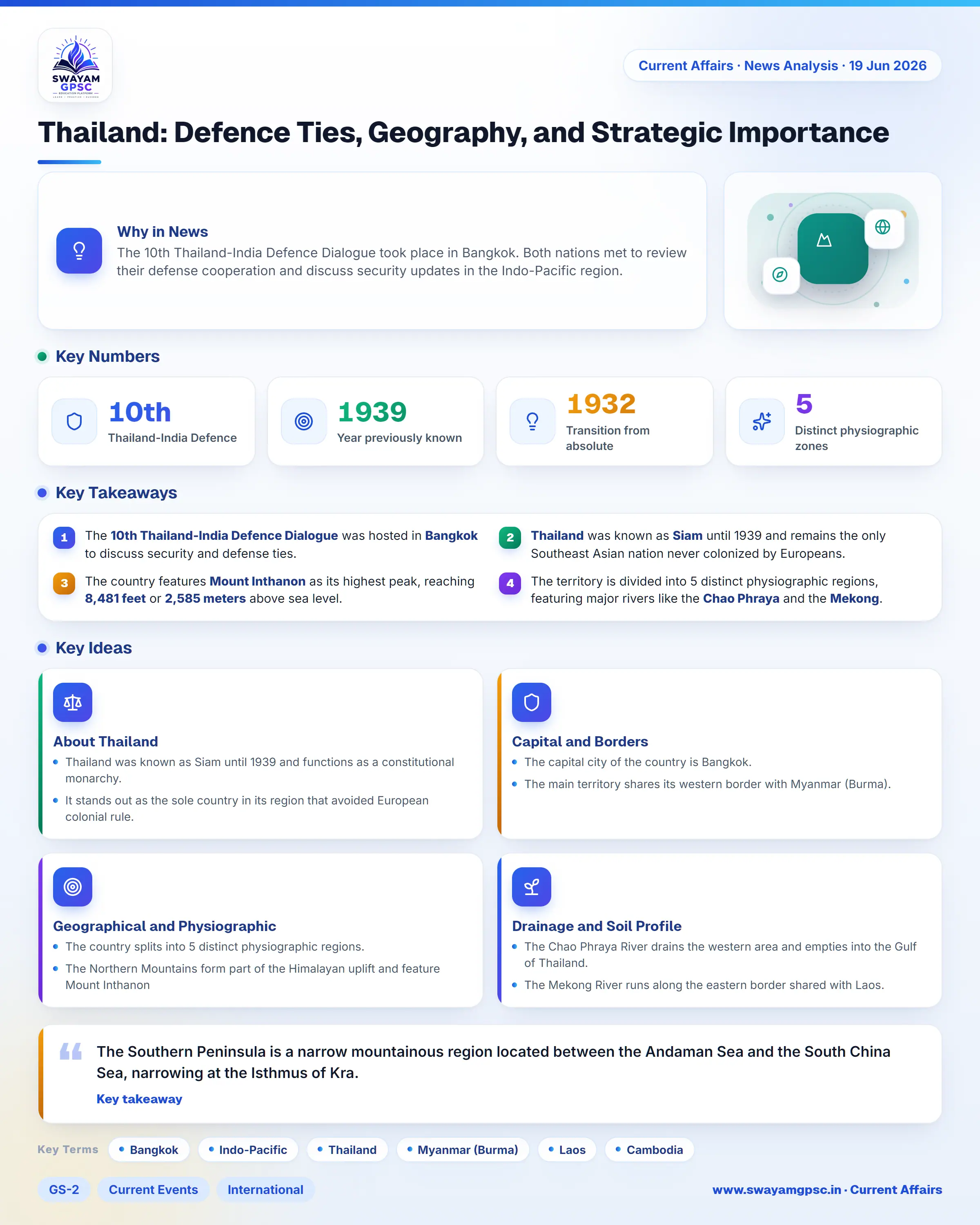
Thailand: Defence Ties, Geography, and Strategic Importance
#GS-2 #Current Events #International #Economy #Geography
Key takeaways
- The 10th Thailand-India Defence Dialogue was hosted in Bangkok to discuss security and defense ties.
- Thailand was known as Siam until 1939 and remains the only Southeast Asian nation never colonized by Europeans.
- The country features Mount Inthanon as its highest peak, reaching 8,481 feet or 2,585 meters above sea level.
- The territory is divided into 5 distinct physiographic regions, featuring major rivers like the Chao Phraya and the Mekong.
Why in News
- The 10th Thailand-India Defence Dialogue took place in Bangkok.
- Both nations met to review their defense cooperation and discuss security updates in the Indo-Pacific region.
About Thailand
- Thailand was known as Siam until 1939 and functions as a constitutional monarchy.
- It stands out as the sole country in its region that avoided European colonial rule.
- The political system changed from an absolute monarchy in 1932, and governance has often shifted between parliamentary and military leaders.
Capital and Borders
- The capital city of the country is Bangkok.
- The main territory shares its western border with Myanmar (Burma).
- To the north and east, the country shares its borders with Laos.
- Cambodia sits along the southeastern border of the country.
- A southern peninsular land boundary connects the country with Malaysia.
Geographical and Physiographic Features
- The country splits into 5 distinct physiographic regions.
- The Northern Mountains form part of the Himalayan uplift and feature Mount Inthanon, the highest peak at 8,481 feet or 2,585 meters.
- The Khorat Plateau in the northeast is a wide tableland bordered by the Mekong River.
- The Chao Phraya River Basin forms the central plain and serves as the economic and cultural center.
- The Southeastern Coast features rolling hills and popular tourist beaches.
- The Southern Peninsula is a narrow mountainous region located between the Andaman Sea and the South China Sea, narrowing at the Isthmus of Kra.
Drainage and Soil Profile
- The Chao Phraya River drains the western area and empties into the Gulf of Thailand.
- The Mekong River runs along the eastern border shared with Laos.
- The central delta plain and northern mountain basins contain highly fertile alluvial soils that refresh every year.