Textiles Summit 2026
#Economy #Infrastructure #Agriculture #GS-3
Key takeaways
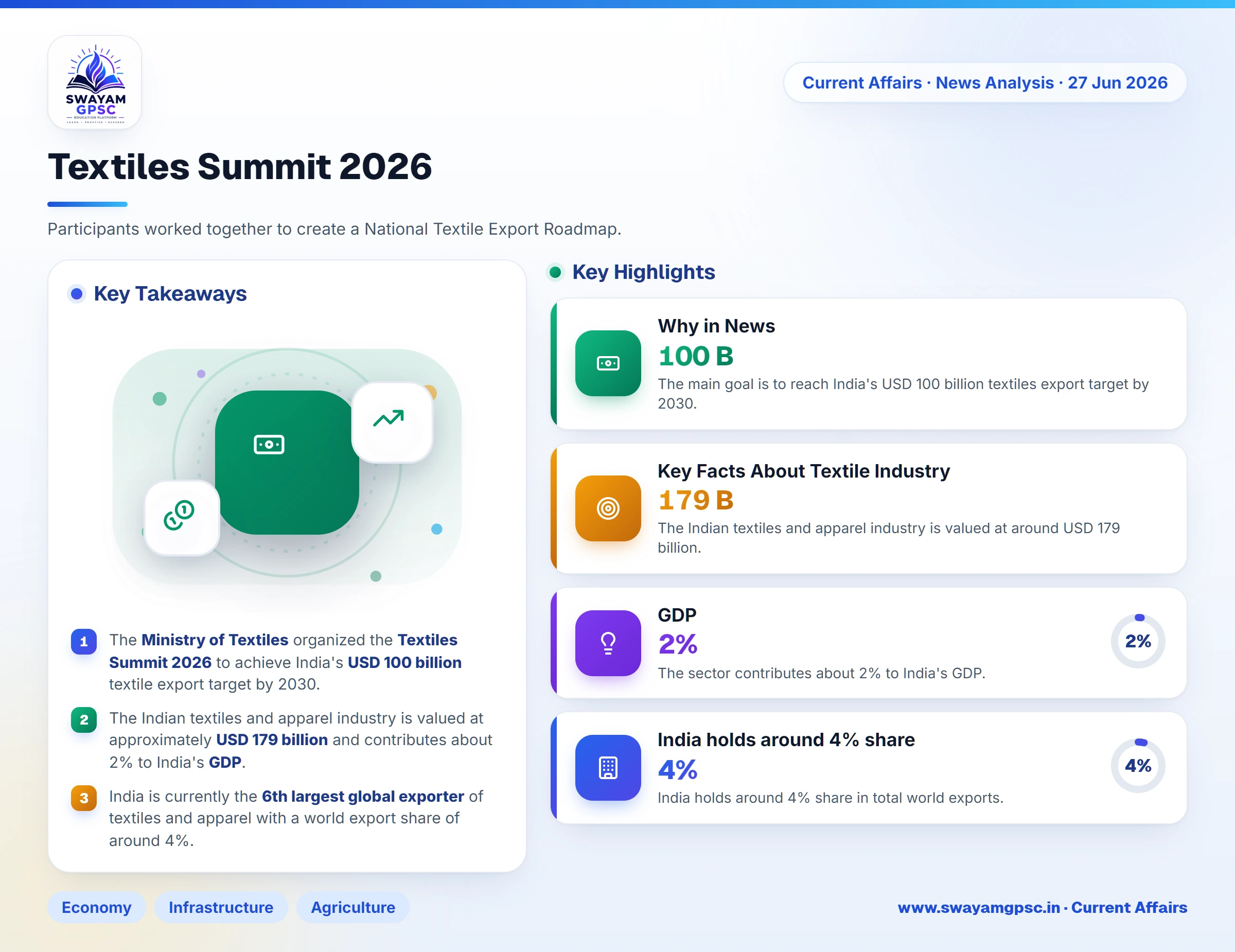
- The Ministry of Textiles organized the Textiles Summit 2026 to achieve India's USD 100 billion textile export target by 2030.
- The Indian textiles and apparel industry is valued at approximately USD 179 billion and contributes about 2% to India's GDP.
- India is currently the 6th largest global exporter of textiles and apparel with a world export share of around 4%.
- The textile sector serves as India's 2nd-largest employment generator after agriculture and permits 100% Foreign Direct Investment.
Why in News
- The Ministry of Textiles recently wrapped up the two-day Textiles Summit 2026.
- The event focused heavily on sustainability, exports, and expanding into global markets.
- The main goal is to reach India's USD 100 billion textiles export target by 2030.
About the Summit
- The Ministry of Textiles organized the summit to bring together state governments, industries, academic experts, and Export Promotion Councils.
- Participants worked together to create a National Textile Export Roadmap.
- The roadmap focuses strongly on practical implementation, product-market matching, value addition, niche products, and high-value segments.
- It also gives high priority to quality improvement, innovation, and environmental sustainability.
Sustainability and Traceability
- The summit stressed strict compliance with environmental standards and quality certifications.
- It introduced ideas like digital product passports and complete traceability across the textile value chain.
- Leaders discussed closed-loop recycling, circular economy practices, and better textile waste management.
- Better waste management will happen through close teamwork between municipal bodies and states.
Export Competitiveness
- The industry was urged to take full advantage of recently signed Free Trade Agreements.
- Businesses need to diversify their export markets and product offerings.
- Special focus should go toward man-made fibres and building the Brand India image globally.
- National policies must align with changing international regulatory standards.
Districts as Export Hubs
- States and Union Territories were encouraged to join the revived Districts as Export Hubs initiative.
- The program focuses on solving information gaps at the district level.
- It also works on making local producers ready for international exporting.
Significance
- The summit directly supports India's goal of achieving USD 100 billion in textile exports by 2030.
- It promotes key values like sustainability, traceability, circularity, and empowering MSMEs.
- It helps businesses use Free Trade Agreements, improves market access, and strengthens Brand India through innovation and quality.
Key Facts About Textile Industry
- The Indian textiles and apparel industry is valued at around USD 179 billion.
- The sector contributes about 2% to India's GDP.
- India stands as the 6th largest global exporter of textiles and apparel.
- India holds around 4% share in total world exports.
- This sector is India's 2nd-largest employment generator right after agriculture.
- The government allows 100% Foreign Direct Investment in the textile sector through the automatic route.