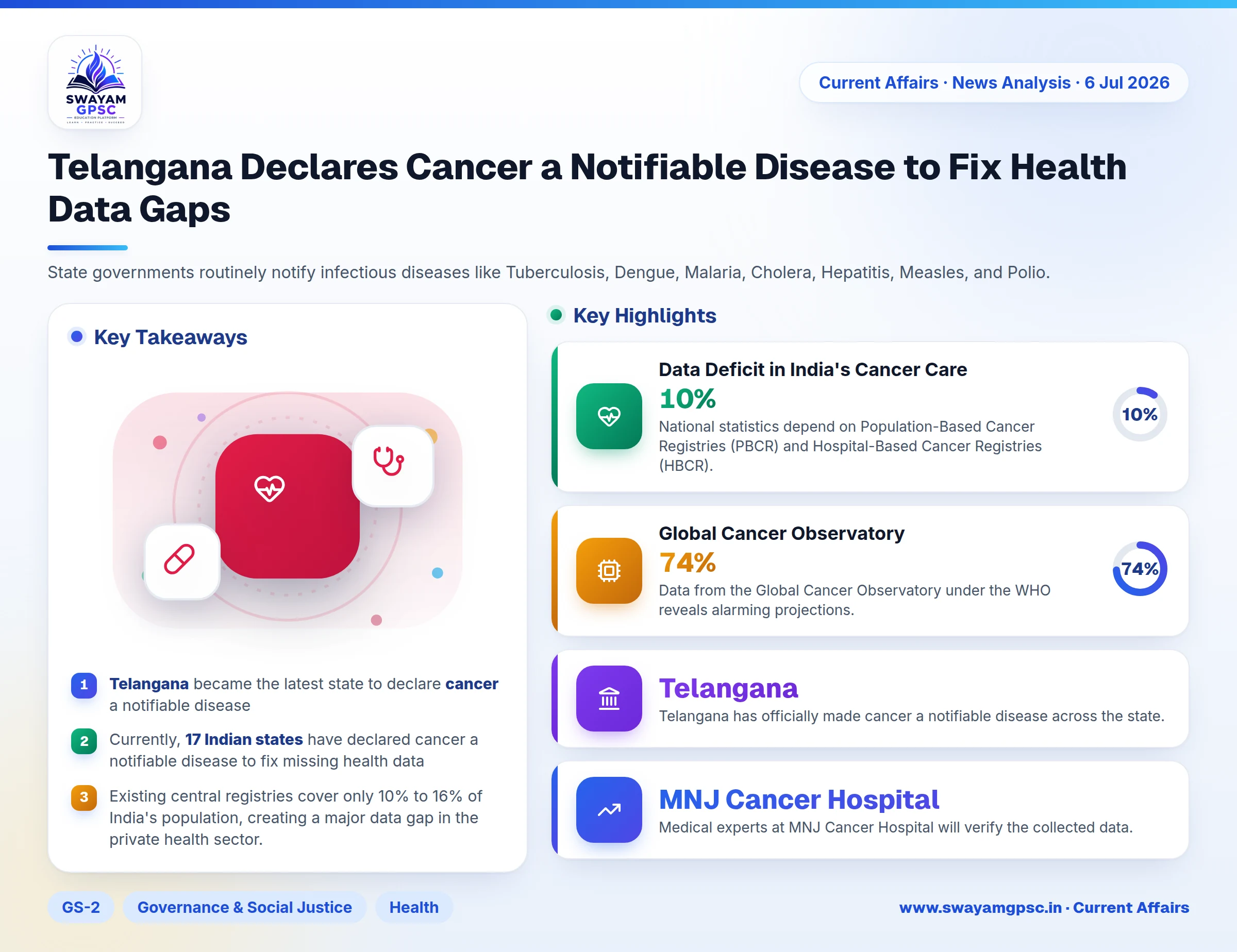
Telangana Declares Cancer a Notifiable Disease to Fix Health Data Gaps
#GS-2 #Governance & Social Justice #Health #Regulatory Bodies #Current Events #National
Why in News
- **Telangana** has officially made **cancer** a notifiable disease across the state. This decision requires all government and private hospitals to upload every diagnosed cancer case to a designated state portal within **1 month**.
- This step helps the government map cancer patterns across the state. By tracking new cases, deaths, and regional distributions, authorities can design better public health strategies.
- Medical experts at **MNJ Cancer Hospital** will verify the collected data. After verification, these records will enter the **National Cancer Registry Programme** run by the **ICMR**.
Understanding Notifiable Diseases
- A **notifiable disease** is any illness that doctors and hospitals must report to government officers by law. Mandatory reporting helps officials detect health crises early and take fast control measures.
- The **Epidemic Diseases Act, 1897** gives state governments the legal right to declare any illness as a notified disease within their own borders.
- State governments routinely notify infectious diseases like **Tuberculosis**, **Dengue**, **Malaria**, **Cholera**, **Hepatitis**, **Measles**, and **Polio**. During the healthcare emergency, states also declared **Covid-19** a mandatory reportable disease.
Data Deficit in India's Cancer Care
- Currently, India lacks a central law making cancer a notifiable disease across all states. The **Ministry of Health and Family Welfare** usually limits mandatory reporting to infectious diseases that spread rapidly.
- National statistics depend on **Population-Based Cancer Registries (PBCR)** and **Hospital-Based Cancer Registries (HBCR)**. However, these tools sample only **10% to 16%** of the country, missing rural areas and private clinics.
- To solve this missing data problem, **17** states have created their own rules to notify cancer cases, with **Telangana** becoming the latest state to join this group.
- Data from the **Global Cancer Observatory** under the **WHO** reveals alarming projections. India's annual cancer cases could jump by **74%**, rising from **1.41 million in 2022** to **2.46 million by 2045** due to longer lifespans and changing habits.
- Prominent bodies like the **ICMR** and the **National Centre for Disease Informatics and Research** want nationwide mandatory reporting. They argue this is the only way to track private hospital patients accurately.
- Making cancer reportable will initially increase official case numbers sharply. However, having real numbers helps the government build specialized hospitals, launch insurance coverage, and run awareness campaigns where needed most.