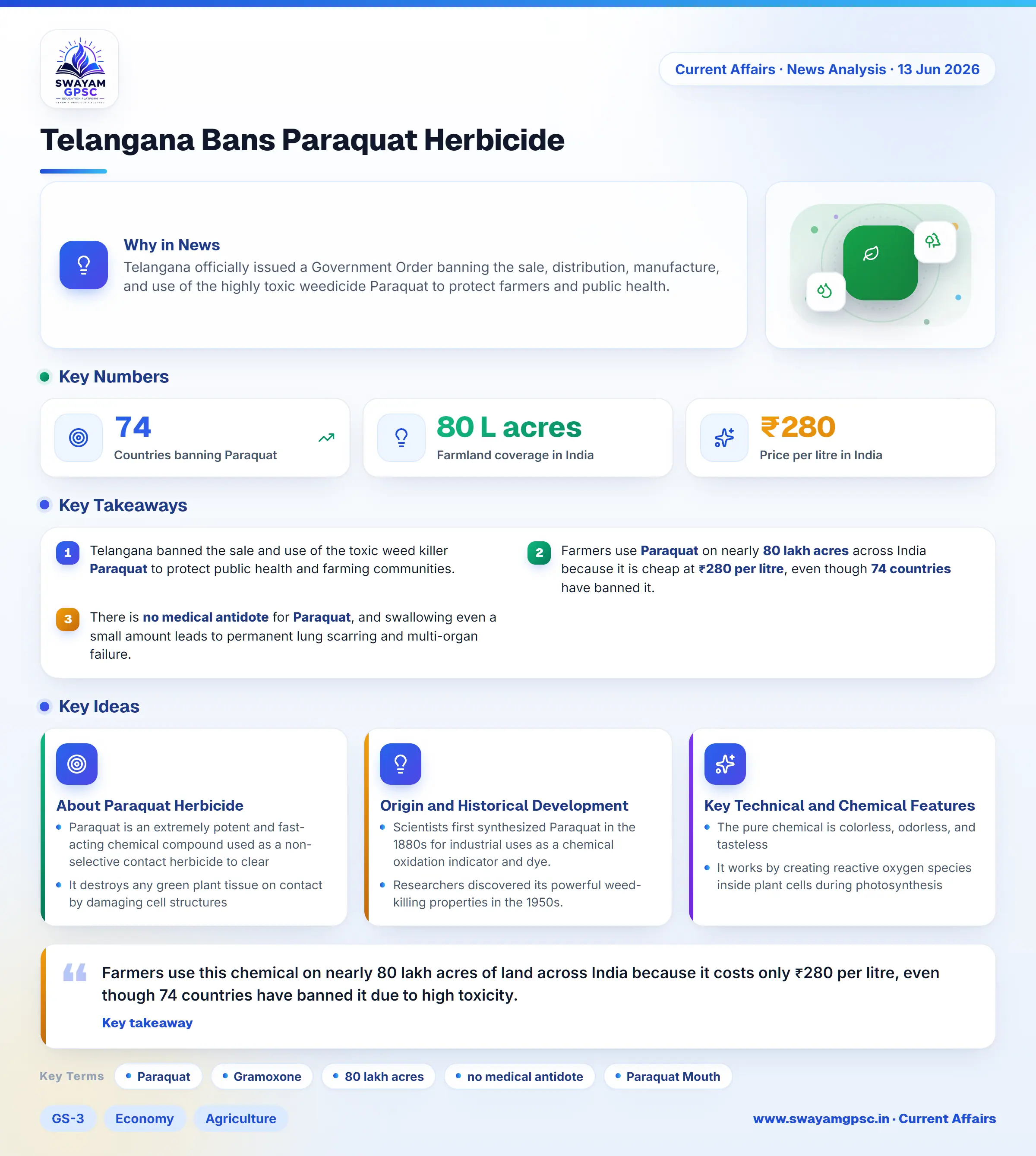
Telangana Bans Paraquat Herbicide
#GS-3 #Economy #Agriculture #Environment #Pollution #Current Events #Gujarat
Key takeaways
- Telangana banned the sale and use of the toxic weed killer Paraquat to protect public health and farming communities.
- Farmers use Paraquat on nearly 80 lakh acres across India because it is cheap at ₹280 per litre, even though 74 countries have banned it.
- There is no medical antidote for Paraquat, and swallowing even a small amount leads to permanent lung scarring and multi-organ failure.
Why in News
- Telangana officially issued a Government Order banning the sale, distribution, manufacture, and use of the highly toxic weedicide Paraquat to protect farmers and public health.
About Paraquat Herbicide
- Paraquat is an extremely potent and fast-acting chemical compound used as a non-selective contact herbicide to clear weeds quickly.
- It destroys any green plant tissue on contact by damaging cell structures, which makes it popular in farming despite its lethal risks.
Origin and Historical Development
- Scientists first synthesized Paraquat in the 1880s for industrial uses as a chemical oxidation indicator and dye.
- Researchers discovered its powerful weed-killing properties in the 1950s.
- Imperial Chemical Industries (ICI) started selling the chemical worldwide in the 1960s under the brand name Gramoxone.
- Farmers use this chemical on nearly 80 lakh acres of land across India because it costs only ₹280 per litre, even though 74 countries have banned it due to high toxicity.
Key Technical and Chemical Features
- The pure chemical is colorless, odorless, and tasteless, which leads to accidental swallowing when people store it in unlabelled drink bottles.
- It works by creating reactive oxygen species inside plant cells during photosynthesis, which destroys cell walls and dries out weeds within hours.
- There is no medical antidote for Paraquat, unlike many other poisonings, meaning the internal damage is permanent once consumed.
- Swallowing even a tiny amount causes severe burns in the mouth and throat, often called Paraquat Mouth.
- The poison enters the bloodstream and damages the kidneys and liver before settling in the lungs.
- It causes permanent lung scarring known as pulmonary fibrosis, and putting a poisoned patient on a ventilator only makes the lung damage happen faster.